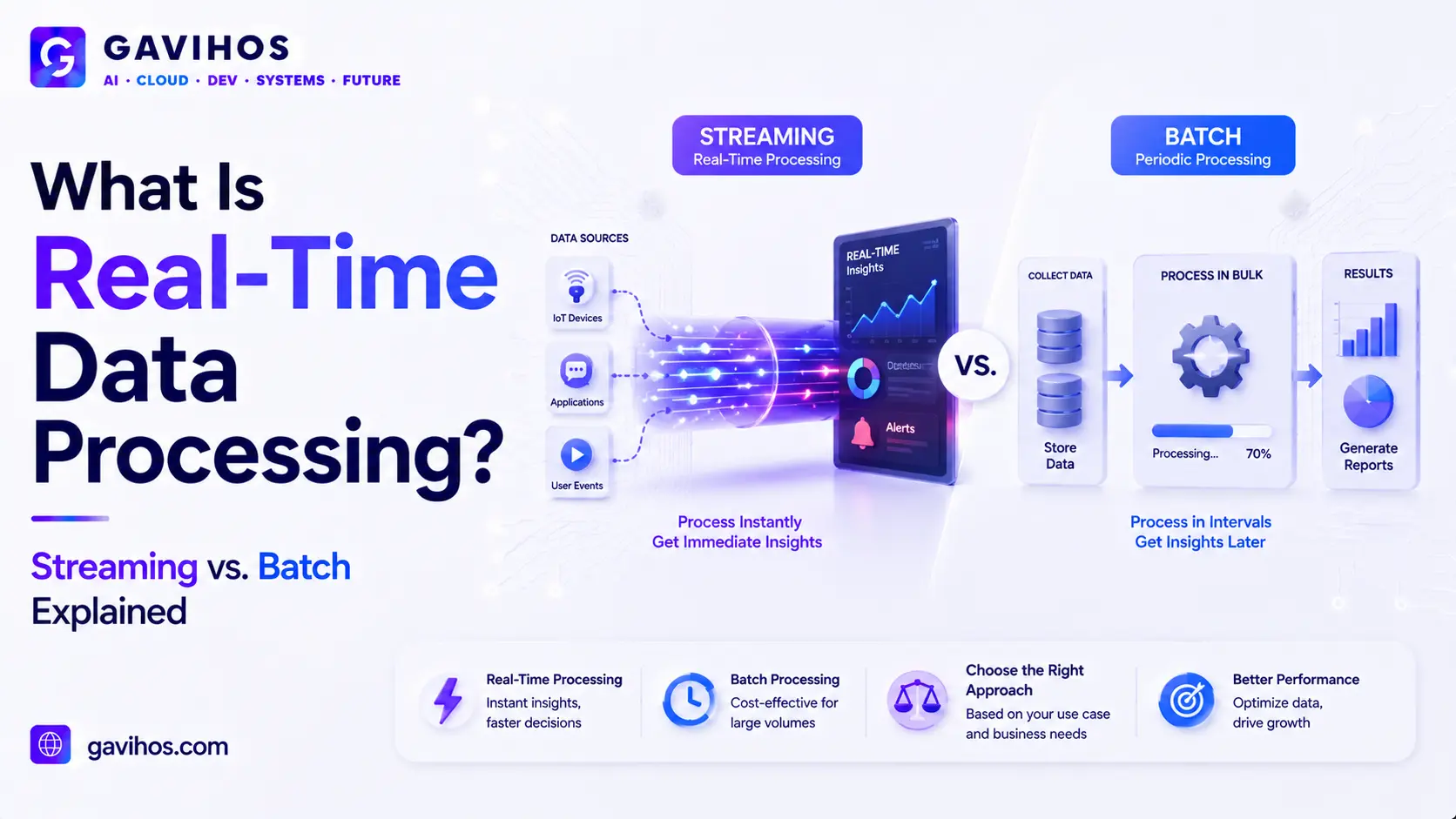
A fraud-detection system that catches a stolen credit card five minutes after the purchase has already failed. A recommendation engine that only knows what you clicked on yesterday is guessing, not personalizing. In both cases the data existed — it just arrived too late to be useful. That gap between “the data exists” and “the data is usable in time” is exactly what real-time data processing is built to close.
Real-time data processing is the practice of ingesting, analyzing, and acting on data within seconds (sometimes milliseconds) of it being generated, instead of collecting it and processing it later in a scheduled batch. It sits opposite an older, still very common pattern: batch processing, where data piles up for an hour, a day, or a week, then gets processed all at once. Neither approach is universally correct — they solve different problems, and most serious data platforms end up using both, on purpose, side by side.
This guide explains what real-time data processing actually means, how streaming and batch architectures differ under the hood, when each one earns its complexity, and why AI systems in particular have made this distinction more practically important than it’s been in years.
What Is Real-Time Data Processing?
Real-time data processing (also called stream processing) is a data architecture pattern where records are processed individually, or in very small groups, as soon as they arrive — typically within seconds of being generated. Instead of waiting for a full dataset to accumulate, a streaming system treats data as a continuous, unbounded flow and reacts to each new event immediately.
This is fundamentally different from batch processing, where data is collected over a fixed window — every hour, every night, every week — and then processed together as one large, bounded job. A nightly ETL job that loads yesterday’s sales into a data warehouse is batch processing. A system that updates a live dashboard the instant a sale happens is real-time data processing.
Neither pattern is a newer or more “advanced” version of the other. They’re different tools built around a different core assumption: batch processing assumes it’s fine — even preferable — to wait, because the value of the answer doesn’t degrade much with a delay. Real-time data processing assumes the opposite: that the value of the answer drops sharply, sometimes to zero, the longer you wait.
Why Does It Matter?
Business impact. Decisions that depend on stale data are decisions made with a blind spot. A retailer that only knows inventory levels from last night’s batch job can oversell a product that actually sold out three hours ago. A logistics company routing delivery vehicles off yesterday’s traffic data is optimizing for a world that no longer exists.
Technology impact. Real-time processing changes what “correct” architecture looks like. Systems built around batch assumptions — a nightly job, a data warehouse refreshed once a day — cannot be casually retrofitted into real-time systems; the underlying storage, processing engine, and failure-handling model all have to change, not just the schedule.
Industry impact. Entire product categories now assume real-time behavior as a baseline, not a premium feature — fraud detection, ride-hailing pricing, ad bidding, live sports statistics, operational monitoring. Companies that can’t process data in real time in these categories aren’t offering a slower version of the same product; they’re often not competitive in the category at all.
Why Now?
Real-time data processing isn’t a new idea — stream processing research and early systems go back to the 2000s, and technologies like Apache Kafka have existed since 2011. What’s changed is how many systems now depend on it as a default requirement rather than a specialized capability.
Data volume and velocity have both grown. Applications now generate far more events per second — clicks, sensor readings, API calls, financial transactions — than they did even five years ago, and much of that data loses relevance quickly if it isn’t acted on close to the moment it’s created.
AI systems have added a new, structural source of demand. AI agents and AI-powered applications increasingly need to reason over data that’s current, not day-old — an agent monitoring infrastructure, moderating content, or personalizing a live interaction needs to see what just happened, not what happened during last night’s batch run. This mirrors a pattern covered in our companion guide on OLTP vs. OLAP database architecture: as AI systems blur the line between transactional and analytical workloads, they’re doing the same thing to the line between batch and real-time processing — pulling more of the stack toward “as it happens” rather than “on a schedule.”
Managed streaming infrastructure has gotten dramatically easier to run. A decade ago, running a production Kafka cluster or an equivalent streaming pipeline required a dedicated infrastructure team. Managed streaming and stream-processing services have lowered that operational bar significantly, which means teams that would never have attempted real-time architecture a few years ago can now reasonably consider it.
How It Works
Trace what happens to a single event — a customer clicking “add to cart” — through a real-time pipeline versus a batch pipeline.
Real-time (streaming) path:
- The click event is published immediately to a streaming platform (for example, a Kafka topic) the instant it happens.
- A stream-processing job is already running continuously, subscribed to that topic — it doesn’t wait to be triggered.
- Within milliseconds to a few seconds, the processing job updates a live inventory counter, checks for a fraud pattern, or updates a personalization model.
- The result is available to downstream systems (a dashboard, an alert, a pricing engine) almost immediately, with no fixed schedule involved.
Batch path:
- The same click event is written to a log or staging table and simply accumulates, alongside every other event, for a defined window.
- At a scheduled time — nightly, hourly, weekly — a batch job wakes up and processes the entire accumulated dataset at once.
- The output (an updated report, a retrained model, a refreshed dashboard) reflects the state of the world as of the end of that window, not the current moment.
- Nothing happens again until the next scheduled run.
The core architectural difference is this: streaming systems are built around continuously running processes that react to an unbounded, ongoing flow of data, while batch systems are built around discrete jobs that run against a bounded, complete dataset. That single distinction cascades into almost every other difference between the two approaches — how errors are handled, how state is stored, and how much infrastructure has to run at all times versus only during a scheduled window.
Architecture / Components
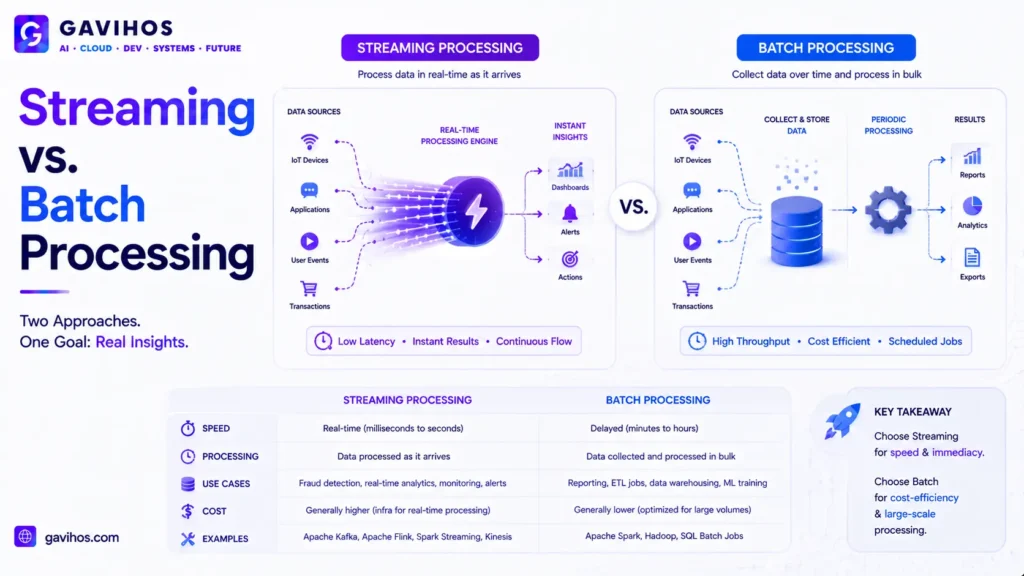
| Aspect | Real-Time (Streaming) | Batch |
|---|---|---|
| Data treated as | An unbounded, continuous flow | A bounded, complete dataset |
| Processing trigger | Continuous — reacts as events arrive | Scheduled — runs at fixed intervals |
| Typical latency | Milliseconds to a few seconds | Minutes to hours (sometimes days) |
| Infrastructure pattern | Always-on processing jobs and message brokers | Jobs that start, run, and stop on a schedule |
| Example technologies | Apache Kafka, Apache Flink, Amazon Kinesis, Spark Structured Streaming | Traditional ETL tools, scheduled Spark/Hadoop jobs, nightly SQL pipelines |
| Failure handling | Must handle partial, out-of-order, or duplicate events gracefully, continuously | Can often simply re-run the whole job if something fails |
| Cost profile | Continuous compute cost, even during quiet periods | Compute cost concentrated in scheduled bursts |
Core workflow in a typical real-time pipeline: a producer emits events into a message broker (the streaming platform), one or more stream-processing jobs consume from it continuously, and the processed output is written to a fast-access store (a cache, a real-time database, or directly pushed to a dashboard or alerting system) — all without a human or scheduler ever pressing “go.”
Real World Use Cases
- Fraud detection in payments. A card-payment processor scores each transaction for fraud risk within milliseconds of it happening, because a fraud signal is nearly worthless once the transaction has already been approved and the money has moved.
- Ride-hailing and delivery pricing. Surge pricing and delivery-time estimates are computed from real-time demand and traffic data — a price based on last night’s traffic patterns would be actively wrong, not just stale.
- Infrastructure and application monitoring. Observability platforms process logs and metrics as they’re emitted so that an outage triggers an alert in seconds, not after the next scheduled report runs.
- Ad bidding and real-time auctions. Real-time bidding platforms must evaluate an ad impression opportunity and respond within milliseconds, an entire pipeline of data ingestion, scoring, and decision-making compressed into a single web request’s worth of time.
- Live personalization and recommendations. A streaming platform or e-commerce site adjusts what it shows a user based on what that user just did in this session, not only on historical batch-computed preferences.
Benefits
- Decisions and user-facing behavior reflect the current state of the world, not a stale snapshot.
- Problems (fraud, outages, abuse) can be caught and acted on while they’re still small, rather than discovered after the fact in a scheduled report.
- Real-time architectures scale naturally to continuous, high-velocity data sources where “waiting for a batch window” isn’t a meaningful option at all.
- Well-designed streaming systems can process the same data both for real-time reaction and for later historical analysis, avoiding duplicate ingestion logic.
Limitations
- Streaming systems are meaningfully harder to build and operate correctly — handling out-of-order events, partial failures, and duplicate delivery is a genuinely harder engineering problem than re-running a batch job.
- Continuous infrastructure means continuous cost — a streaming pipeline runs (and is billed) all the time, even during quiet periods, unlike a batch job that only consumes resources when scheduled.
- Debugging is harder. A batch job’s failure is usually visible and re-runnable; a subtle bug in a streaming pipeline can silently produce slightly wrong results for hours before anyone notices.
- Not every use case benefits from the added complexity — a monthly financial reconciliation report gains nothing from being real-time and loses simplicity by trying to be.
Engineering Tradeoffs
Adopting real-time data processing improves responsiveness and lets a system react to what’s happening now, but it introduces real, ongoing complexity: continuously running infrastructure that must stay healthy at all times, careful handling of out-of-order and duplicate events, and monitoring that has to catch problems as they happen rather than during a scheduled review.
What becomes harder isn’t just the initial build — it’s the operational discipline required afterward. A batch job that breaks overnight can usually just be re-run in the morning. A streaming pipeline that breaks is actively producing wrong or missing results right now, which raises the operational bar considerably: on-call processes, alerting, and recovery procedures all need to be built for a system that’s never supposed to stop.
This tradeoff is worth making when the value of an answer genuinely decays with delay — fraud, outages, live pricing, real-time personalization. It is not worth making for reporting and analytics workloads where a delay of hours or a day has no real business cost; forcing those into a streaming architecture adds cost and operational risk for no corresponding benefit.
Best Practices
- Default to batch processing unless there’s a specific, articulable cost to delay — don’t reach for streaming architecture just because it sounds more modern.
- Design stream-processing logic to be idempotent (safe to process the same event twice) from the start, since duplicate delivery is a normal, expected condition in streaming systems, not an edge case.
- Build explicit handling for out-of-order and late-arriving events rather than assuming data always arrives in the order it was generated.
- Monitor pipeline lag (how far behind “real time” the system actually is) as a first-class metric, not an afterthought — a streaming system that’s silently 20 minutes behind is easy to miss without dedicated monitoring.
- Consider a hybrid approach for many real workloads: real-time processing for the specific signals that need it (fraud scores, alerts), batch processing for everything else (historical reporting, model retraining).
Common Mistakes
- Building a fully real-time architecture for a use case where a daily or hourly batch job would have worked fine, adding unnecessary operational burden.
- Assuming events always arrive in order and exactly once, then being surprised when duplicate or out-of-order events silently corrupt downstream results.
- Treating a streaming pipeline like a batch job that “just runs continuously” instead of designing it from the start for partial failure and recovery.
- Underinvesting in monitoring pipeline lag, so a degraded (but not fully down) streaming system goes unnoticed for hours.
What Most People Get Wrong
“Real-time processing is strictly better than batch processing.” It isn’t — it solves a different problem at a real cost in complexity and operational overhead. Plenty of legitimate, high-value workloads (financial reconciliation, monthly reporting, model retraining) are correctly served by batch processing and would gain nothing from being real-time.
“Real-time means instant, with zero delay.” In practice, “real time” almost always means “near real time” — a latency target measured in seconds or low milliseconds, not literally zero. Systems marketed as real-time still have a defined, non-zero latency budget they’re built to hit.
“You have to choose one approach for your whole system.” Most mature data platforms run both deliberately: a streaming path for the small set of signals that genuinely need immediate action, and a batch path for the much larger volume of data where a scheduled delay is perfectly acceptable and considerably simpler to operate.
“Adding Kafka (or any streaming platform) automatically makes a system real-time.” A message broker is one component of a real-time architecture, not the whole thing — without stream-processing logic actually consuming and acting on events continuously, a message broker alone is just a more complicated queue.
Future Outlook
Expect the operational cost of running real-time infrastructure to keep falling as managed streaming and stream-processing services mature, which will keep lowering the bar for smaller teams to adopt patterns that were previously reserved for large-scale platforms.
Expect the batch-versus-streaming decision to increasingly get made per-signal rather than per-system — the same platform running a streaming path for the handful of metrics that need immediate reaction and a batch path for everything else, rather than committing an entire architecture to one model.
Expect AI systems to keep pushing more workloads toward real-time processing, as agents and AI-powered products increasingly need to reason over current state rather than day-old snapshots — echoing the same shift already visible in the OLTP/OLAP pairing pattern used across modern AI-era data stacks.
FAQ
1. What is real-time data processing? Real-time data processing is a data architecture pattern where individual events are ingested and processed within seconds (often milliseconds) of being generated, instead of being collected and processed later in a scheduled batch.
2. What is the difference between real-time processing and batch processing? Real-time processing reacts to each event continuously as it arrives. Batch processing collects data over a fixed window and processes it all together on a schedule. The core difference is whether data is treated as an unbounded continuous flow or a bounded, complete dataset.
3. Is streaming the same thing as real-time data processing? Streaming (or stream processing) is the technical approach most commonly used to achieve real-time data processing — the two terms are frequently used interchangeably in practice.
4. What technologies are used for real-time data processing? Common technologies include Apache Kafka and Amazon Kinesis for event streaming, and Apache Flink or Spark Structured Streaming for processing that stream of events continuously.
5. Do I need real-time data processing for my application? Only if the value of an answer meaningfully decreases the longer you wait to compute it — fraud detection, live pricing, and monitoring are classic cases. If a daily or hourly delay has no real business cost, batch processing is simpler and cheaper.
6. Is real-time data processing more expensive than batch processing? Generally yes, because streaming infrastructure runs continuously and must be monitored at all times, while batch infrastructure only consumes significant resources during its scheduled run window.
7. Can a system use both real-time and batch processing together? Yes, and most mature data platforms do exactly this — a streaming path for the specific signals that need immediate reaction, and a batch path for the larger volume of data where scheduled processing is sufficient.
8. What does “near real-time” mean if it’s not truly instant? It means a defined, non-zero latency target — typically seconds to a few minutes — rather than the literal zero-delay implied by the phrase “real time.” The goal is a latency budget small enough that the data feels current for its use case.
9. Why has real-time data processing become more common recently? Growing data volume and velocity, combined with AI systems that increasingly need to reason over current rather than day-old data, and the maturing of managed streaming infrastructure that’s lowered the operational bar to adopt it.
10. What’s the biggest engineering challenge in real-time data processing? Correctly handling out-of-order events, duplicate delivery, and partial failures continuously — a batch job that fails can usually just be re-run, while a broken streaming pipeline is actively producing wrong or missing results right now.
Analyst Perspective
The most important thing to understand about real-time data processing is that it’s a decision about where delay actually costs you something, not a general upgrade every system should pursue. The hidden implication of the current push toward more real-time architecture is that it’s being driven less by hype and more by a genuine structural shift: AI agents and AI-powered products are collapsing the acceptable delay between “something happened” and “the system needs to know about it,” in the same way they’re collapsing the line between transactional and analytical database workloads.
A second-order effect worth watching: as managed streaming infrastructure keeps getting easier to operate, the real constraint on adopting real-time processing shifts away from “can we run this infrastructure” and toward “can we design processing logic that correctly handles duplicate and out-of-order events” — a harder, less commoditized problem that tooling alone doesn’t solve. Developers should pay close attention to idempotency and failure handling from day one, since that’s where real-world streaming systems most often break quietly. Businesses should watch which specific signals in their product actually lose value with delay, rather than assuming an entire platform needs to become real-time at once — the batch-versus-streaming decision is best made signal by signal, not system by system.
Key Takeaways
- Real-time data processing (streaming) processes events within seconds of generation; batch processing collects data over a window and processes it all at once on a schedule.
- Neither approach is universally better — they solve different problems, and most mature data platforms deliberately run both, applied to different signals.
- The core architectural difference is treating data as an unbounded continuous flow versus a bounded, complete dataset — that single distinction drives most other differences in infrastructure, cost, and failure handling.
- Real-time processing earns its added complexity specifically when the value of an answer decays quickly with delay — fraud detection, live pricing, monitoring, and personalization are classic examples.
- AI systems are a major driver of renewed demand for real-time processing, since agents increasingly need to reason over current state rather than day-old data.
- Idempotency, out-of-order event handling, and pipeline-lag monitoring are the practical engineering disciplines that make real-time systems reliable — not just choosing a streaming platform.
Continue Learning
- What Is a Data Catalog? Complete Guide to Metadata Management and Data Lineage
- What Is OLAP? OLTP vs OLAP Explained
- What Is Kubernetes, Explained? A Complete 2026 Guide to Container Orchestration
- Google Cloud Datastream and Dataplex Universal Catalog
- What Is AI Model Routing? The Complete Guide to Multi-Model AI Systems
About GAVIHOS
GAVIHOS helps developers, founders and technology enthusiasts understand AI, software engineering and emerging technologies through practical guides, tutorials and industry analysis.
Stay Updated
Follow GAVIHOS for practical AI, technology and developer-focused insights.
External Links
| Source | URL |
|---|---|
| Apache Kafka Documentation | https://kafka.apache.org/documentation/ |
| Confluent — What Is Stream Processing? | https://www.confluent.io/learn/stream-processing/ |
| Google Cloud Dataflow (streaming and batch data processing) | https://cloud.google.com/dataflow |
| Amazon Kinesis Documentation | https://aws.amazon.com/kinesis/ |