Most organizations that have been collecting data for more than a few years run into the same problem: nobody actually knows what data they have. A table exists in a warehouse somewhere, a stream flows through a pipeline nobody remembers building, and three different teams keep separate, slightly different copies of what should be the same customer record. This isn’t a tooling failure exactly — it’s what happens by default when an organization grows faster than its ability to document its own data.
A data catalog is the tool built specifically to solve this problem. It is a searchable inventory of an organization’s data assets — tables, streams, files, dashboards — along with the metadata that describes what each asset is, where it came from, who owns it, and how trustworthy it is. Google Cloud made this concept concrete again on July 2, 2026, by integrating its Datastream change-data-capture service directly with Dataplex Universal Catalog, automating the metadata sync that data catalogs have historically required manual effort to maintain.
This guide explains what a data catalog actually is, why “data silos” are a real and costly problem rather than an abstract complaint, how catalogs and lineage tracking work under the hood, and what the honest tradeoffs are.
What Is a Data Catalog?
A data catalog is a centralized, searchable system that records metadata about an organization’s data assets: what a dataset contains, its schema, who created it, which systems it depends on, how sensitive it is, and how frequently it’s used.
The critical distinction is between data and metadata. The catalog does not store the data itself — it stores information about the data. Think of it as a library’s card catalog rather than the library’s actual books: it tells you a book exists, where to find it, what it’s about, and whether it’s checked out, without being the book.
A closely related concept is data lineage — the ability to trace a piece of data back through every transformation it passed through, from its original source to its current form. If a number in a quarterly report looks wrong, lineage tracking lets an analyst trace it backward: which dashboard, which transformation job, which source table, which original system. Without lineage, that trace is often reconstructed manually by asking around, which is slow and unreliable at any real scale.
Google Cloud’s Dataplex Universal Catalog is one current example of this category — a managed catalog product that, as of Google’s July 2, 2026 update, now automatically ingests metadata from Datastream (a change-data-capture and replication service) as data flows through it, rather than requiring a separate manual cataloging step. This is a useful concrete illustration, but the underlying pattern — catalog products integrating directly with data movement tools — is a general direction the data infrastructure category is moving in, not a single-vendor story.
Why Does It Matter?
Business impact. Data silos have a direct, measurable cost: teams rebuild analyses that already exist elsewhere, decisions get made on stale or duplicated data, and compliance teams struggle to answer basic questions like “where does this customer’s personal data live” — a question regulators increasingly expect organizations to answer quickly and accurately.
Technology impact. As data pipelines have grown more automated (streaming ingestion, real-time transformation, AI-driven data generation), the volume of data assets an organization accumulates has grown faster than any manual documentation process can track. Catalogs that update automatically as data moves, rather than requiring a human to log a new table after the fact, are becoming a practical necessity rather than a nice-to-have.
Industry impact. Data catalog and governance tooling is converging with the broader data platform stack — cloud providers are integrating cataloging directly into their data movement and warehousing products rather than treating it as a bolt-on third-party tool, which changes how organizations evaluate and adopt this category.
Why Now?
Data catalogs are not a new idea — the concept has existed in enterprise data warehousing for over a decade. What’s changed is why they’ve become urgent rather than optional.
Data volume and pipeline complexity outpaced manual documentation. A decade ago, a data team might manage a few dozen tables in a single warehouse, tracked in a shared spreadsheet. Modern data architectures involve streaming pipelines, multiple cloud regions, real-time transformations, and often dozens of interconnected services. Manual cataloging simply cannot keep pace with that rate of change.
Regulatory pressure made “where is this data” a compliance question, not just a convenience question. Data privacy regulations increasingly require organizations to demonstrate they know where specific categories of data live and how they flow through internal systems. A catalog with accurate lineage is no longer just useful for engineers — it’s evidence an organization can produce during an audit.
AI and machine learning workloads made data discoverability a direct blocker to shipping. Teams building AI applications need to know what training data exists, whether it’s current, and whether it’s been properly governed for the intended use — questions a well-maintained catalog answers directly and an undocumented data estate does not.
Cloud providers started integrating cataloging into core data infrastructure rather than treating it as an add-on. Google’s Datastream-to-Dataplex Universal Catalog integration is a direct example: instead of requiring a separate manual step to register new data assets, the catalog updates automatically as data flows through the pipeline. This kind of native integration is what makes catalogs practical at scale, rather than another tool teams have to remember to maintain.
A few years ago, most organizations treated cataloging as a documentation exercise that inevitably fell out of date. The conditions that made that acceptable — smaller data estates, lighter regulatory scrutiny, less AI-driven demand for data discoverability — have all shifted, which is why catalog and lineage tooling is getting real investment now.
How It Works
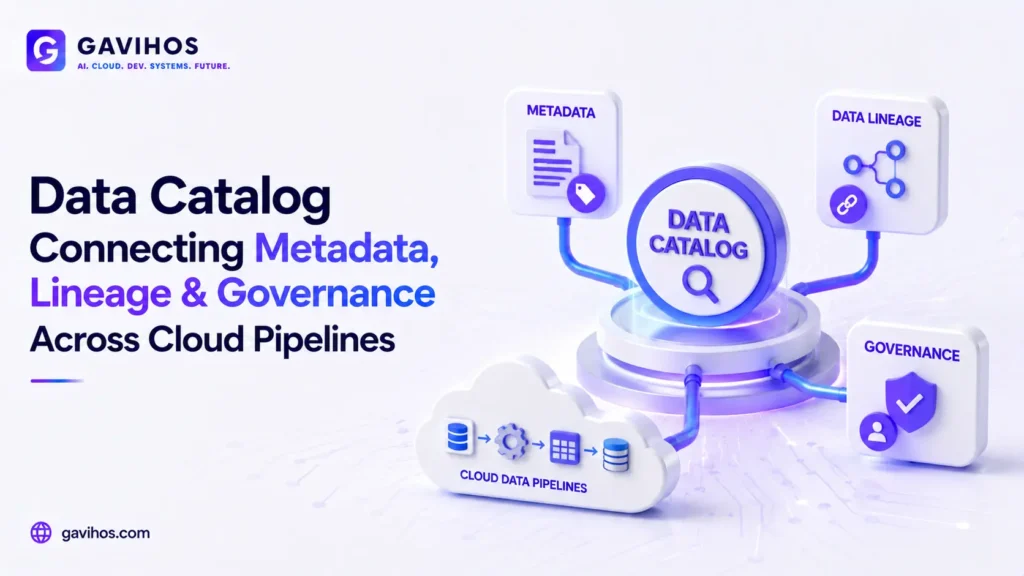
Step 1 — Ingestion and discovery. The catalog needs to know a data asset exists in the first place. In manual systems, this requires someone to register a new table or dataset. In automated systems — like the Datastream-to-Dataplex Universal Catalog integration — the catalog discovers new assets automatically as data flows through connected pipelines.
Step 2 — Metadata extraction. For each discovered asset, the catalog extracts descriptive metadata: schema (column names and types), size, update frequency, and often business context like a description or owning team, where that information is available.
Step 3 — Lineage mapping. As data moves between systems — from a source database, through a change-data-capture stream, into a transformation job, and into a final table — the catalog records each hop. This builds the trackable chain that lets someone trace a final output back to its origin.
Step 4 — Governance tagging. Sensitive data (personal information, financial data, health records) gets tagged with classification labels, which downstream systems can use to enforce access controls automatically rather than relying on someone remembering which tables are sensitive.
Step 5 — Search and discovery for end users. Analysts, data scientists, and engineers can search the catalog to find relevant datasets, see their lineage, and check their governance status — instead of asking around in chat channels or relying on tribal knowledge about where data lives.
Architecture / Components
| Component | Role | Why It Matters |
|---|---|---|
| Metadata store | Central repository of information about data assets | The core of the catalog — without it, there’s nothing to search |
| Change-data-capture (CDC) / streaming ingestion | Detects and moves data as it changes at the source | Automatic metadata registration depends on the catalog being connected to how data actually moves, not a separate manual process |
| Lineage graph | Tracks the chain of transformations from source to output | Enables root-cause tracing when a number looks wrong or a compliance question is asked |
| Classification / governance tags | Labels indicating data sensitivity and ownership | Enables automated access control instead of manual policy enforcement |
| Search interface | Lets users find and understand data assets | The point where the catalog actually delivers value to a human, not just to automated systems |
Real World Use Cases
1. Regulatory compliance and data subject requests. When a regulator or a customer asks “where does my personal data live and how is it used,” a data catalog with accurate lineage lets a compliance team answer with a documented trace rather than a manual investigation across teams.
2. Onboarding new data engineers and analysts. A new team member can search a catalog to understand what data exists and how it’s structured, rather than depending entirely on tribal knowledge from existing team members.
3. Root-cause analysis of data quality issues. When a dashboard shows an unexpected number, lineage tracking lets an analyst trace backward through every transformation to find where the discrepancy was introduced.
4. AI/ML training data governance. Teams building machine learning models need to verify what data they’re training on is current, correctly licensed, and appropriately governed — a catalog with lineage makes this verifiable rather than assumed.
5. Reducing duplicate data engineering work. When data assets are discoverable, teams are less likely to rebuild a pipeline or table that already exists elsewhere in the organization, reducing wasted engineering effort and inconsistent versions of the same underlying data.
Benefits
Faster root-cause analysis. Lineage tracking turns “why does this number look wrong” from a multi-day investigation into a traceable, documented path.
Reduced duplicate work. When data is discoverable, teams stop rebuilding pipelines and tables that already exist, which is a real, ongoing cost in organizations without a catalog.
Stronger compliance posture. Automated classification and lineage give compliance and legal teams a documented, defensible answer to “where does this data live and how is it used” instead of a reconstructed best guess.
Better AI/ML data governance. Verifiable data provenance is increasingly a prerequisite for responsible AI development, not an optional extra.
Limitations
A catalog is only as good as its coverage. If large parts of an organization’s data estate aren’t connected to the catalog’s discovery mechanisms, those parts remain invisible — the catalog can create a false sense of completeness if adoption is partial.
Automated metadata extraction doesn’t replace business context. A catalog can tell you a table’s schema and update frequency automatically, but it usually can’t tell you why the table exists or which stakeholders depend on it without someone providing that context manually.
Governance tagging requires ongoing maintenance. Classification labels can become stale as data usage evolves — a table tagged “internal only” a year ago might now feed a customer-facing product, and nothing forces that tag to be revisited automatically.
Implementation is a real project, not a toggle. Connecting existing pipelines, warehouses, and streaming systems to a catalog takes real engineering effort, particularly in organizations with a long history of undocumented, ad hoc data infrastructure.
Engineering Tradeoffs
What improves: Discoverability, root-cause analysis speed, compliance defensibility, and reduced duplicate data engineering work.
What becomes harder: Ensuring the catalog stays complete and accurate as new data sources are added — a catalog that isn’t kept current becomes actively misleading, which can be worse than having no catalog and knowing to ask around.
New complexity introduced: Another system that needs to be maintained, monitored, and kept in sync with the actual state of the data estate — cataloging is not a one-time setup task.
Operational costs: Beyond the direct cost of catalog tooling, organizations need to invest in connecting existing systems to the catalog’s discovery mechanisms and in maintaining governance tags as data usage evolves.
When this approach should not be the first priority: Very small data estates (a handful of tables, one team) may not yet justify the overhead of a formal catalog — the tipping point is usually when more than one team depends on shared data, or when compliance requirements start asking questions a catalog would answer directly.
Best Practices
Connect the catalog to how data actually moves, not just where it currently sits. Automated discovery through CDC and streaming integration (like Datastream feeding Dataplex Universal Catalog) keeps the catalog current without requiring manual registration for every new asset.
Treat governance tags as living documentation, not a one-time classification exercise. Schedule periodic reviews of sensitive-data classifications, since data usage patterns change over time.
Prioritize the highest-risk and highest-reuse data first. Don’t try to catalog an entire legacy data estate on day one — start with the data that’s most sensitive (compliance risk) or most frequently duplicated across teams (efficiency gain).
Make the catalog genuinely searchable for humans, not just machine-readable. A catalog that only technical specialists can query defeats much of its purpose — the value compounds when analysts and less technical stakeholders can self-serve.
Common Mistakes
Treating cataloging as a one-time documentation project. Data estates change continuously; a catalog that isn’t connected to ongoing data movement becomes stale within months.
Cataloging everything at once instead of prioritizing. Organizations that try to catalog their entire data estate immediately often stall — starting with the highest-value subset produces faster, more sustainable results.
Assuming automated metadata extraction is sufficient. Schema and lineage are necessary but not sufficient — business context (why a dataset exists, who owns it) usually still requires human input.
Ignoring governance tag maintenance. Classification labels set once and never revisited drift out of sync with actual data sensitivity and usage, undermining the compliance value the catalog was meant to provide.
What Most People Get Wrong
“A data catalog is just documentation.” It’s documentation that’s connected to live systems and (ideally) automatically maintained — closer to a live index than a static wiki page, which is the entire point.
“Once we buy a catalog tool, our data problems are solved.” The tool is necessary but not sufficient. Coverage, ongoing maintenance, and organizational adoption determine whether a catalog actually delivers value or becomes another unused dashboard.
“Data lineage and data catalogs are the same thing.” Lineage is one component of what a catalog tracks — the historical path data took — but a catalog also covers current schema, ownership, governance classification, and search/discovery, which lineage alone doesn’t provide.
“This is only relevant for large enterprises.” The tipping point for needing a catalog is about data complexity and cross-team dependency, not company size — a fast-growing startup with several interdependent data pipelines can hit the same discoverability problems as a much larger, older organization.
Future Outlook
Expect data catalogs to keep converging with the data movement layer rather than remaining separate, bolt-on tools — Google’s Datastream-to-Dataplex Universal Catalog integration is one example of a broader direction where catalogs update automatically as data flows through pipelines, rather than requiring manual registration.
AI-assisted cataloging is a likely near-term development: using models to infer business context, suggest classifications, and flag likely-duplicate datasets — reducing the manual effort that currently limits how completely organizations can catalog their data estates. Expect this to be marketed heavily, and expect real value to lag the marketing somewhat, consistent with how automated metadata extraction has historically been useful but not sufficient on its own.
Regulatory pressure is also likely to keep increasing the baseline expectation for data lineage specifically — as more jurisdictions require organizations to demonstrate data provenance for both privacy and AI-training-data reasons, lineage tracking moves from a nice-to-have engineering practice toward a documented compliance requirement.
FAQ
1. What is a data catalog? A data catalog is a centralized, searchable system that records metadata about an organization’s data assets — what a dataset contains, where it came from, who owns it, and how it’s governed — without storing the underlying data itself.
2. What is data lineage? Data lineage is the ability to trace a piece of data back through every transformation it passed through, from its original source to its current form, enabling root-cause analysis and compliance reporting.
3. What is a data silo? A data silo is a dataset that’s isolated from the rest of an organization’s data infrastructure — often duplicated, inconsistently maintained, and invisible to teams outside the one that created it.
4. What is the difference between a data catalog and a data warehouse? A data warehouse stores the actual data. A data catalog stores metadata about data, which can span multiple warehouses, streaming systems, and file stores — it’s an index, not a storage system.
5. What is Dataplex Universal Catalog? Dataplex Universal Catalog is Google Cloud’s managed data catalog product. As of July 2, 2026, it integrates directly with Datastream (Google Cloud’s change-data-capture service) to automatically sync metadata as data flows through connected pipelines.
6. Why do data catalogs matter for AI and machine learning? Teams training AI models need to verify their training data is current, properly licensed, and appropriately governed. A catalog with lineage makes this verifiable rather than something the team has to assume or manually investigate.
7. Do small companies need a data catalog? Not necessarily on day one. The need for a catalog typically emerges once more than one team depends on shared data, or once compliance requirements start requiring documented answers about where data lives.
8. What is change data capture (CDC) and how does it relate to catalogs? CDC is a technique for detecting and capturing changes to data as they happen at the source, typically for streaming or replication purposes. When a CDC service is connected to a catalog, new and changed data assets can be registered automatically instead of requiring manual cataloging.
9. Can a data catalog automatically classify sensitive data? Many modern catalogs support automated classification suggestions based on data patterns, but human review is generally still needed to confirm and maintain accurate sensitivity labels over time.
10. What’s the biggest mistake organizations make when adopting a data catalog? Treating it as a one-time documentation project rather than an ongoing practice connected to how data actually moves — a catalog that isn’t kept current becomes misleading rather than useful.
Analyst Perspective
The most important shift in this category isn’t the catalog concept itself — it’s been around for years — but where cataloging sits in the data infrastructure stack. Historically, catalogs were separate tools that data teams had to remember to update, which is precisely why so many catalog initiatives quietly failed: the tool worked, but the discipline to keep it current didn’t survive contact with daily engineering pressure.
Integrating cataloging directly into data movement services — as Google has done by connecting Datastream to Dataplex Universal Catalog — changes the failure mode. Instead of depending on a human remembering to register a new data asset, the catalog updates because the data literally can’t move through the pipeline without the catalog seeing it. This is a more durable design pattern than better catalog UX or smarter search, because it removes the step that most commonly broke down: voluntary human maintenance.
The second-order effect worth watching is what this does to the AI training-data governance conversation. As regulators and enterprises increasingly ask “can you prove where this training data came from,” organizations without automated lineage tracking will find that question expensive and slow to answer, while organizations with catalogs wired into their data movement layer will have a documented answer nearly for free. This is likely to become a meaningful competitive and compliance differentiator over the next few years, not just an engineering nicety.
For data engineers evaluating this category: the practical question isn’t “should we have a catalog” — most organizations past a certain size already answer that correctly — it’s “is our catalog connected to how data actually moves, or does it depend on someone remembering to update it.” The second pattern degrades quietly over time; the first one doesn’t.
Key Takeaways
- A data catalog is a searchable inventory of metadata about an organization’s data assets — what exists, where it came from, who owns it, and how sensitive it is — not the data itself
- Data lineage tracks the path data took through transformations, enabling root-cause analysis and compliance reporting
- Catalogs that integrate directly with data movement (like Google’s Datastream-to-Dataplex Universal Catalog connection) avoid the most common failure mode: depending on manual, voluntary maintenance
- Data silos have real costs — duplicated engineering work, slow compliance answers, and unreliable AI training-data governance
- Implementation should prioritize the highest-risk and highest-reuse data first, not attempt full coverage immediately
- Regulatory and AI-governance pressure are pushing lineage tracking from an engineering nicety toward a documented compliance requirement
Continue Learning
- What is RAG? Complete Guide to Retrieval-Augmented Generation
- AI Export Controls Explained: How Government Policy Shapes Model Access
- What Is AI for Science? Complete Guide to AI Research Workbenches
- Vercel AI SDK Complete Guide: How to Build AI Applications in TypeScript
- What Are AI Agents? Architecture, Memory, Tools and Real-World Use Cases
About GAVIHOS
GAVIHOS helps developers, founders and technology enthusiasts understand AI, software engineering and emerging technologies through practical guides, tutorials and industry analysis.
Stay Updated
Follow GAVIHOS for practical AI, technology and developer-focused insights.
External Links
| Source | URL |
|---|---|
| Google Cloud — Dataplex Universal Catalog | https://cloud.google.com/dataplex/docs/universal-catalog-overview |
| Google Cloud Blog — What’s New | https://cloud.google.com/blog/topics/inside-google-cloud/whats-new-google-cloud |