Introduction
Most AI products built for professional use are general-purpose: a chat assistant, a coding agent, a writing tool. “AI for science” is different. It describes a growing category of AI systems purpose-built for the specific workflows of scientific research — reading and synthesizing literature, generating and testing hypotheses, analyzing experimental data, and helping researchers move from a question to an answer faster than manual methods allow.
The category became concrete on June 30, 2026, when Anthropic launched Claude Science, an AI workbench built specifically for research use, with early case studies involving Novo Nordisk and the Allen Institute. That launch is a useful anchor for this guide, but the underlying idea is bigger than any single product: research is a distinct kind of knowledge work with its own bottlenecks, and general-purpose AI assistants only partially address them.
This guide explains what AI for science actually means, why it is emerging as a distinct category now rather than years ago, how these systems typically work, and what the real tradeoffs and limitations are.
What Is AI for Science?
AI for science refers to AI systems designed around the specific tasks researchers do: reviewing large bodies of literature, connecting findings across papers and disciplines, generating testable hypotheses, analyzing structured experimental or clinical data, and drafting research documentation.
This is different from a general-purpose AI assistant used by a researcher. A general assistant can summarize a paper if you paste it in. An AI-for-science system is built around the assumption that the user’s job is research specifically — so it is designed to work with citation graphs, structured scientific data formats, domain-specific terminology, and the kind of multi-step reasoning that connecting evidence across sources requires.
Anthropic’s Claude Science, announced at the company’s “The Briefing: AI for Science” event, is a current example of this category: an AI workbench positioned for scientific research use, with named case studies including the pharmaceutical company Novo Nordisk and the biomedical research organization the Allen Institute. Anthropic also introduced a research-credits grant program connected to the launch, with applications closing July 15, 2026.
The category is not limited to one vendor or one product. It includes any AI system — whether a dedicated product, an agent framework, or a retrieval-augmented pipeline — that is purpose-built around the research workflow rather than adapted to it after the fact.
Why Does It Matter?
Business impact. Research and development is one of the most expensive, slowest parts of many industries — pharmaceuticals, materials science, biotechnology, and increasingly, software and AI research itself. Tools that meaningfully compress the time between a research question and a validated answer have a direct effect on R&D cost and time-to-market. This is why a pharmaceutical company adopting an AI research workbench is a substantively different story than a marketing team adopting a chatbot: the stakes and the potential savings are both much larger.
Technology impact. AI for science pushes general AI capabilities in specific directions: longer-context reasoning to hold entire literature reviews in working memory, more reliable structured output for working with tabular and experimental data, and stronger tool use for querying databases, running calculations, or interfacing with lab equipment and data pipelines. Building for research use cases tends to surface capability gaps — around citation accuracy, numerical reasoning, and long-horizon multi-step tasks — that general chat use does not stress as hard.
Industry impact. A credible AI-for-science category changes how research organizations think about hiring, tooling budgets, and workflow design. If AI systems can reliably do a meaningful fraction of literature review and hypothesis screening, research teams can redirect human time toward experimental design, judgment calls, and work that genuinely requires domain expertise rather than information gathering.
Why Now?
AI for science is emerging as a distinct category in 2026 for reasons that are more structural than any single company’s product roadmap.
Context windows got long enough to matter. Reading and synthesizing across dozens of research papers requires holding a large amount of text in context simultaneously. Until recently, model context windows were too short to make this practical without heavy chunking and retrieval tricks that lose cross-document connections. Longer context windows make it feasible to reason across a body of literature in a single pass.
Reasoning quality crossed a usability threshold for multi-step research tasks. Research tasks are rarely single-step. Generating a useful hypothesis requires synthesizing evidence from multiple sources, noticing contradictions, and reasoning about what has not yet been tested. Earlier generations of language models were good at summarizing single documents but weak at this kind of extended, multi-step reasoning. That gap has narrowed enough that dedicated research tools are now viable products rather than research-lab curiosities.
Frontier AI labs have a direct incentive to court research institutions. Partnerships with organizations like Novo Nordisk and the Allen Institute give AI labs real-world validation of their models’ reasoning and reliability on hard, high-stakes problems — a different kind of proof point than consumer chat usage. This is also why AI labs increasingly fund academic and nonprofit research access directly, through grant and research-credit programs, rather than waiting for institutions to become paying customers organically.
Research organizations are under budget and speed pressure. Drug discovery, materials research, and other lab-driven fields have long development cycles and high failure rates. Any tool that plausibly shortens the literature-review or hypothesis-generation phase attracts serious institutional interest, which creates a market that did not exist in a meaningful way even two or three years ago.
A few years ago, none of these conditions held simultaneously: context windows were too short, multi-step reasoning was too unreliable, and AI labs had less incentive to build specialized research tooling instead of general consumer and developer products. Now they do.
How It Works
AI-for-science systems generally combine several components that are individually familiar from other AI application categories, arranged around the research workflow specifically.
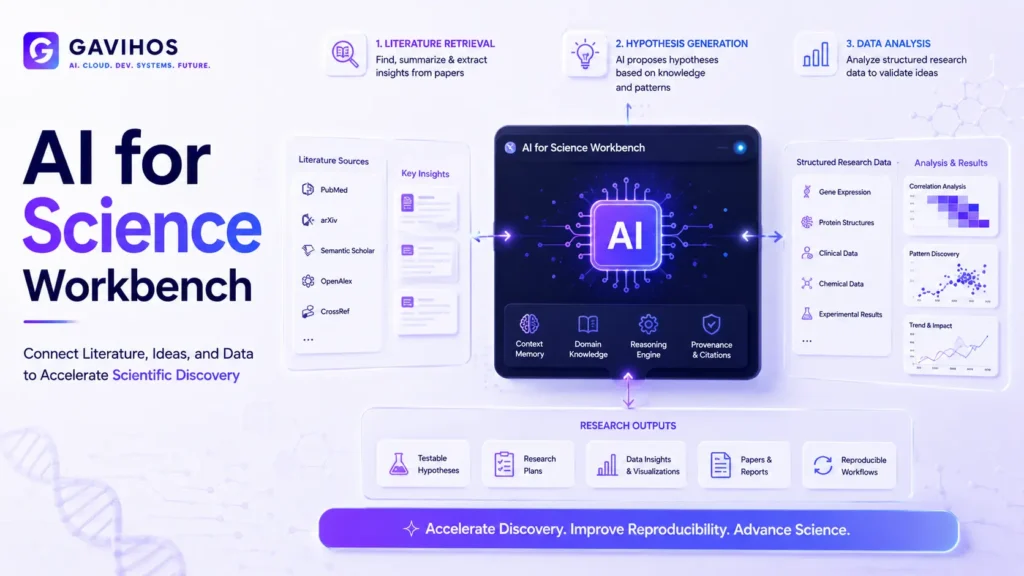
Step 1 — Ingestion and retrieval. The system ingests research literature, internal datasets, or lab records, typically using retrieval-augmented generation (RAG) so the model can pull relevant passages instead of relying only on what it learned during training. This matters enormously in research contexts because published literature changes constantly and internal experimental data is never part of any model’s training data.
Step 2 — Synthesis across sources. Rather than summarizing one document, the system is asked to reason across many — finding where studies agree, where they conflict, and what has not yet been tested. This step depends heavily on both context length and reasoning quality, which is why it has only recently become practical.
Step 3 — Structured output for scientific data. Research work involves numbers, statistics, chemical structures, gene sequences, and other structured data formats — not just prose. Systems in this category need reliable structured output generation so that a hypothesis or an analysis can be represented in a form a researcher, a database, or downstream software can actually use.
Step 4 — Tool use for computation and lookup. Research questions often require calculation, database queries, or interaction with domain-specific software (statistical packages, sequence databases, chemical structure tools). AI-for-science systems typically integrate tool-calling so the model can offload precise computation rather than attempting arithmetic or lookups from memory, where language models are unreliable.
Step 5 — Human review and iteration. No credible AI-for-science tool is presented as a replacement for scientific judgment. The output — a literature synthesis, a candidate hypothesis, a data analysis — is meant to be reviewed, challenged, and iterated on by a researcher, not accepted directly.
Architecture / Components
| Component | Role | Why It Matters in Research Contexts |
|---|---|---|
| Retrieval-augmented generation (RAG) | Pulls relevant literature and internal data into context | Keeps the system current with new publications and proprietary data the model was never trained on |
| Long context window | Holds multiple documents in working memory simultaneously | Enables synthesis across sources rather than one document at a time |
| Structured output generation | Produces validated, typed data (not just prose) | Research data needs to be usable by other software and databases, not just readable |
| Tool use / function calling | Lets the model call calculators, databases, or domain tools | Offloads precision-critical tasks that language models handle poorly on their own |
| Multi-step reasoning / agent loop | Chains retrieval, analysis, and tool calls together | Real research questions are rarely answerable in a single step |
| Human-in-the-loop review | Researcher validates and iterates on AI output | Scientific claims require human accountability and judgment before publication or action |
Real World Use Cases
1. Pharmaceutical literature review and hypothesis generation. Drug discovery teams, such as those at Novo Nordisk, use AI research workbenches to synthesize findings across large volumes of published and internal research, surfacing candidate mechanisms or drug targets faster than manual review alone.
2. Biomedical research at nonprofit institutes. Organizations like the Allen Institute, which conduct large-scale biological and neuroscience research, use AI tools to help researchers connect findings across specialized subfields that individual scientists rarely have time to track comprehensively.
3. Academic literature synthesis. University researchers and graduate students use AI research tools to accelerate the literature review phase of a project — identifying relevant prior work, spotting contradictions between studies, and mapping the current state of a research question before designing new experiments.
4. Clinical and experimental data analysis. Research teams analyzing structured trial data or lab results use AI systems with strong structured-output capabilities to draft initial statistical summaries and flag anomalies for human review, rather than replacing statistical rigor entirely.
5. Grant and research proposal drafting. Researchers use AI tools to draft literature review sections, structure research proposals, and summarize prior work for grant applications — a time-consuming task that benefits from AI assistance without requiring the AI to make scientific judgments.
Benefits
Faster literature synthesis. What might take a researcher days of manual reading can be substantially accelerated when an AI system can ingest and cross-reference many sources at once, though the researcher still needs to verify the synthesis.
Reduced blind spots across disciplines. Research increasingly requires cross-disciplinary awareness — a biologist benefiting from a materials-science finding, for example. AI systems with broad training can surface connections that a specialist working within one field might not encounter.
Lower barrier to entry for smaller institutions. Research-credit and grant programs tied to AI-for-science launches can give smaller labs and academic groups access to capabilities that would otherwise require infrastructure or licensing budgets they do not have.
Structured, reviewable output. When these systems produce structured data rather than only prose, their outputs are easier for a research team to verify, challenge, and integrate into existing workflows and databases.
Limitations
Hallucination risk is higher-stakes in research than in casual use. A fabricated citation or an invented statistic is a minor annoyance in a chatbot conversation. In a scientific context, it can propagate into a hypothesis, a grant application, or worse, a decision about which experiments to run. AI-for-science tools reduce this risk with retrieval grounding, but they do not eliminate it.
These systems do not perform experiments. An AI research workbench can synthesize existing evidence and suggest hypotheses. It cannot run a wet-lab experiment, operate physical equipment, or generate new empirical data. The lab work — and the accountability for it — remains entirely human.
Domain coverage is uneven. A model’s training data and retrieval sources determine how well it performs in a given field. A system with excellent coverage of biomedical literature may perform far worse in a niche materials-science subfield with less published, less digitized literature.
Verification remains a human responsibility. No credible vendor claims these tools remove the need for peer review, statistical validation, or experimental confirmation. Any output needs to be checked against primary sources before it informs a real research decision.
Engineering Tradeoffs
What improves: Time spent on literature review and initial hypothesis screening drops substantially. Researchers can explore a wider space of possible directions before committing scarce experimental resources to any one of them.
What becomes harder: Trust calibration. Teams need clear internal norms for which AI outputs require verification against primary sources and which do not — and that norm-setting takes real organizational effort, not just a tool rollout.
New complexity introduced: Integrating an AI research tool into existing lab information systems, data pipelines, and compliance workflows (particularly in regulated fields like pharmaceuticals) is nontrivial engineering and process work, not a plug-and-play addition.
Operational costs: Beyond the direct cost of API or subscription access, organizations need to invest in training researchers to use these tools effectively and in building review processes that catch AI errors before they affect real decisions.
When this approach should not be used: For any step where a wrong answer has irreversible consequences — dosing decisions, safety-critical calculations, final statistical conclusions in a published paper — AI output should inform, not replace, rigorous human verification and standard scientific method.
Best Practices
Treat AI-generated hypotheses as a starting point, not a conclusion. Use the system to expand the space of directions worth investigating, then apply normal experimental rigor to test them.
Always verify citations against primary sources. Do not cite a paper in a publication or grant application based solely on an AI system’s description of it — retrieve and read the actual source.
Match the tool to the domain’s data maturity. AI-for-science tools perform best in fields with large volumes of digitized, well-structured literature and data. In under-digitized fields, expect more limited value and verify outputs more aggressively.
Build a review workflow before rollout. Decide in advance who checks AI-assisted literature reviews, how discrepancies are resolved, and what documentation is required before an AI-assisted finding informs a real decision.
Take advantage of research-credit and grant programs where eligible. Programs tied to AI-for-science launches, like the one accompanying Claude Science, can meaningfully lower the cost of evaluating whether these tools are useful for a specific research group.
Common Mistakes
Assuming broad AI capability transfers directly to research reliability. A model that writes fluent, confident-sounding text about a scientific topic is not the same as a model that is reliably accurate about that topic. Fluency is not evidence of correctness.
Skipping domain-specific evaluation before adoption. Teams sometimes adopt an AI research tool based on general benchmarks rather than testing it specifically against their own field’s literature and terminology, where performance can vary significantly.
Letting AI-generated summaries substitute for reading key primary sources. Summaries are useful for triage — deciding what to read in depth — but should not replace reading the sources that actually matter to a research decision.
Underinvesting in the human review layer. Organizations sometimes roll out AI research tools without updating their internal review and verification processes, which is where most of the real risk in this category lives.
What Most People Get Wrong
“AI for science means AI that does science.” It does not, at least not in its current form. These are tools that accelerate specific parts of the research process — literature synthesis, hypothesis generation, data analysis support — while leaving experimental design, execution, and validation to human researchers.
“If a major pharmaceutical company uses it, it must be broadly reliable.” A named case study demonstrates that a tool provides value in a specific, often narrowly scoped use case within that organization. It does not mean the tool is uniformly reliable across all research tasks or domains.
“AI research tools eliminate the need for domain expertise.” If anything, they increase the importance of domain expertise, because expert judgment is exactly what is needed to evaluate whether an AI-generated hypothesis or synthesis is actually sound.
“This is the same as a general chatbot with a research theme.” A purpose-built research workbench differs from a general assistant in its retrieval infrastructure, its handling of structured scientific data, and its design around multi-step research workflows — differences that matter significantly for real research use, even if the underlying model is similar.
Future Outlook
AI for science is likely to grow along a few predictable lines. Context windows and multi-step reasoning will keep improving, making literature synthesis across larger bodies of work more reliable. Research-credit and grant programs, like the one tied to Claude Science, are likely to become a standard go-to-market pattern for AI labs seeking validation from research institutions, not a one-off gesture.
Expect increasing specialization: general AI-for-science platforms today will likely be joined by tools tuned for specific fields — genomics, materials science, clinical research — where domain-specific data and evaluation matter more than general capability. Expect also more scrutiny of these tools’ actual track record, as institutions that have adopted them long enough to measure real outcomes start publishing their own assessments, separate from vendor case studies.
The organizations most likely to benefit early are those with large volumes of internal research data and literature-heavy workflows — pharmaceutical and biomedical research chief among them — but the underlying pattern (retrieval-augmented, multi-step, tool-using AI applied to a specific professional workflow) is one that will likely extend well beyond scientific research into other high-stakes knowledge work.
FAQ
1. What is AI for science? AI for science refers to AI systems built specifically for research workflows — literature synthesis, hypothesis generation, and data analysis — rather than general-purpose AI assistance adapted after the fact for research use.
2. What is Claude Science? Claude Science is an AI workbench for scientific research launched by Anthropic on June 30, 2026, at “The Briefing: AI for Science” event, with case studies involving Novo Nordisk and the Allen Institute, and an accompanying research-credits grant program.
3. Is AI for science the same as a general AI chatbot? No. AI-for-science tools are built around research-specific needs: retrieval over scientific literature, structured scientific data output, and multi-step reasoning across many sources — capabilities a general chatbot is not specifically optimized for.
4. Can AI systems perform scientific experiments? No. Current AI-for-science tools support the cognitive and analytical parts of research — literature review, hypothesis generation, data analysis — but do not conduct physical experiments or replace laboratory work.
5. How reliable are AI-generated research hypotheses? They should be treated as a starting point for investigation, not a validated conclusion. Reliability depends heavily on the domain’s data maturity and requires human expert review before any hypothesis informs a real research decision.
6. Why is AI for science becoming popular now rather than earlier? Longer context windows, improved multi-step reasoning, and growing institutional pressure to accelerate research and development have converged to make dedicated research AI tools practical in a way they were not a few years ago.
7. What industries benefit most from AI for science? Pharmaceutical research, biomedical science, and other literature-heavy, data-intensive fields tend to benefit most, since they combine large volumes of digitized research with high costs for slow development cycles.
8. What are research-credit or grant programs in this context? These are programs where AI labs provide research institutions or individual researchers with subsidized or free access to AI tools, often as part of a product launch, to encourage adoption and gather real-world validation.
9. What is retrieval-augmented generation and why does it matter for AI-for-science tools? Retrieval-augmented generation (RAG) lets an AI system pull relevant information from an external source — like a literature database — into its context rather than relying only on what it learned during training. This is essential for research use, where staying current with new publications matters.
10. Does using AI research tools reduce the need for domain expertise? No. It increases the importance of domain expertise, since expert judgment is required to evaluate whether AI-generated syntheses and hypotheses are actually sound before acting on them.
Analyst Perspective
The most important thing about the AI-for-science category is not any single product’s feature list — it is what it reveals about where frontier AI labs are directing their credibility-building efforts.
Consumer chat usage and developer adoption are useful growth metrics, but they do not prove that a model can be trusted with hard, high-stakes reasoning. A named partnership with an organization like Novo Nordisk or the Allen Institute is a different kind of signal: it says an AI lab is willing to be measured against real research outcomes, in a domain where being wrong has consequences beyond a bad chat response.
This is why research-credit and grant programs matter more than they might appear to at first glance. They are not simply goodwill gestures — they are a mechanism for AI labs to accumulate real-world evidence of research-grade reliability from institutions that would otherwise be slow, skeptical adopters. Expect every major AI lab to build some version of this playbook over the next year: partner with credible research institutions, publish case studies, and offer subsidized access to accelerate adoption in a market segment that confers unusual credibility.
The second-order effect worth watching is what happens to the research process itself once literature synthesis becomes substantially cheaper. Historically, the bottleneck in much research has been human attention — there is simply too much published literature for any individual to track comprehensively. If AI tools genuinely relieve that bottleneck, the constraint shifts toward experimental capacity and judgment, which means the value of researchers with strong critical evaluation skills — the ability to tell a good hypothesis from a plausible-sounding one — goes up, not down.
For developers and technologists outside the research world, the pattern here — retrieval-augmented, multi-step, tool-using AI applied to a specific professional workflow — is a template that will recur. Watch which other high-stakes, literature-heavy professions (legal research, financial analysis, regulatory compliance) get their own version of this category next.
Key Takeaways
- AI for science is a distinct AI application category built around research-specific workflows: literature synthesis, hypothesis generation, and structured data analysis
- Claude Science, launched by Anthropic on June 30, 2026, is a current example, with case studies involving Novo Nordisk and the Allen Institute and a research-credits grant program
- The category is emerging now because context windows, multi-step reasoning, and institutional pressure to accelerate R&D have all matured enough to make it practical
- These tools accelerate literature review and hypothesis generation; they do not perform experiments or replace scientific judgment
- Hallucination and citation risk are higher-stakes in research contexts, making human verification against primary sources non-negotiable
- Research-credit and grant programs are likely to become a standard pattern for AI labs seeking research-grade credibility, not a one-time gesture
Continue Learning
- What is RAG? Complete Guide to Retrieval-Augmented Generation
- What Are AI Agents? Architecture, Memory, Tools and Real-World Use Cases
- What is Agentic AI? How Autonomous AI Systems Think and Act
- What is Claude Fable 5?
- Prompt Engineering Complete Guide: From Basics to Advanced Techniques
About GAVIHOS
GAVIHOS helps developers, founders and technology enthusiasts understand AI, software engineering and emerging technologies through practical guides, tutorials and industry analysis.
Stay Updated
Follow GAVIHOS for practical AI, technology and developer-focused insights.
External Links
| Source | URL |
|---|---|
| Anthropic — Claude Science AI Workbench | https://www.anthropic.com/news/claude-science-ai-workbench |