Introduction
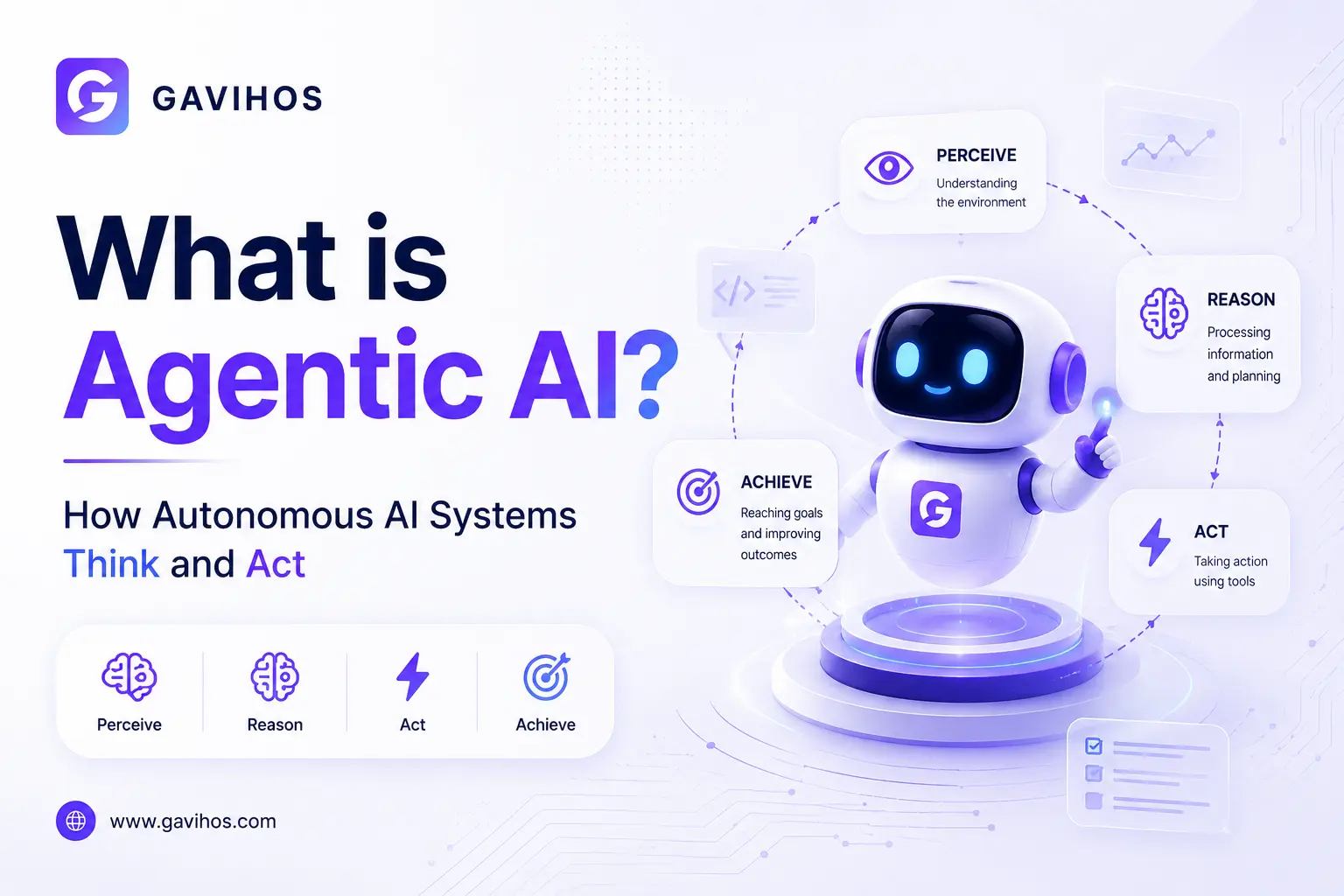
Agentic AI refers to AI systems that pursue goals autonomously — planning a sequence of actions, executing them, observing results, and adjusting based on what they find — rather than waiting for a human to direct each step.
The word “agentic” comes from agency: the capacity to act independently toward a goal. An agentic AI system does not just answer a question and stop. It takes initiative. It decides what to do next. It uses tools. It checks its own work. It continues until the task is complete or it determines it cannot proceed.
This is different from the AI most people used until recently. Asking ChatGPT a question, generating an image, or getting a code suggestion are all single-step interactions — you provide input, the AI produces output, the interaction ends. Agentic AI operates in a loop. The output of one step becomes the input of the next, and the system manages the entire sequence without a human directing each transition.
Understanding what agentic AI is — not just technically, but in terms of what it can and cannot do, and what it changes — is now relevant for anyone working with or making decisions about AI systems.
What Is Agentic AI?
Agentic AI is an AI system that can:
- Receive a goal — a task described in natural language or structured input
- Plan — decide what steps are needed to achieve the goal
- Act — use tools, call APIs, read files, search the web, write code, or interact with external systems
- Observe — read the results of its actions
- Adapt — update its plan based on what it observes
- Complete — recognize when the goal is achieved and stop
The key distinction from traditional AI: agentic AI takes a sequence of actions over time to complete a task, rather than producing a single response to a single input.
A practical example: you ask an agentic AI system to “research our three main competitors, find their current pricing, and prepare a comparison table.” The system searches the web for each competitor, navigates to their pricing pages, extracts the relevant information, formats it into a table, and returns the result — all without you needing to direct each search, read each page, or copy each data point. The system owned the entire workflow from goal to deliverable.
Why Does It Matter?
AI is moving from tool to collaborator. Tools do what you tell them, one step at a time. A collaborator takes a goal and figures out how to achieve it. Agentic AI represents the shift from AI as a tool that amplifies a specific action to AI as a system that can own a category of work.
The economic implications are direct. Tasks that previously required sustained human attention — research, monitoring, analysis, multi-step coordination — can now be delegated to agentic systems. This does not eliminate the need for human judgment; it changes where human judgment is applied. Instead of directing each step of a workflow, a person defines the goal, reviews the output, and makes decisions the agent could not make autonomously.
Every industry is exposed. Agentic AI is not specific to software engineering or data science. Legal research, financial analysis, customer support escalation, procurement workflow, compliance monitoring — any domain with multi-step information workflows is a candidate for agentic automation. The question in each case is not whether agentic AI could perform the work, but whether it can do so reliably enough and with appropriate human oversight.
Why Now?
Agentic AI has been theoretically possible since early language models could generate text that described plans. It became practically viable between 2023 and 2025 because several independent conditions were met simultaneously.
Structured tool use became reliable. Early agentic systems had to parse tool calls from free-form text — a fragile approach that broke frequently. When major AI providers introduced structured function calling APIs, the reliability of tool use improved dramatically. Agents could now call external systems predictably.
Context windows became large enough. Multi-step tasks require holding the history of previous actions in the AI’s working memory. When context windows were limited to a few thousand tokens, agents could not maintain enough history to complete complex tasks without losing track of earlier steps. Modern models support context windows large enough to hold the full history of substantial multi-step workflows.
Models improved at following complex instructions without drifting. Earlier models would lose track of the original goal partway through a multi-step task, or would follow one instruction while inadvertently violating another. Improved instruction following and goal persistence made agents reliable enough to deploy in production systems.
Infrastructure matured. Frameworks like LangGraph and CrewAI built the orchestration layer — the plumbing that manages the agent loop, handles tool calls, manages memory, and provides error handling. This infrastructure reduced the engineering cost of building agentic systems from months to days.
How Agentic AI Works
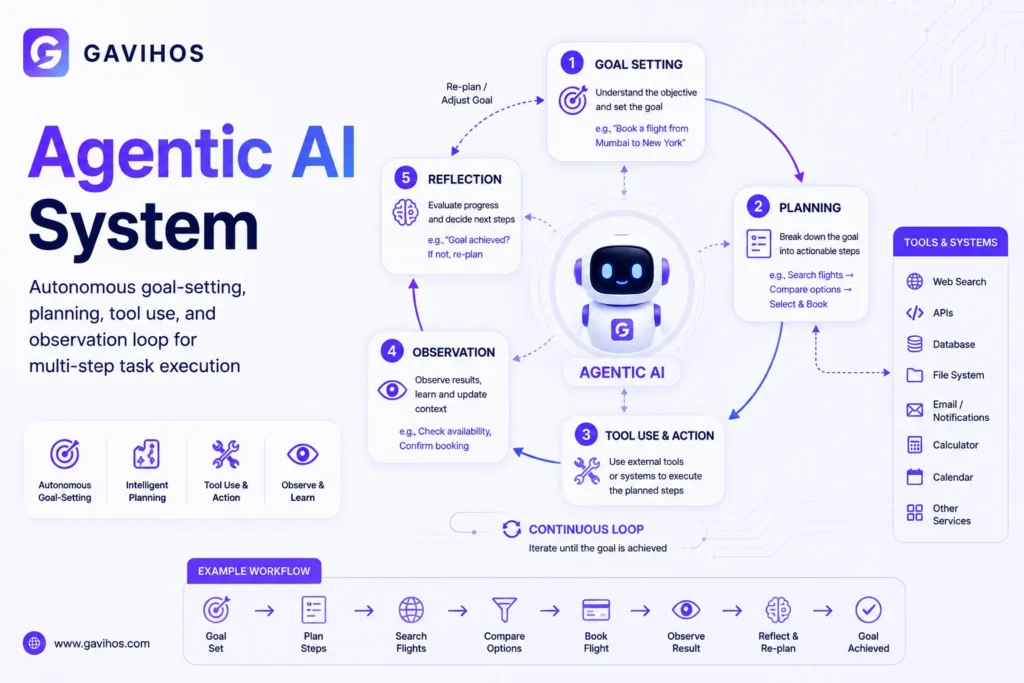
The core of every agentic AI system is a loop — sometimes called the agent loop or the reasoning-action cycle.
Perceive: The agent receives its current state — the original goal, the history of actions taken so far, the results of those actions, and any new information available.
Reason: The agent (using an underlying language model) processes this state and decides what to do next. It may think through options internally, check what tools are available, and identify the action most likely to advance toward the goal.
Act: The agent executes the chosen action — a web search, a database query, a file read, a code execution, an API call, or a message to another agent.
Observe: The agent receives the result of the action and adds it to its state.
Repeat: The loop continues until the goal is achieved, the agent determines it cannot proceed, or a maximum step limit is reached.
This loop is the fundamental difference between agentic AI and a standard AI query. A standard query runs the loop once. An agentic system runs it repeatedly, with each iteration building on the last.
Agentic AI vs Traditional AI
| Dimension | Traditional AI | Agentic AI |
|---|---|---|
| Interaction model | One input → one output | Goal → multi-step execution → deliverable |
| Human involvement | Required at each step | Required at goal-setting and output review |
| Tool use | Typically none | Core capability — web, APIs, code, files |
| State | Stateless per query | Stateful across the full task |
| Reliability | High for well-defined tasks | Varies with task complexity |
| Best for | Answering questions, generating content | Completing multi-step workflows end-to-end |
The distinction is not about which is better — it is about which is appropriate for a given task. Asking an AI to summarize a document is a one-step task; traditional AI handles it well and an agentic loop adds unnecessary complexity. Asking an AI to monitor a data feed, detect anomalies, trace them to their source, and alert the appropriate team is a multi-step workflow; an agent is necessary.
Real-World Use Cases
1. Business Research and Competitive Intelligence An agentic system given a competitor analysis task searches multiple sources, reads company pages, extracts product and pricing information, cross-references with news coverage, and assembles a structured report. A task that takes a human analyst several hours completes in minutes, with the human reviewing the output rather than performing each step.
2. Customer Support at Scale Enterprise customer support agents receive an inbound request, query the CRM for account history, search the knowledge base for relevant solutions, determine if the issue matches a known pattern, draft a response aligned with company policy, and either send it or escalate to a human agent when confidence is low. The agent handles routine cases end-to-end; humans handle exceptions.
3. Software Development Assistance Tools like Claude Code and GitHub Copilot Agent Mode accept a task description — “add unit tests for the auth module” or “refactor this function to handle null inputs” — and execute the full sequence: reading the relevant files, writing the changes, running tests, observing failures, and iterating. The developer reviews the output rather than writing each line.
4. Financial Monitoring and Anomaly Detection Agentic systems monitor transaction streams, detect patterns that fall outside expected ranges, query historical data to determine if similar patterns preceded known issues, generate a summary of findings, and alert analysts. Tasks that previously required continuous human monitoring run autonomously with human notification only when action is required.
5. Legal and Compliance Research Agentic systems search case law databases, regulatory filings, and policy documents for relevant precedents, extract the key holdings or requirements, check for updates since a specified date, and compile the results into a structured memo. Legal professionals review and apply judgment rather than performing the research steps.
Benefits
Task delegation, not just task assistance. Agentic AI does not help you complete a task faster — it can complete the task on your behalf. The human role shifts from doing to directing and reviewing.
Available continuously. Agentic systems run when scheduled or triggered, not only when a human is present. Monitoring, alerting, and response workflows that previously required human availability run autonomously.
Consistent process execution. An agent follows the same process every time — it does not skip steps when tired, does not take shortcuts under deadline pressure, and does not vary its approach based on mood. For compliance-critical workflows, this consistency is valuable.
Scales without proportional human cost. Adding more agentic capacity does not require proportionally more human staff. The human investment is in designing the agent, reviewing its outputs, and handling exceptions — not in running the workflow instance by instance.
Limitations
Reliability degrades with complexity. Agentic systems work well on well-scoped, well-defined tasks with clear success criteria. As tasks become more open-ended, require more steps, or involve ambiguous judgment calls, reliability decreases. A ten-step task has more opportunities for compounding errors than a two-step task.
Agents cannot verify their own outputs reliably. An agent that completes a research task may have made a wrong assumption at step three that invalidated the remaining steps — and it may not know this. External verification, either by a human reviewer or a separate verification agent, is required for high-stakes outputs.
Tool quality determines agent quality. An agent is only as good as the tools it has access to. If the web search tool returns low-quality results, if the database query returns stale data, or if the code executor silently fails, the agent’s output reflects these tool failures. The full system — not just the AI model — determines reliability.
Observability is harder than for traditional AI. When a standard AI query produces a wrong answer, there is one input and one output to examine. When an agentic system produces a wrong result after twenty steps, tracing the error requires reviewing the full sequence of reasoning steps, tool calls, and tool results. This is tractable but requires investment in logging and observability infrastructure.
What Most People Get Wrong
“Agentic AI and AI agents are the same thing.” Agentic AI is a property — a system that exhibits agency, that acts autonomously toward goals. An AI agent is a specific implementation — a software system built around a language model with tools, memory, and an orchestration loop. Agentic AI describes the capability; AI agent describes the architecture. In practice, the terms are often used interchangeably, and the distinction rarely matters outside technical discussions.
“Agentic AI is fully autonomous.” Practical agentic systems operate on a spectrum of autonomy. Most production deployments include human checkpoints — particularly before irreversible actions, when confidence is low, or when a task falls outside the agent’s defined scope. Full autonomy without oversight is not the goal; calibrated autonomy with appropriate human involvement is.
“Agentic AI will replace jobs immediately.” Agentic AI changes which parts of a job require human attention, not whether humans are needed. Tasks that are fully routine and well-defined can be automated. Tasks that require judgment, relationship management, ethical assessment, or accountability remain human responsibilities. The practical effect, job by job, depends on what fraction of the role is automatable versus what fraction requires human qualities.
“Agentic AI is only for large companies.” The infrastructure for agentic AI — model APIs, orchestration frameworks, tool integrations — is available to any developer. Small teams building with Claude, GPT-4o, or Gemini APIs have access to the same underlying capability as large enterprises. The difference is implementation depth and operational maturity, not access.
Future Outlook
Agentic systems will become the default interface for complex work. Today, interacting with software requires navigating interfaces, filling forms, and executing sequences of operations. Agentic AI abstracts this: you state a goal, the system executes the operations. This shift will accelerate as agents become more reliable and as more software exposes tool interfaces that agents can use.
Multi-agent coordination will handle tasks too large for single agents. Complex enterprise workflows — a full sales cycle, a complete code review and deployment pipeline, an end-to-end procurement process — involve more steps and more domain knowledge than a single agent can hold reliably. Multi-agent systems, where specialized agents collaborate under the coordination of an orchestrator, will become the standard architecture for these workflows.
Trust and verification infrastructure will define which agentic systems get deployed. The limiting factor for agentic AI adoption is not capability — it is verifiability. Organizations need to be able to audit what an agent did, why it did it, and whether the outcome was correct before they can deploy agents in consequential workflows. The companies that build reliable audit trails, explainable agent reasoning, and external verification capabilities will see faster enterprise adoption.
FAQ
Q: What is the simplest definition of agentic AI? Agentic AI is an AI system that pursues a goal through a sequence of actions — planning, acting, observing results, and adapting — rather than responding to a single prompt and stopping.
Q: Is ChatGPT an agentic AI? Standard ChatGPT conversations are not agentic — they are single-turn or multi-turn exchanges where a human directs each step. ChatGPT’s “Operator” and custom GPT features with tool access have agentic elements. The underlying model can be part of an agentic system, but the conversational interface itself is not agentic by default.
Q: What is the difference between agentic AI and automation? Traditional automation executes a fixed, predefined sequence of steps. Agentic AI decides dynamically what steps to take based on the current state and goal. Automation is rigid; agentic AI is adaptive. Both have appropriate use cases — if a workflow never changes, automation is simpler and more reliable. If the workflow must adapt to varying inputs or unexpected results, agentic AI is necessary.
Q: How reliable is agentic AI? Reliability varies significantly with task complexity and how well the agent is designed for its specific task. Well-scoped agentic systems running on well-defined workflows with clear success criteria can be highly reliable. Open-ended agents tasked with complex, multi-step work in ambiguous domains are less reliable. Current production deployments succeed by matching agent autonomy to validated reliability levels.
Q: What is prompt injection in the context of agentic AI? Prompt injection is a security risk where malicious content that the agent processes — a web page, an email, a document — contains text designed to manipulate the agent’s behavior. For example, a web page might contain hidden instructions telling the agent to ignore its original task and take a different action. Agentic systems that process untrusted content are vulnerable and require specific defenses.
Q: Can agentic AI make mistakes that are hard to reverse? Yes. An agentic system that has write access to databases, email accounts, or external APIs can take actions that are difficult or impossible to undo — sending an email, deleting a record, making a financial transaction. This is why well-designed agentic systems require human confirmation before irreversible actions, especially in early deployment phases.
Q: What tools does an agentic AI typically use? Web search, file reading and writing, database queries, code execution, API calls, browser automation, email, calendar, and in multi-agent systems, calling other agents. The set of tools available defines the boundary of what the agent can do.
Q: Is agentic AI safe for enterprise use? With appropriate design — scope limits, human checkpoints, audit logging, sandboxed execution, and verification steps — yes. Without these safeguards, no. The question is not whether agentic AI is safe in the abstract, but whether a specific deployment has the right controls for its specific risk profile.
Q: What is an AI orchestrator? An orchestrator is the component that manages the agent loop — it passes state to the reasoning model, receives the model’s decision, executes the requested tool call, adds the result back to the state, and repeats. In multi-agent systems, an orchestrator agent also coordinates the work of other agents. LangGraph and CrewAI are orchestration frameworks.
Q: How do I know if agentic AI is right for my use case? If your use case requires a fixed, known sequence of steps that never changes, traditional automation is better. If it requires multiple steps where each step’s content depends on the result of the previous step, or where the sequence varies based on inputs, agentic AI is appropriate. If it requires autonomous judgment calls on ambiguous situations without human review, the current generation of agentic AI requires careful evaluation before deployment.
Analyst Perspective
The most important thing to understand about agentic AI is that it changes the boundary of what requires human time — not whether humans are needed.
This distinction matters because most coverage of agentic AI collapses into one of two narratives: either it is going to automate everything and displace vast numbers of workers, or it is overhyped and won’t work reliably enough to matter. Both framings miss the more useful question: for a specific workflow, which parts can be reliably automated, and which parts still require human judgment?
The answer, for most knowledge work, is that the routine, process-following, information-gathering parts of a workflow are automatable with current agentic systems. The judgment-intensive, relationship-dependent, accountability-bearing parts are not. This is not a temporary limitation waiting to be solved — it is a structural characteristic of what current AI systems are and are not good at.
The practical implication for organizations: agentic AI creates leverage, not replacement. A researcher with an agentic system can cover ground that previously required a team. A developer with an agentic coding assistant can implement features in a fraction of the time. A support team with an agentic triage system can handle volume that would otherwise require additional headcount. The constraint on value creation shifts from execution capacity to judgment capacity. That is a significant change — but it is a different change than “AI replaces workers.”
Key Takeaways
- Agentic AI pursues goals through sequences of actions — planning, acting, observing, and adapting — rather than responding to single prompts.
- The practical difference from traditional AI: the human role shifts from directing each step to setting the goal and reviewing the output.
- Agentic AI became practically viable between 2023–2025 due to reliable tool calling, larger context windows, and improved instruction-following in frontier models.
- Reliability is the key constraint. Well-scoped agentic systems on defined workflows are highly reliable. Open-ended agents on complex tasks require careful evaluation.
- Agentic AI changes where human judgment is applied in a workflow — not whether human judgment is needed.
Continue Learning
- What Are AI Agents? Architecture, Memory, Tools and Real-World Use Cases
- GitHub Copilot Agent Mode: Autonomous Coding in VS Code
- What is MCP? Model Context Protocol Explained
About GAVIHOS
GAVIHOS helps developers, founders and technology enthusiasts understand AI, software engineering and emerging technologies through practical guides, tutorials and industry analysis.
Stay Updated
Follow GAVIHOS for practical AI, technology and developer-focused insights.