Introduction
In June 2026, Vercel ran two Ship events — London on June 17, New York City on June 30 — and the core message of both was the same: software deployment has structurally changed. Six months ago, fewer than 3% of Vercel deployments were triggered by coding agents. As of the NYC event, that number is above 50%.
That statistic is the most important thing Vercel said at Ship 2026. Not because it validates Vercel’s product decisions — though it does — but because it describes something that is now true of the broader infrastructure layer. The assumption that a human pushes code to deploy a service is no longer the dominant pattern on one of the largest deployment platforms in the world. Agents are.
This analysis covers what Vercel shipped at Ship 2026, why it matters beyond the product announcements, what it means for developers building AI applications today, and what is coming next.
What Happened
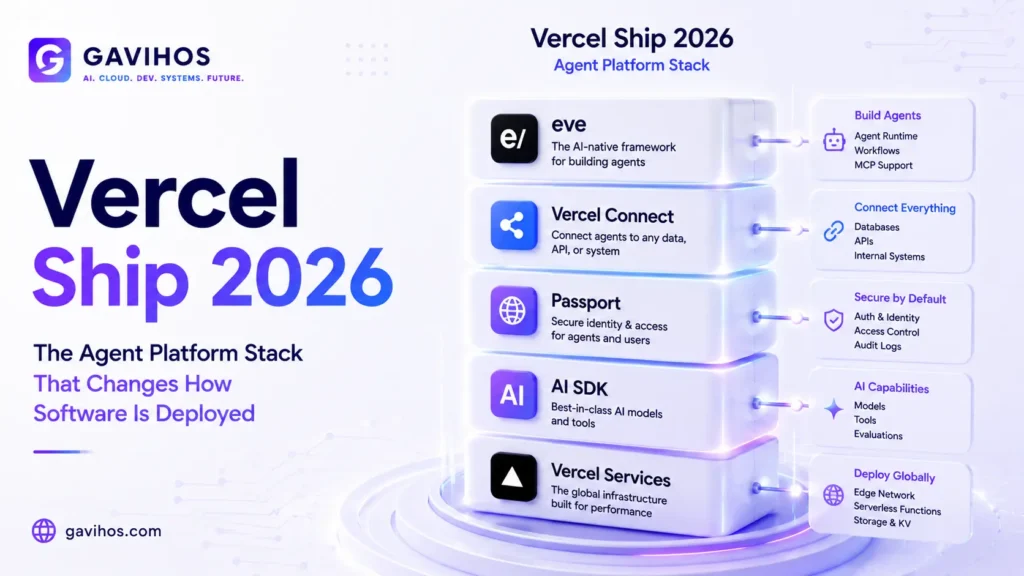
Vercel Ship 26 introduced five interconnected products that together form what the company calls the Agent Stack.
eve — The Open-Source Agent Framework
eve is an open-source TypeScript framework for building and deploying AI agents in production. Vercel describes it as “Next.js for agents” — the pitch being that Next.js removed the need to hand-roll server configuration and routing for every web application, and eve does the same for agents.
In eve, an agent is a directory of files mapped to capabilities. Each file defines a skill. Durability (surviving process crashes), sandboxed compute (isolated execution environments), agent tools, human-in-the-loop approvals, and evaluation are built into the framework structure rather than libraries you compose yourself.
eve was built from Vercel’s internal agent infrastructure — specifically the same system that powers v0, Vercel’s AI-driven development tool. That matters because it means eve’s design reflects what production agent deployment actually requires, not what a thought experiment suggests it might require.
Vercel Connect — Agent Credentials Without Long-Lived Tokens
Vercel Connect provides agents with secure access to external tools, data, and services without requiring long-lived credentials stored in environment variables. Instead, Connect issues scoped, short-lived tokens with full audit trails for each agent session.
The credential problem is one of the most underappreciated security challenges in agent deployment. An agent that needs to access a database, a third-party API, and an internal service requires credentials for all of them. Storing those credentials as environment variables means they are available to all code in the deployment — including code the agent generates or executes. Scoped, short-lived tokens are the right architecture; Vercel has now made this a first-class platform feature.
Vercel Passport — Enterprise AI Governance
Passport is a management layer for AI projects that develop outside official IT channels — what Vercel calls “shadow AI.” It gives enterprise administrators visibility and control over AI deployments across their organization: which models are in use, which projects are active, which agents have access to which data.
The problem Passport addresses is real. Enterprise organizations are full of engineers who have built internal AI tools on personal accounts or shared team credentials. Passport is how IT and security teams get that inventory under control.
Agent Stack — The Unified Tooling Layer
The Agent Stack is Vercel’s name for the collection of tools that constitute its AI application infrastructure: the AI SDK (LLM calls), AI Gateway (provider management and caching), Vercel Sandbox (isolated code execution), Workflow SDK (durable execution), Chat SDK (UI components), and Vercel Connect (credentials).
These tools existed before Ship 2026 as separate products. Naming them as the Agent Stack and making them interoperate explicitly is Vercel committing to a coherent platform, not a collection of libraries.
Vercel Services — Microservices as a First-Class Primitive
Vercel Services (entering beta July 1) allows teams to deploy frontends, backends, and services within a single Vercel project, communicating with each other privately over internal networking — without touching the public internet.
Previously, Vercel was primarily a frontend deployment platform with Edge Function support. Vercel Services extends it into full-stack application hosting. For agent applications specifically, this enables architectures where different agent steps run as separate services, communicating over private networking with no public API surface.
Why It Matters
The 50% Statistic Is Not a Marketing Number
When Vercel says more than 50% of its deployments are now agent-triggered, that is a measurement of actual deployment events on its platform — not a survey of intent or a prediction. Agents are running git push (or the equivalent) at a higher rate than humans on one of the world’s largest deployment platforms.
The implication is not that human developers are being replaced. It is that the deployment pipeline has acquired a new actor — the agent — that operates at a higher frequency than humans can. Agents can deploy dozens of times per hour. Humans rarely deploy more than a few times per day. As agent-triggered deployments become common, deployment infrastructure that was designed for human cadence (minutes to deploy, seconds to rollback) may need to rethink its assumptions about frequency, observability, and governance.
eve Is a Different Bet Than LangGraph
LangGraph (Python, by LangChain) and eve (TypeScript, by Vercel) are both trying to be the production framework for AI agents, but they make fundamentally different architectural bets.
LangGraph models agents as state machines — explicit graphs of computation with typed state that flows between nodes. It gives you full control over execution flow and is built for complex, stateful, long-running workflows. Its natural home is the Python backend.
eve models agents as directories — files that define capabilities. Its natural home is a Vercel deployment. The bet is that most production agents are not complex state machines; they are capable functions with tools, approvals, and observability. The simpler model — an agent is a directory — is more accessible and maps better to how teams already deploy software on Vercel.
Both frameworks are addressing a real gap. The question for any team is which model fits their workflows and which language ecosystem they live in.
The Agent Security Problem Is Becoming Unavoidable
Vercel Connect and Vercel Passport both address the same root issue: agents that take actions in the world need credentials to do so, and the current state of credential management for agents is poor.
Most agent implementations today use long-lived API keys stored in environment variables or secrets managers. This works until it does not — until an agent executes code that exfiltrates environment variables, until a developer commits a credential to a repository, or until a compromised agent has access to every service the environment gives it access to.
Scoped, short-lived tokens (Connect) and organizational credential governance (Passport) are not product features; they are the minimum viable security posture for organizations that deploy agents with real access to production systems. Vercel shipping these as platform primitives means they become the default for teams building on its stack, which is a meaningful improvement in the baseline security of agent deployments.
Developer Impact
For JavaScript/TypeScript developers: Vercel Ship 2026 has made the choice of a TypeScript-first agent framework concrete. eve gives you the framework, the AI SDK gives you the LLM interface, and Vercel Services gives you the deployment infrastructure. This is the most coherent end-to-end agent development stack in the JavaScript ecosystem as of June 2026.
For teams already using Vercel: The Agent Stack components (AI SDK, AI Gateway, Sandbox, Workflow SDK, Chat SDK) are now officially integrated. If you have been using any of these separately, the integration story improves: they are designed to work together, share authentication through Connect, and be observable through a unified interface.
For teams choosing between Python and TypeScript for agent development: The eve + Vercel AI SDK combination narrows the capability gap with Python-based frameworks significantly. Six months ago, the Python agent ecosystem (LangGraph, LangChain, CrewAI) was substantially more mature. Eve, combined with the AI SDK and Vercel Services, brings TypeScript closer to parity for the use cases that matter most to web-focused development teams.
For security and platform engineering teams: Vercel Passport is worth evaluating specifically for enterprise organizations with many engineers who have independently built AI tools. It provides the inventory and governance layer that most organizations currently lack.
Business Impact
Vercel’s platform strategy has shifted. For most of its history, Vercel was a frontend deployment platform — exceptional at deploying Next.js applications, less relevant for backend services. Vercel Services changes this. By making microservices a first-class primitive, Vercel is extending into territory previously occupied by AWS, Railway, and Fly.io. The timing is deliberate: as agent applications require backend services alongside frontends, Vercel wants to capture both.
The enterprise governance gap is now a product. AI-native companies rarely need Passport — they have established how AI tools are used. Enterprise organizations with thousands of developers do need it. Passport is Vercel’s enterprise offering for AI governance, which is a new revenue category for a company that has historically been developer-focused.
The deployment frequency shift creates new infrastructure requirements. If agent-triggered deployments become the majority pattern at scale, the infrastructure cost per deployment needs to fall significantly. Vercel Services’ private networking (no public routing overhead) and eve’s built-in durability (no repeated setup on failure) are both optimizations for high-frequency agent deployment patterns.
Industry Impact
Vercel Ship 2026 is notable not just for the products shipped but for what it reveals about where the developer platform market is heading.
Three frameworks are competing to be “Next.js for agents.” Vercel has eve. LangChain has LangGraph. The agentic AI space has AutoGen and CrewAI. The framing of “Next.js for agents” is useful because it captures exactly what each is trying to do: remove the production plumbing that every team otherwise has to build themselves. The framework that wins this position will shape agent development patterns for years, the way Next.js shaped React development patterns.
Platform integration is becoming the differentiator. The Agent Stack’s value is not any individual component — the AI SDK, Sandbox, and Workflow SDK are all available separately. The value is that they are integrated: shared authentication, unified observability, consistent deployment model. As agent applications become more complex, the friction of integrating disparate tools becomes a real cost. Platforms that reduce that friction will win teams that would otherwise assemble their own stack.
Security is the next battleground. Vercel Connect and Passport signal that security is moving from an afterthought in agent development to a primary concern. Organizations deploying agents in production — which increasingly means all organizations — will soon be required to answer questions about credential management, access scoping, and audit trails. The platforms that provide good answers to these questions by default will be better positioned than those that leave security to the application developer.
Future Outlook
Vercel Services (beta July 1) is the most consequential near-term development. Private microservice communication within a Vercel project enables agent architectures that do not expose internal APIs to the public internet. When stable, this will allow teams to build agent applications with the security model of a traditional internal service architecture — not the public API model that most current agent deployments use.
eve’s ecosystem will be the test. Next.js became dominant partly because of ecosystem: plugins, component libraries, example repositories, and community patterns that accumulated over years. eve is at day one of that process. The quality of the initial ecosystem — official integrations, example agents, community-built tools — will determine whether it achieves Next.js-level adoption or remains a Vercel-specific tool.
The 50% deployment statistic will keep moving. The trajectory is clear — agent-triggered deployments are growing faster than human-triggered deployments. Whether the final steady state is 70%, 80%, or higher is less important than the direction. Infrastructure, tooling, and security practices that assume human-cadence deployment will need to adapt.
FAQ
1. What is Vercel Ship 2026? Vercel Ship 26 is Vercel’s annual developer conference, held in London on June 17 and New York City on June 30, 2026. At Ship 2026, Vercel launched the Agent Stack, the eve open-source agent framework, Vercel Connect, Vercel Passport, and announced Vercel Services (beta July 1).
2. What is the eve framework? eve is an open-source TypeScript framework for building production AI agents. It models agents as directories of files mapped to capabilities. Durability, sandboxed execution, human-in-the-loop approvals, and evaluation are built in. Vercel describes it as “Next.js for agents” and built it from the same infrastructure that powers v0.
3. What is Vercel Connect? Vercel Connect gives AI agents secure access to external tools and services using scoped, short-lived tokens with full audit trails, instead of long-lived credentials stored in environment variables.
4. What is Vercel Passport? Vercel Passport is an enterprise governance layer for AI projects. It gives IT and security teams visibility and control over AI deployments across an organization, including which models are in use and which agents have access to which data.
5. What is Vercel Services? Vercel Services (entering beta July 1, 2026) allows teams to deploy frontends, backends, and services within a single Vercel project, with private internal networking between services. It makes Vercel a full-stack deployment platform rather than a primarily frontend platform.
6. What is the Agent Stack? The Agent Stack is Vercel’s integrated set of AI application tools: AI SDK (LLM calls), AI Gateway (provider management), Vercel Sandbox (code execution), Workflow SDK (durable execution), Chat SDK (UI), and Vercel Connect (credentials).
7. What does “50% of Vercel deployments are agent-triggered” mean? It means that more than half of the deployment events on Vercel’s platform are initiated by AI coding agents rather than human developers pushing code manually. This is measured from actual deployment events, not a prediction.
8. How does eve compare to LangGraph? eve is TypeScript-first, models agents as directories, and is designed for Vercel deployment. LangGraph is Python-first, models agents as state graphs, and is designed for complex stateful orchestration. They target different ecosystems and different levels of workflow complexity.
9. Is Vercel Services available now? Vercel Services enters public beta on July 1, 2026.
10. Do I need to use eve to benefit from Vercel’s agent platform? No. The AI SDK, AI Gateway, and Vercel Sandbox work independently of eve. eve is Vercel’s opinionated framework for teams who want a structured starting point; the other Agent Stack components can be used in any architecture.
Analyst Perspective
The thing most coverage of Vercel Ship 2026 is missing: the product announcements are secondary to what the deployment data reveals.
50% of deployments agent-triggered is a measurement, not a marketing claim. It tells you something about what a large number of development teams are actually doing right now. They are integrating coding agents into their workflows at a rate sufficient to surpass human-triggered deployments by volume. That is not a future prediction — it is the current state of development at the teams Vercel serves.
The implication for infrastructure is significant and underappreciated. Deployment infrastructure was designed for human cadence. Code review takes hours. Staging takes time. Production pushes are deliberate events. An agent that can generate a fix, run tests, and deploy in minutes — and do this dozens of times per day — is operating at a fundamentally different tempo. The infrastructure that served the human model needs to evolve for the agent model: faster rollbacks, finer-grained observability per deployment, access controls that are meaningful at high deployment frequency, and governance that can handle volume that security teams have never had to deal with before.
Vercel is building for this future faster than any other deployment platform. Eve, Connect, and Passport are not independent products — they are the security, framework, and governance layers that high-frequency agent deployment requires. The team has seen the deployment data before anyone else; they are building the infrastructure to match it.
The competitive risk for Vercel: eve’s success depends on TypeScript/JavaScript ecosystem adoption. The Python agent ecosystem (LangGraph, LangChain, AutoGen) is more mature and has deeper roots in enterprise ML teams. If organizations deploy agents primarily from Python services, eve and the Vercel AI SDK lose relevance. Vercel’s bet is that web-adjacent teams — which represent a large fraction of the developer market — will build their agents in TypeScript. That bet is plausible, but it is a bet.
Key Takeaways
- More than 50% of Vercel deployments are now agent-triggered as of June 2026 — a structural shift in how software is deployed, not a trend
- Vercel Ship 2026 launched five interconnected products: eve (agent framework), Vercel Connect (agent credentials), Vercel Passport (enterprise governance), Agent Stack (unified tooling), and Vercel Services (microservices, beta July 1)
- eve is an open-source TypeScript agent framework built from Vercel’s internal agent infrastructure — designed for production, not demos
- Vercel Connect replaces long-lived credentials with scoped, short-lived tokens for agents — addressing the most underappreciated security problem in agent deployment
- Vercel Services (July 1) makes full-stack deployment a first-class Vercel capability, enabling agent architectures with private internal networking
- The deployment frequency shift creates requirements that traditional infrastructure was not designed to meet — the platforms building for agent cadence now will lead this category
Continue Learning
- Vercel AI SDK Complete Guide: How to Build AI Applications in TypeScript
- LangGraph Explained: Complete Guide to Multi-Agent Orchestration
- What Are AI Agents? Architecture, Memory, Tools and Real-World Use Cases
- What is Agentic AI? How Autonomous AI Systems Think and Act
- GitHub Copilot Agent Mode: Complete Guide
About GAVIHOS
GAVIHOS helps developers, founders and technology enthusiasts understand AI, software engineering and emerging technologies through practical guides, tutorials and industry analysis.
Stay Updated
Follow GAVIHOS for practical AI, technology and developer-focused insights.
External Links
| Source | URL |
|---|---|
| Vercel Ship 2026 Recap | https://vercel.com/blog/vercel-ship-2026-recap |
| Introducing eve — Vercel Changelog | https://vercel.com/changelog/introducing-eve-an-open-source-agent-framework |
| Vercel Ship NYC Event Page | https://vercel.com/ship/nyc |