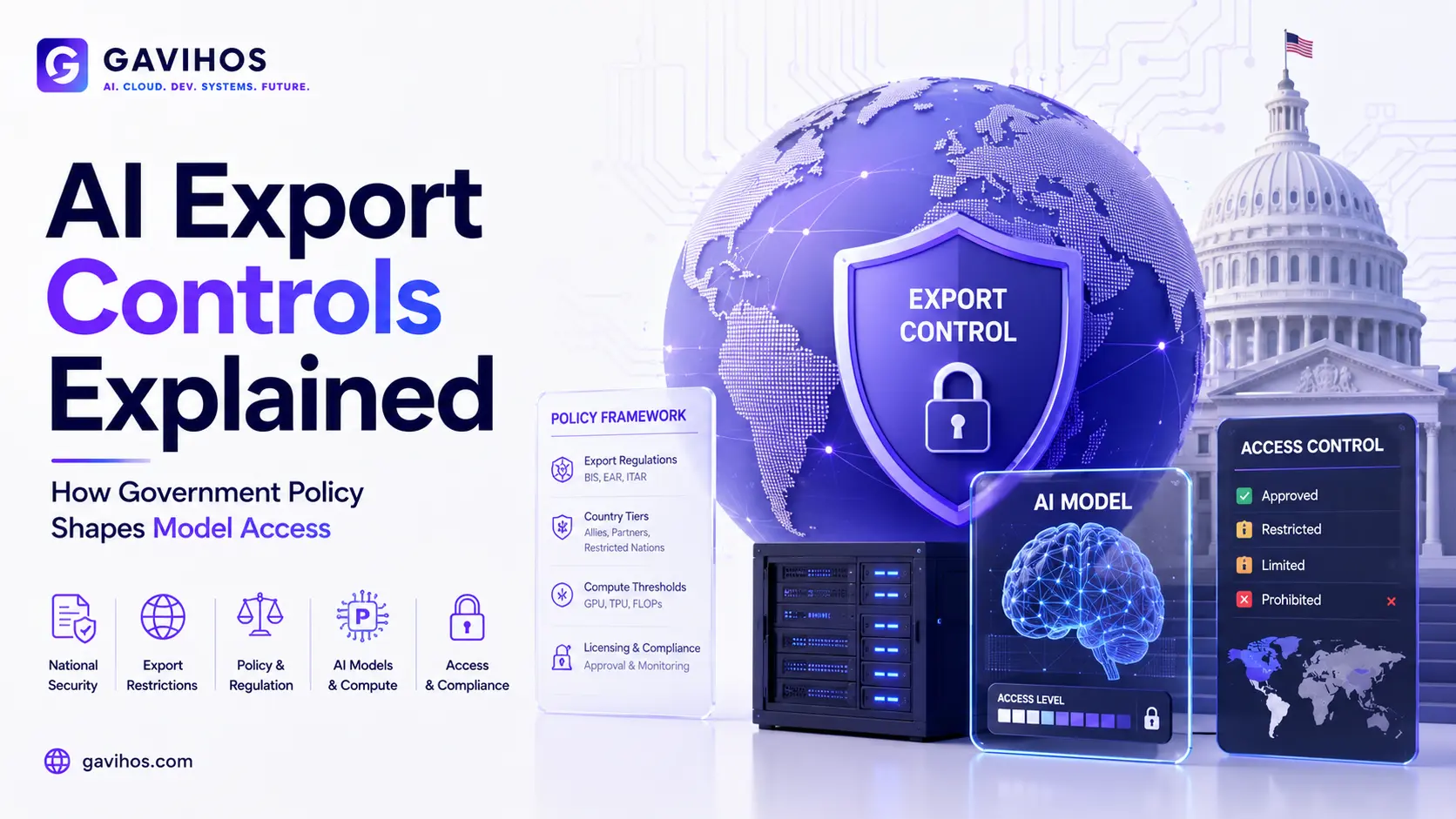
Most discussions of what determines whether you can use a given AI model focus on price, capability, or platform availability. There is a fourth factor that increasingly matters just as much: government policy. In some cases, a model that is technically ready and commercially available can become unavailable — or have its usage capped — because of an export control decision made in Washington, Brussels, or another capital, with no connection to the model’s technical readiness at all.
This became concrete on July 1, 2026, when Anthropic confirmed that US Commerce Department export controls, which had restricted access to its Fable 5 and Mythos 5 models since June 12, 2026, were lifted, allowing Fable 5 to be redeployed globally. That episode is a clean, recent example of a pattern that developers and organizations building on frontier AI need to understand: model access is not purely a technical or commercial decision anymore.
This guide explains what AI export controls are, why governments impose them, how they affect developers and enterprises in practice, and why this is a recurring feature of the AI industry rather than an isolated event.
What Are AI Export Controls?
Export controls are government restrictions on the sale, transfer, or use of specific technologies, historically applied to items like advanced weapons systems, encryption software, and dual-use technologies — items with both civilian and military applications.
Frontier AI models increasingly fall into the dual-use category. A model capable of sophisticated reasoning, code generation, or scientific analysis can be used for entirely benign commercial purposes, but the same capabilities are relevant to national security concerns: cybersecurity offense and defense, biological and chemical research with weapons implications, and general strategic technology competition between nations.
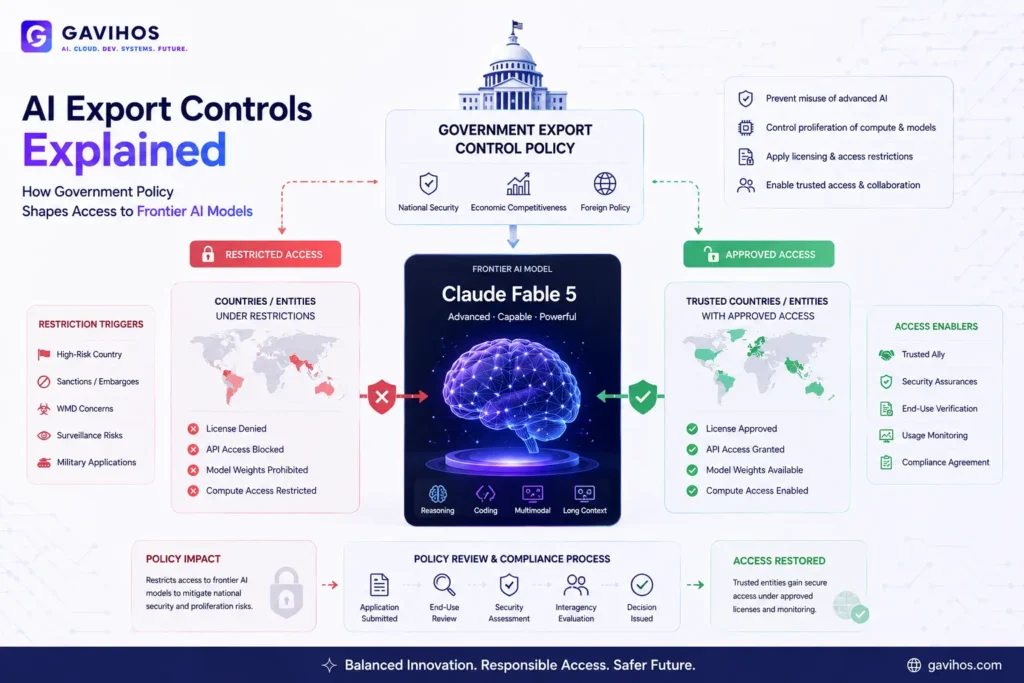
When a government determines that a specific AI model’s capabilities or its usage pattern raises these concerns, it can restrict who is allowed to access that model — by geography, by user classification, or in some cases, universally, until a specific concern is addressed.
The Anthropic Fable 5 case illustrates this directly: restrictions were placed on the model in response to a specific jailbreak/cybersecurity concern, not because of a geopolitical dispute over the technology itself. Once Anthropic addressed the underlying issue — deploying new classifiers reported to block the flagged technique in more than 99% of cases — the Commerce Department lifted the restriction and access was restored.
Why Does It Matter?
Business impact. Organizations building products on top of a specific frontier model face a real operational risk: the model they have built their roadmap around can become unavailable, capped, or degraded with little notice, for reasons entirely outside their control. This is a new category of vendor risk that did not meaningfully exist for most software dependencies a decade ago.
Technology impact. Export control decisions are pushing AI labs to build technical mitigations — like jailbreak-detection classifiers — directly into their deployment infrastructure, not as an afterthought but as a condition of maintaining broad market access. Safety engineering and regulatory compliance are becoming the same discipline in practice.
Industry impact. As more governments treat frontier AI capability as a strategic asset, expect export control decisions to become a more routine, higher-frequency feature of the industry — similar to how semiconductor export controls became a recurring news cycle in the chip industry over the preceding several years.
Why Now?
Export controls on AI models specifically are a recent phenomenon relative to the technology itself, and several factors explain why they are becoming common in 2026 rather than years earlier.
Model capability crossed a threshold that concerns policymakers. Earlier generations of language models were broadly useful but rarely capable enough, on their own, to meaningfully assist with sophisticated cybersecurity offense, complex scientific synthesis in sensitive domains, or other dual-use tasks that draw regulatory attention. As frontier models became substantially more capable at multi-step reasoning and technical synthesis, they started to resemble the kind of dual-use technology that export control regimes were designed for.
Jailbreaking became a demonstrated, not theoretical, risk. The Fable 5 restriction was reportedly triggered by an actual identified jailbreak technique, not a hypothetical concern. As adversarial techniques for bypassing model safety measures have grown more sophisticated, the gap between “a model that refuses harmful requests in normal use” and “a model that can be manipulated into harmful outputs” has become a real, demonstrable regulatory concern rather than a speculative one.
Governments have institutionalized AI as a strategic technology category. AI capability is increasingly treated in policy circles the way semiconductor manufacturing or advanced computing hardware has been for years — as a technology where national competitive position and security concerns both apply. Once that institutional framing exists, applying existing export control mechanisms to AI models becomes a natural extension of policy, not a novel invention.
AI labs now have global infrastructure that regulators can act on. Frontier AI labs are deployed across major cloud platforms and reach a global user base immediately at launch. This scale is exactly what makes export control mechanisms — which act on distribution and access, not just development — practically enforceable and relevant in a way they were not when frontier AI development was more contained.
A few years ago, models were less capable, jailbreak techniques were less sophisticated, and AI had not yet been institutionally categorized as a strategic technology in the way semiconductors have been. All three conditions now hold, which is why AI export controls are becoming a recurring policy tool rather than a one-off event.
How It Works
Step 1 — A concern is identified. This can originate from a security researcher, an AI lab’s own red-teaming, a government agency, or reported misuse. In the Fable 5 case, the trigger was a specific jailbreak/cybersecurity concern identified around June 12, 2026.
Step 2 — A government agency evaluates and acts. In the US, this typically involves the Commerce Department’s Bureau of Industry and Security, which administers export control regulations. The agency can impose restrictions ranging from limiting access to specific countries or entities to broader usage caps or full restrictions, depending on the severity of the concern.
Step 3 — The AI lab responds with technical mitigations. This is where the AI lab’s engineering response matters directly to the regulatory outcome. Anthropic’s response to the Fable 5 restriction included deploying new classifiers designed specifically to detect and block the identified jailbreak technique, reportedly effective in more than 99% of cases.
Step 4 — The restriction is reviewed and potentially lifted. Once the underlying concern is addressed to the regulator’s satisfaction, restrictions can be lifted — though often not immediately or fully. In the Fable 5 case, redeployment began at approximately 50% of normal weekly usage limits, a cautious, phased restoration rather than an immediate full return to prior availability.
Step 5 — Industry coordination often follows. Following the Fable 5 episode, Anthropic disclosed a new cross-industry jailbreak-severity framework developed jointly with Amazon, Microsoft, and Google — suggesting that individual incidents are increasingly driving shared industry standards, not just single-company fixes.
Architecture / Key Concepts
| Concept | What It Means | Why It Matters |
|---|---|---|
| Dual-use technology | A technology with both civilian and military/strategic applications | Frontier AI models increasingly qualify, which is why export control frameworks apply to them |
| Export control agency (e.g. Commerce Dept / BIS) | Government body that evaluates and enforces restrictions | The entity that can restrict, cap, or restore model access |
| Jailbreak technique | A method for bypassing a model’s safety guardrails | A common trigger for restrictions when techniques are identified as high-severity |
| Safety classifier | An automated system that detects and blocks specific harmful request patterns | The primary technical mitigation labs use to address regulatory concerns |
| Phased restoration | Gradually restoring access (e.g., capped usage limits) rather than immediate full restoration | Reflects regulatory caution even after a concern is technically addressed |
| Cross-industry framework | Shared standards developed jointly by multiple AI labs | Signals that individual incidents are increasingly shaping industry-wide practice |
Real World Use Cases
1. Enterprise AI vendor risk assessment. Organizations building critical infrastructure on a specific frontier model need contingency plans for the possibility that model access could be restricted or degraded with limited notice, similar to how organizations already plan for cloud provider outages or pricing changes.
2. AI lab safety and compliance engineering. Teams inside AI labs building classifier systems and jailbreak-detection infrastructure are increasingly doing so with an awareness that these systems are also regulatory compliance mechanisms, not purely internal safety features.
3. Multi-model deployment strategies. Developers who architect applications to support multiple model providers, rather than hard-coding a single frontier model, reduce their exposure to any single vendor’s export-control risk — a practical engineering response to a policy-level risk.
4. Policy and government affairs teams at AI labs. Frontier AI companies increasingly need dedicated teams tracking export control regulation, engaging with agencies like the Commerce Department, and coordinating cross-industry responses — a function that barely existed at AI labs a few years ago.
5. Journalists and analysts covering the AI industry. Understanding export control mechanics is now necessary background for accurately covering major model availability changes, distinguishing a genuine policy event from a routine outage or a marketing-driven access change.
Benefits
A mechanism for addressing genuine security concerns. When a real jailbreak technique or misuse pattern is identified, export controls give governments a tool to compel a timely technical fix, rather than relying solely on a company’s internal incentives to prioritize the issue.
Drives faster safety engineering. The threat of restricted market access is a strong incentive for AI labs to build and deploy safety classifiers quickly, as demonstrated by Anthropic’s response timeline in the Fable 5 case.
Encourages cross-industry coordination. As seen with the jailbreak-severity framework developed alongside Amazon, Microsoft, and Google, a single company’s regulatory episode can catalyze broader industry standards that benefit users of every major AI platform, not just the company directly involved.
Limitations
Restrictions can be blunt instruments. A restriction targeting a specific jailbreak concern can affect all users of a model globally, including the vast majority using it for entirely benign purposes, not just the actors exploiting the identified vulnerability.
Uncertainty is itself a cost. Even after a restriction is lifted, the phased, capped restoration (as with Fable 5’s roughly 50% usage cap) means full service normalization can take additional time, during which affected organizations must manage reduced capacity.
Regulatory processes are not always transparent in real time. Organizations relying on a restricted model often have limited visibility into when or whether restrictions will be lifted, making contingency planning difficult.
Export controls do not eliminate misuse risk entirely. A 99% classifier effectiveness rate, as reported for Fable 5’s new safeguards, still implies a nonzero failure rate — export controls and technical mitigations manage risk, they do not eliminate it.
Engineering Tradeoffs
What improves: Faster deployment of safety classifiers and jailbreak-detection systems, driven by the direct business incentive of avoiding or resolving export restrictions.
What becomes harder: Predictable capacity planning for any application built heavily around a single frontier model, since usage limits and availability can change for reasons outside normal product or infrastructure risk management.
New complexity introduced: AI labs now need policy and government-affairs functions integrated with their engineering and safety teams — a genuinely new organizational requirement that adds coordination overhead.
Operational costs: Organizations with mission-critical dependencies on a specific model may need to build and maintain fallback logic to alternate models or providers, adding engineering cost purely as risk mitigation against a policy-level, not technical, failure mode.
When this approach should not be used as a sole mitigation: Relying entirely on one AI lab’s export-control compliance as your organization’s risk management strategy is insufficient for mission-critical systems. Multi-provider architecture and clear fallback behavior are the more robust response.
Best Practices
Design for multi-model fallback where feasible. Applications with meaningful business dependency on a specific frontier model should have a documented fallback path to an alternative model or provider in case of an export-control event.
Monitor official AI lab announcements, not just aggregated news. As the Fable 5 case shows, press coverage of these events can precede or lag official confirmation. Treat AI lab newsroom pages as the authoritative source before making operational decisions.
Build usage-cap awareness into capacity planning. Phased restorations with usage caps (like Fable 5’s ~50% limit) mean that even a “resolved” restriction can still constrain your application’s throughput for a period afterward.
Track cross-industry safety frameworks as they emerge. Coordinated frameworks, like the jailbreak-severity standard developed by Anthropic, Amazon, Microsoft, and Google, are likely to shape future compliance requirements across multiple providers, not just the company that triggered them.
Common Mistakes
Assuming export controls only affect geopolitically sensitive countries. The Fable 5 case was a global restriction triggered by a specific technical/security concern, not a country-specific geopolitical dispute — a broader and more universally applicable pattern than many assume.
Treating a restriction lift as an immediate full restoration. Phased, capped restoration is common. Assuming full capacity is available immediately after a restriction is lifted can lead to unexpected throttling.
Building single-provider architecture for critical AI-dependent systems. This concentrates export-control risk (along with other vendor risks) in a way that a multi-provider design would mitigate.
Conflating export controls with general model deprecation or pricing changes. These are different risk categories with different causes, timelines, and mitigation strategies, and should be tracked separately in vendor risk assessments.
What Most People Get Wrong
“Export controls on AI are the same as controls on physical hardware like chips.” The underlying legal framework is often similar, but the mechanics differ — model access can be restricted or restored far faster than physical hardware supply chains can be redirected, since it is fundamentally a software distribution and access-control problem.
“A restriction means the model itself is dangerous.” In the Fable 5 case, the restriction was triggered by a specific exploitable jailbreak technique, not a claim that the model’s core capabilities were inherently too dangerous for civilian use. The distinction between “a specific vulnerability was found” and “the technology is fundamentally too risky” matters and is often lost in casual coverage.
“Once lifted, everything returns to normal immediately.” As covered above, phased restoration with usage caps is a common pattern, not an exception.
“This is a one-company problem.” The emergence of a cross-industry jailbreak-severity framework following the Fable 5 episode shows that these events increasingly drive shared standards across multiple major AI labs and cloud providers, not isolated single-vendor fixes.
Future Outlook
Expect AI export control events to become more frequent, not less, as frontier model capability continues to grow and as governments continue building out the regulatory frameworks and enforcement capacity to act on AI specifically, rather than treating it as an edge case of existing technology export rules.
The cross-industry coordination pattern demonstrated by Anthropic, Amazon, Microsoft, and Google’s joint jailbreak-severity framework is likely to become a template other AI labs adopt, both as a genuine safety measure and as a way to demonstrate proactive self-regulation to policymakers — a strategy that can reduce the likelihood or severity of future government-imposed restrictions.
For organizations building on frontier AI, the practical trajectory is clear: vendor risk management for AI dependencies needs to expand beyond the traditional categories (pricing, reliability, deprecation) to explicitly include export-control and regulatory risk, with concrete fallback plans rather than an assumption that this category of disruption will not happen to a system they depend on.
FAQ
1. What are AI export controls? AI export controls are government restrictions on the distribution, sale, or use of specific AI models or capabilities, typically applied when a model’s capabilities raise dual-use concerns relevant to national security.
2. What happened with Claude Fable 5 and export controls? US Commerce Department export controls restricted access to Anthropic’s Fable 5 and Mythos 5 models starting June 12, 2026, following a jailbreak/cybersecurity concern. The restrictions were lifted, and Fable 5 was redeployed globally on July 1, 2026, initially at reduced usage capacity.
3. Why do governments impose export controls on AI models? Governments impose these controls when a model’s capabilities are assessed as having significant dual-use potential — useful for both legitimate civilian purposes and activities that raise security concerns, such as sophisticated cybersecurity offense or hazardous research assistance.
4. Does an export control restriction mean a model is unsafe? Not necessarily in a blanket sense. It typically means a specific vulnerability, exploitation technique, or misuse pattern was identified that needed to be addressed, rather than a determination that the model’s overall capability is unsafe for its intended use.
5. How do AI labs respond to export control restrictions? Typically by deploying technical mitigations — such as safety classifiers designed to detect and block the specific concerning behavior — and working with the relevant government agency to demonstrate the concern has been addressed.
6. What is a phased restoration of AI model access? It means access is restored gradually rather than immediately in full — for example, capped at a percentage of normal usage limits for a period — reflecting continued regulatory caution even after a restriction is lifted.
7. Are AI export controls specific to the United States? No, though the US Commerce Department is a prominent example. Other governments and regions have their own export control frameworks that can apply to AI technology, and this is an evolving area of policy globally.
8. What is a cross-industry jailbreak-severity framework? It is a shared standard, developed jointly by multiple AI companies, for classifying and responding to the severity of jailbreak techniques or vulnerabilities — an example is the framework Anthropic developed with Amazon, Microsoft, and Google following the Fable 5 episode.
9. How can organizations protect themselves from AI export-control risk? By designing applications with multi-model or multi-provider fallback options, monitoring official AI lab announcements directly, and incorporating export-control risk into standard vendor risk assessments for AI dependencies.
10. Will AI export controls become more common? Most available evidence suggests yes — as frontier AI capability continues to advance and governments build out AI-specific regulatory frameworks, export control actions are likely to become a more routine, higher-frequency feature of the industry.
Analyst Perspective
The most important thing about the Fable 5 export-control episode is not the restriction itself but the speed and completeness of the resolution. A restriction imposed on June 12 was lifted with a public, detailed technical explanation by July 1 — roughly three weeks. That timeline suggests something notable: AI labs are now capable of responding to specific, identified security concerns fast enough that export control restrictions can function as intended — a genuine safety mechanism with a defined resolution path — rather than becoming indefinite, ambiguous restrictions that outlast their original justification.
The cross-industry jailbreak-severity framework is the detail most initial coverage is likely to underweight. Individual AI labs building their own safety classifiers is expected and has been happening for years. Four major AI and cloud companies — direct competitors in most other respects — coordinating on a shared severity framework is a different and more significant development. It suggests that at least some categories of AI safety risk are now understood industry-wide as collective action problems, where one company’s vulnerability disclosure and fix benefits from being standardized across the industry rather than solved in isolation.
The second-order effect worth watching: as this pattern repeats — and it likely will — expect export control episodes to become a recurring input into how frontier AI models are engineered from the start, not just how they are patched after an incident. Classifier robustness, jailbreak resistance, and explainability for regulators may become design requirements considered at the same stage as capability and cost, rather than compliance work bolted on after a public incident forces the issue.
For developers and organizations building on frontier AI, the practical lesson is not to avoid dependency on capable models — that is often not a realistic option — but to build the same kind of resilience into AI vendor relationships that mature organizations already build into cloud and infrastructure vendor relationships: monitoring, fallback plans, and an assumption that disruption, even for reasons entirely outside your control, is a “when,” not an “if.”
Key Takeaways
- AI export controls are government restrictions on model access, applied when a model’s capabilities raise dual-use national security concerns
- The Anthropic Fable 5 case (restricted June 12, restored July 1, 2026) shows the full cycle: a specific jailbreak concern, a government restriction, a technical fix, and a phased restoration
- Restoration is often capped or phased rather than immediate and complete — plan capacity accordingly
- A notable outcome of the Fable 5 episode was a new cross-industry jailbreak-severity framework developed with Amazon, Microsoft, and Google — a sign that some AI safety risks are being treated as shared, industry-wide problems
- Organizations with critical dependencies on a single frontier model should build multi-provider fallback plans, since export-control risk is a distinct vendor risk category from pricing, reliability, or deprecation
- Expect AI export control events to become more common, not less, as frontier model capability and government AI-specific regulation both continue to grow
Continue Learning
- What is Claude Fable 5? Complete Guide to Anthropic’s Latest AI Model
- What Is AI for Science? Complete Guide to AI Research Workbenches
- What Are AI Agents? Architecture, Memory, Tools and Real-World Use Cases
- What is Agentic AI? How Autonomous AI Systems Think and Act
About GAVIHOS
GAVIHOS helps developers, founders and technology enthusiasts understand AI, software engineering and emerging technologies through practical guides, tutorials and industry analysis.
Stay Updated
Follow GAVIHOS for practical AI, technology and developer-focused insights.
External Links
| Source | URL |
|---|---|
| Anthropic — Redeploying Claude Fable 5 | https://www.anthropic.com/news/redeploying-fable-5 |