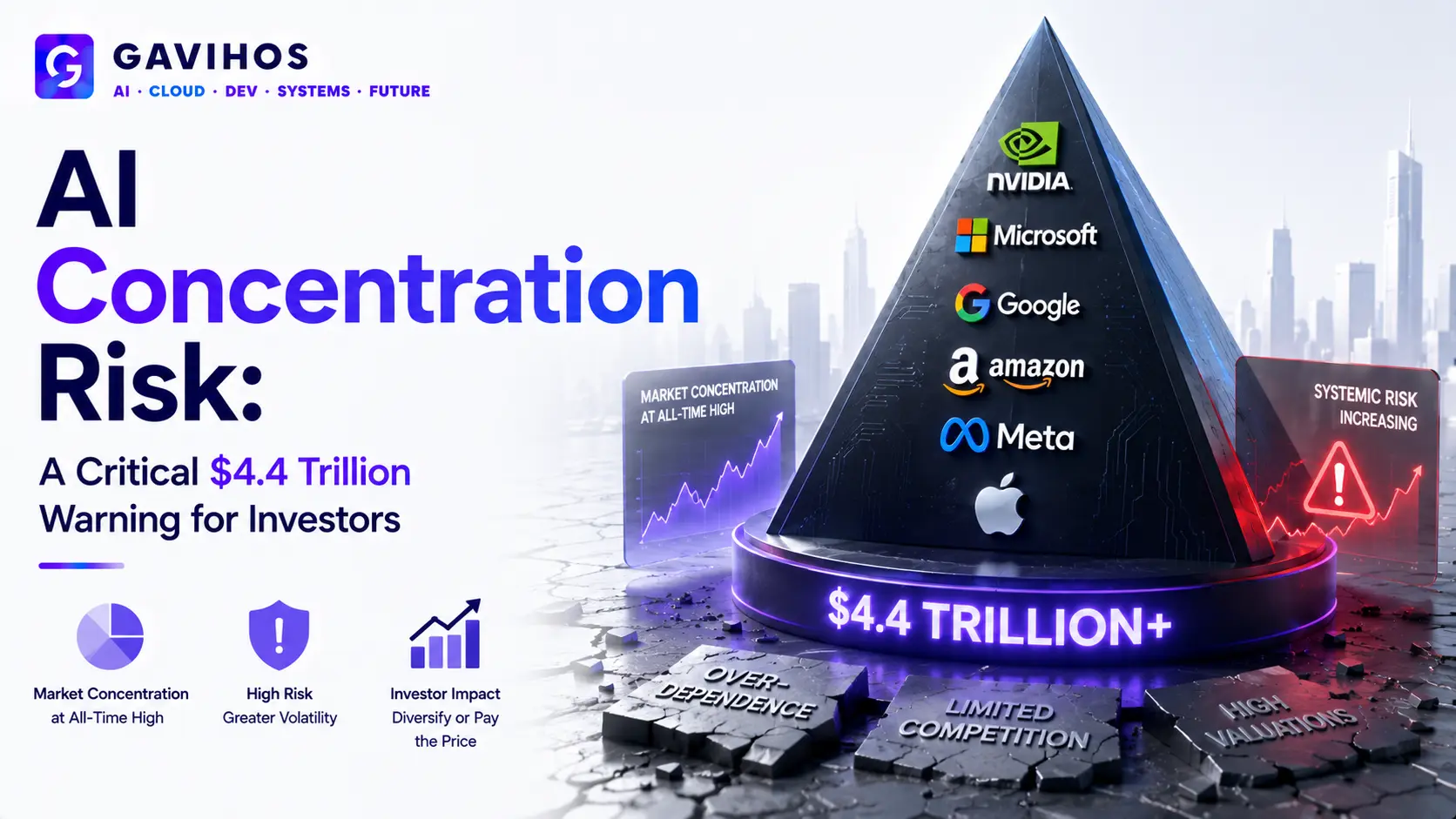
Three companies now make up such a large share of some emerging-market stock indexes that fund managers are starting to treat it as a problem in its own right — separate from whether those three companies are actually good investments. On July 12, 2026, Bloomberg reported that professional investors are actively rotating money away from this concentrated bet, worth an estimated $4.4 trillion combined, and into gaming, energy, and other less AI-dependent sectors.
This isn’t a story about whether AI companies are overvalued. It’s a narrower, more mechanical story about AI concentration risk — the danger that comes from too much of an index, a portfolio, or an economy’s value sitting in too few, too-similar bets, regardless of how good any individual bet actually is. Understanding that distinction is useful for developers and founders too, not just fund managers, because it explains a pattern showing up everywhere from stock indexes to hiring decisions to cloud infrastructure spending: a small number of AI-linked companies now carry an outsized share of the weight, and everyone downstream of that concentration inherits some of its risk.
This article explains what Bloomberg reported, why concentration risk is a distinct concern from valuation risk, and what it signals about where capital is heading next.
What Happened
According to Bloomberg’s July 12, 2026 report, fund managers investing in emerging markets have grown increasingly uneasy about how much of their index exposure is concentrated in a small handful of AI-linked mega-cap companies — a grouping the report refers to as an “AI trio” collectively worth approximately $4.4 trillion. Rather than continuing to ride that concentration, some funds are actively rotating capital toward other sectors, including gaming and energy, that carry less direct AI-cycle exposure.
The reporting frames this as a portfolio-construction response, not a bearish call on AI itself. Fund managers aren’t necessarily arguing that AI-linked companies will underperform — they’re responding to the structural risk of having too much of their overall exposure move together, driven by the same narrow set of catalysts (AI infrastructure spending, AI model releases, AI-linked earnings). If sentiment toward that one theme turns, a portfolio overweight in it has nowhere to hide within its own allocation.
This rotation is happening against the backdrop of a broader AI-driven capital cycle already visible elsewhere in the market this year — including record fusion-energy funding aimed at solving AI’s power constraints (see our coverage of Proxima Fusion’s €411M round backed by Google) and continued heavy cloud infrastructure investment tied directly to AI demand (see DigitalOcean’s Q2 2026 AI infrastructure results). The Bloomberg report is best read as one visible symptom of that same underlying dynamic: enormous, concentrated capital flows chasing a single technological theme.
Why It Matters
Concentration risk is a distinct category from valuation risk, and it’s often overlooked. A stock or sector can be reasonably priced and still represent excessive risk if it makes up too large a share of a portfolio or index — because a shock to that one theme (a regulatory change, a technical setback, a shift in AI capital-spending plans) then affects a much larger share of total exposure than a diversified allocation would. Bloomberg’s reporting is fundamentally about this structural risk, not a judgment on whether the underlying companies are good businesses.
Emerging-market indexes are particularly exposed to this dynamic. Unlike broader developed-market indexes with hundreds of large constituents, some emerging-market indexes derive an outsized share of their total value from a small number of mega-cap technology names — which means a rotation away from AI-linked names has a proportionally larger effect on those indexes than on a more diversified benchmark.
This is a leading indicator worth watching, not just a historical data point. Institutional capital rotation decisions like this one tend to happen before, not after, a broader narrative shift becomes obvious in public commentary — professional fund managers are often responding to portfolio-construction math well before retail sentiment catches up.
Industry Impact
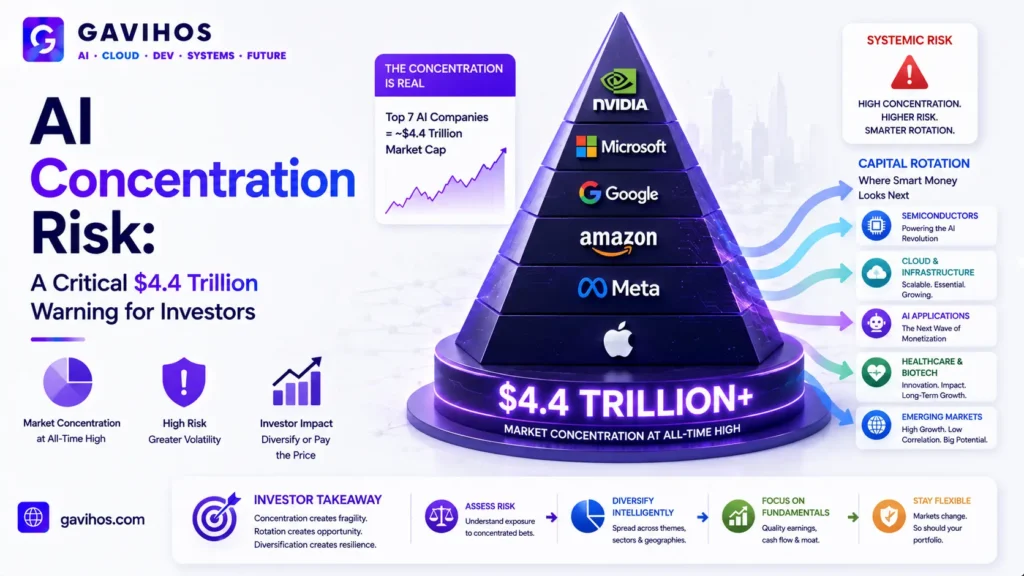
AI concentration risk isn’t limited to stock portfolios — it’s showing up across the AI capital stack. The same dynamic playing out in emerging-market indexes echoes a broader pattern this year: enormous amounts of capital converging on a narrow set of AI-linked bets, whether that’s mega-cap equities, cloud infrastructure buildouts, or now even fusion-energy funding aimed at powering AI data centers. A shock to the AI narrative doesn’t just move stock prices — it ripples through every part of that stack simultaneously, because so much of it is now correlated to the same underlying theme.
Fund managers rotating toward gaming and energy signals a search for genuine diversification, not a rejection of AI. Gaming and energy are notable choices specifically because they have real, but more indirect, exposure to the AI cycle — energy companies benefit from AI’s power demand without carrying pure-play AI valuation risk, and gaming has historically moved on a different cycle than enterprise AI infrastructure spending.
This adds a new lens to how AI-adjacent industry news should be read. Stories about AI infrastructure buildouts, mega-deals, and capital raises — including large moves like SpaceX’s $60 billion acquisition of Cursor — increasingly need to be understood not just as individual company news, but as additional weight being added to an already concentrated bet that professional capital is actively trying to diversify away from.
Developer Impact
Understand that “the AI industry” isn’t one uniform, evenly distributed thing financially, even though it can feel that way from inside engineering teams. A small number of companies account for a disproportionate share of AI-linked market value, funding, and infrastructure spend — which means the health of “AI” as an investment theme is more fragile and more concentrated than the breadth of daily AI product launches might suggest.
Job security and hiring patterns at AI-adjacent companies are indirectly tied to this concentration. When restructuring decisions at large technology companies get framed around “the AI era” — as covered in our reporting on Microsoft’s Xbox layoffs and AI-era restructuring — that framing exists within the same broader capital environment where investors are actively questioning how much value should really be concentrated in AI-linked bets.
This is a useful reminder to separate “AI is genuinely useful” from “the current AI investment concentration is healthy.” Both can be true or false independently — a technology can be genuinely transformative for developers and products while the market’s current way of pricing and concentrating capital around it is still a real structural risk worth understanding.
Business Impact
Founders raising capital in AI-adjacent categories should expect more scrutiny on differentiation, not less. As professional investors grow more conscious of AI concentration risk, capital is likely to reward companies that can articulate a distinct, defensible position rather than simply riding the broader AI narrative — a partial explanation for why capital is also flowing into adjacent infrastructure bets like fusion energy rather than only AI software and model companies directly.
Companies whose valuations are closely tied to the “AI trio” narrative face a genuine correlated-risk exposure. If institutional rotation away from AI concentration continues or accelerates, companies whose fortunes are closely linked to those same few mega-cap names — through partnerships, supply relationships, or comparable-valuation framing — could see indirect effects even if their own fundamentals haven’t changed.
This reinforces a broader theme in 2026’s AI capital cycle: money is starting to flow toward the physical and adjacent infrastructure enabling AI, not just AI software itself. Fusion energy funding, cloud infrastructure buildouts, and now a rotation toward energy and gaming as diversification plays are all consistent with capital looking for AI-adjacent, but not AI-concentrated, exposure.
Future Outlook
Expect continued institutional attention to AI concentration risk as a distinct portfolio-management concern, separate from ongoing debates about whether individual AI companies are overvalued — these are different questions, and the concentration question doesn’t go away even if valuations turn out to be justified.
Expect more capital to flow toward AI-adjacent but non-concentrated bets — energy, infrastructure, and sectors with indirect rather than direct AI exposure — as a hedging strategy against the risk Bloomberg’s report describes.
Expect this dynamic to keep intersecting with the broader AI capital cycle covered elsewhere on GAVIHOS — infrastructure buildouts, mega-acquisitions, and energy investments aimed at powering AI — as fund managers, founders, and infrastructure providers all respond to the same underlying concentration in different ways.
FAQ
1. What is AI concentration risk? AI concentration risk is the danger that too much of a portfolio’s, index’s, or economy’s value is tied to a small number of AI-linked companies or bets, making that exposure vulnerable to a shock affecting the shared underlying theme — separate from whether those individual companies are fairly valued.
2. What did Bloomberg’s July 2026 report actually say? Bloomberg reported that fund managers investing in emerging markets are rotating capital away from a concentrated bet in a small group of AI-linked mega-cap companies — collectively worth an estimated $4.4 trillion — toward gaming, energy, and other less AI-dependent sectors.
3. Is this a signal that AI companies are overvalued? Not necessarily. The reporting frames this as a concentration-risk response — a portfolio-construction concern about too much exposure moving together — rather than a specific claim that the underlying AI companies are mispriced.
4. Why are emerging-market indexes especially affected by AI concentration? Some emerging-market indexes derive an outsized share of their total value from a small number of large technology constituents, so a rotation away from AI-linked names has a proportionally larger effect than it would on a more diversified, broader index.
5. Why are investors rotating toward gaming and energy specifically? Both sectors have real but more indirect exposure to the AI cycle — energy benefits from AI’s growing power demand without carrying pure-play AI valuation risk, and gaming has historically moved on a different cycle than enterprise AI infrastructure spending — making them useful diversification choices.
6. How is AI concentration risk different from a stock being overvalued? Valuation risk is about whether a specific price is justified by expected future performance. Concentration risk is about how much of a total portfolio or index depends on a small number of correlated bets, regardless of whether each individual bet is fairly priced.
7. Does this affect AI companies outside the specific “AI trio” mentioned? Indirectly. Broader institutional caution about AI concentration can affect capital availability and investor sentiment across AI-adjacent companies more generally, even those not part of the specific group Bloomberg’s report describes.
8. Is this the first time this kind of concentration concern has been raised? No — concerns about a small number of mega-cap technology names dominating index performance have been raised in developed-market contexts before. What’s notable here is the specific focus on emerging markets and the scale of capital already responding to it.
9. What should founders take away from this? Expect continued investor scrutiny of how closely a company’s story is tied to the broader AI mega-cap narrative, and expect capital to increasingly reward genuine differentiation and AI-adjacent-but-diversified positioning over a pure “riding the AI wave” pitch.
10. What should developers and technologists take away from this? That the financial health of “AI” as a market theme is more concentrated and more fragile than the pace of daily AI product announcements might suggest — a useful check against assuming market enthusiasm and technological progress are the same thing.
Analyst Perspective
The most important thing to understand about this story is that it’s fundamentally about portfolio math, not AI hype or skepticism. Professional fund managers aren’t saying the “AI trio” is a bad bet — they’re saying it’s too much of the same bet, concentrated in a way that leaves an entire portfolio exposed to a single shared shock. That’s a structurally different concern than the more familiar “is AI overvalued” debate, and it’s one that gets far less mainstream attention despite being, in some ways, more actionable for how capital actually gets allocated.
The hidden implication worth watching is how this concentration concern is already reshaping capital flows across the entire AI-adjacent stack, not just public equities — the same logic that’s pushing fund managers toward gaming and energy is visible in why enormous checks are being written for fusion energy research aimed at AI’s power constraints, and why infrastructure providers continue reporting AI-driven capital expenditure growth. All of it is capital searching for AI-adjacent exposure without AI concentration.
For developers and founders, the second-order effect to watch is what happens to funding and job security at companies whose story is tightly coupled to the AI mega-cap narrative if this rotation accelerates. It doesn’t require AI itself to stop being useful or important — it only requires professional capital to keep preferring diversified, AI-adjacent bets over concentrated, AI-direct ones, which is precisely what this report describes already happening.
Key Takeaways
- Bloomberg reported on July 12, 2026 that fund managers are rotating capital away from a concentrated ~$4.4 trillion bet in a small group of AI-linked mega-cap companies, toward gaming, energy, and other sectors.
- This is a story about AI concentration risk — too much exposure moving together — which is a distinct concern from whether the underlying companies are fairly valued.
- Emerging-market indexes are especially sensitive to this dynamic because a small number of large constituents can represent an outsized share of total index value.
- The rotation toward gaming and energy reflects a search for AI-adjacent but diversified exposure, consistent with broader 2026 capital flows into AI infrastructure and energy investments.
- Founders and developers should separate “AI is genuinely useful” from “the current concentration of AI capital is healthy” — both can be independently true or false.
- Expect continued institutional attention to concentration risk as a distinct, ongoing portfolio-management concern rather than a one-time news event.
Continue Learning
- Proxima Fusion Raises €411M ($469M) in Largest European Fusion Funding Round, Backed by Google
- DigitalOcean Q2 2026 AI Infrastructure Results
- Microsoft Xbox Layoffs: 4,800 Job Cuts and a Costly Reset
- SpaceX Acquires Cursor for $60 Billion: What It Means for AI Coding Tools and Developers
- What Is Data Center Capacity Planning? How Cloud Providers Scale Infrastructure for AI Demand
About GAVIHOS
GAVIHOS helps developers, founders and technology enthusiasts understand AI, software engineering and emerging technologies through practical guides, tutorials and industry analysis.
Stay Updated
Follow GAVIHOS for practical AI, technology and developer-focused insights.
External Links
| Source | URL |
|---|---|
| Bloomberg — Funds Fret Over $4.4 Trillion AI Trio’s Grip on Emerging Markets | https://www.bloomberg.com/news/articles/2026-07-12/funds-fret-over-4-4-trillion-ai-trio-s-grip-on-emerging-markets |
| TechCrunch Mobility — related capital markets roundup | https://techcrunch.com/2026/07/12/techcrunch-mobility-a-robotaxi-ultimatum/ |