Picture a cloud provider signing a customer contract worth hundreds of millions of dollars for AI compute — and then realizing there’s nowhere to physically plug in the servers that contract requires. That’s not a hypothetical. It’s the exact bottleneck cloud providers are racing to solve right now, and it has a name: data center capacity planning.
Data center capacity planning is the process of forecasting how much computing power, electricity, cooling, and physical space a cloud provider will need months or years in advance, and then securing it before customers actually ask for it. Get it wrong in one direction, and a company sits on empty, expensive data centers. Get it wrong in the other direction, and it turns away paying customers because there’s simply no room left to run their workloads.
This guide explains what data center capacity planning actually involves, why it has become one of the most consequential decisions in the cloud industry, and why AI workloads specifically have made this harder than it’s ever been.
What Is Data Center Capacity Planning?
Data center capacity planning is the practice of estimating future compute, power, cooling, and space requirements for a data center, then acquiring or building that capacity ahead of demand. It covers everything from how many server racks a facility can physically hold, to how much electricity (measured in megawatts) the facility can draw, to how efficiently that electricity gets converted into usable computing power.
The discipline isn’t new — cloud providers have always had to plan ahead for growth. What’s changed is the unit of measurement. A traditional web-hosting data center might plan capacity in terms of CPU cores and storage. An AI-era data center plans capacity in terms of GPU racks, power density per rack, and cooling capacity, because AI workloads draw dramatically more electricity per square foot than the workloads that came before them.
Why Does It Matter?
Capacity planning determines whether a cloud provider can actually deliver on the contracts it signs. A cloud company can win a nine-figure customer deal, but if it hasn’t secured the underlying data center capacity, power, and hardware to fulfill that deal, the contract becomes a liability instead of revenue. This is exactly the dynamic behind DigitalOcean’s July 2026 investor disclosure, in which the company reported accelerating revenue growth and a sharp rise in contracted future revenue, tied directly to securing additional data center capacity for AI inference workloads.
For the business side, capacity planning is the difference between a growth story and a credibility problem: providers that can’t scale physical infrastructure fast enough to match demand risk losing customers to competitors who can. For the technology side, it shapes decisions about chip procurement, power contracts, and even where new facilities get built, since capacity is only useful where there’s enough electricity to run it.
Why Now?
For most of the cloud computing era, capacity planning was a relatively predictable exercise — traffic grew steadily, and providers added servers accordingly. AI workloads broke that pattern. Training and running large AI models requires GPUs that draw far more power per rack than traditional servers, and demand for that capacity can spike suddenly when a customer signs a large inference contract or a new AI product goes viral.
This is why data center capacity has become a headline financial metric, not just an engineering detail. DigitalOcean’s July 2026 disclosure specifically called out securing an additional 20 megawatts of AI-driven data center capacity as a driver of its accelerating growth, alongside a sharp jump in Remaining Performance Obligation — the value of contracts already signed but not yet delivered. When a provider highlights megawatts and RPO in the same breath, it’s telling investors that revenue growth is now gated by physical infrastructure capacity, not just sales.
How It Works
- Forecast demand. Providers estimate future compute needs based on sales pipelines, signed contracts, and industry-wide AI adoption trends — often planning 12 to 24 months ahead, since building capacity takes far longer than signing a customer contract.
- Secure power. Before racks can be filled, a facility needs a confirmed electricity supply — this is frequently the actual bottleneck, since utility connections and power contracts can take longer to arrange than the building itself.
- Build or lease space. Providers either build new data centers or lease space and power from colocation providers, choosing based on speed to market versus long-term cost control.
- Install and configure hardware. GPUs, networking equipment, and cooling systems are installed, tested, and brought online in stages rather than all at once.
- Monitor and reforecast continuously. Actual usage is compared against forecasts, and plans are adjusted as new contracts are signed or demand shifts.
Architecture / Components
| Component | Role | Why It Matters for AI Workloads |
|---|---|---|
| Power capacity (measured in megawatts) | Total electricity a facility can draw | AI GPU racks draw far more power per unit than traditional servers, making power the primary constraint |
| PUE (Power Usage Effectiveness) | Ratio of total facility power to power actually used by computing equipment | Lower PUE means more of the electricity paid for goes to useful computing rather than cooling and overhead |
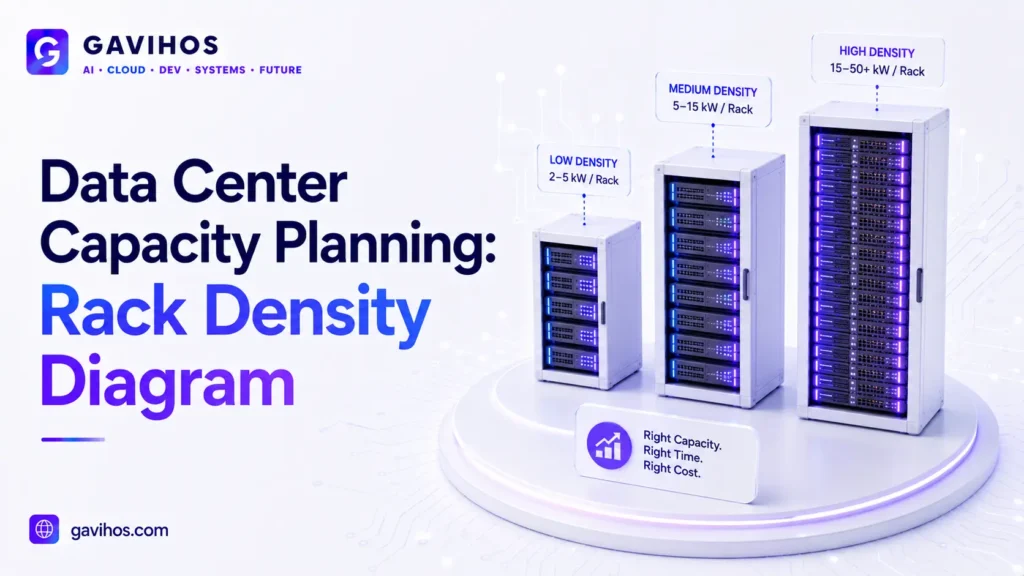
| Rack density | How much compute (and heat) is packed into each server rack | High-density AI racks require advanced cooling that older facilities often can’t support |
| Remaining Performance Obligation (RPO) | Value of signed contracts not yet delivered | A sharp RPO increase signals demand is outrunning currently available capacity |
| Colocation vs. hyperscale build-out | Leasing existing facility space vs. building new dedicated ones | Colocation is faster to activate; owned build-out offers more long-term control and cost efficiency |
Real World Use Cases
- Cloud AI inference providers. Companies like DigitalOcean secure additional megawatts of capacity specifically to run AI inference workloads for enterprise customers, directly tying infrastructure investment to revenue growth.
- Hyperscale cloud platforms. Large providers plan capacity years in advance across multiple regions to support both general cloud computing and dedicated AI training clusters.
- Enterprise customers signing long-term contracts. Businesses negotiating multi-year AI compute commitments need assurance that a provider’s capacity planning can actually deliver the promised resources on schedule.
- Colocation data center operators. Companies that lease data center space and power to cloud providers plan capacity around anticipated demand from multiple tenants at once.
- Chip and hardware vendors. GPU manufacturers use cloud providers’ capacity plans as a leading indicator of future hardware demand, shaping their own production planning.
Benefits
- Accurate capacity planning lets providers commit to large customer contracts with confidence that they can actually be fulfilled.
- Forecasting power and space needs ahead of time avoids the far higher cost of emergency infrastructure expansion.
- Well-planned capacity supports predictable revenue recognition, since contracted (but undelivered) revenue like RPO reflects real, plannable future capacity.
- Efficient capacity planning (via metrics like PUE) reduces wasted electricity and operating costs.
Limitations
- Capacity planning cycles (12–24+ months) are far slower than how quickly AI demand can shift, creating a persistent risk of under- or over-building.
- Power availability is often outside a provider’s direct control, dependent on utility infrastructure and local regulatory approval timelines.
- Over-forecasting demand ties up massive capital in unused capacity; under-forecasting turns away revenue and damages customer trust.
- Capacity decisions made today are locked in for years, making them difficult and expensive to reverse if AI demand patterns shift.
Engineering Tradeoffs
Building ahead of demand improves a provider’s ability to win and fulfill large contracts, but it introduces real financial risk: capacity that goes unused for months or years while waiting for demand to catch up. Leasing colocation space instead of building owned facilities speeds up time-to-market but increases long-term operating costs and reduces control over power and cooling upgrades.
This approach should not be used uniformly across every workload. Smaller, less capital-intensive providers may be better served by leasing capacity incrementally rather than committing to large owned build-outs, accepting slightly higher per-unit costs in exchange for lower financial risk.
Best Practices
- Tie capacity forecasts directly to signed contracts and pipeline data, not just historical growth trends.
- Secure power commitments early in the planning cycle, since power is frequently the longest lead-time item.
- Monitor Remaining Performance Obligation and similar forward-looking metrics as an early warning signal for capacity strain.
- Diversify between owned and leased capacity to balance cost efficiency against flexibility.
Common Mistakes
- Treating data center capacity planning as a pure hardware problem while underestimating power and cooling lead times.
- Signing large customer contracts before confirming the underlying capacity to deliver on them.
- Failing to account for the higher power density of AI workloads when planning based on historical, non-AI usage patterns.
- Ignoring regional power grid constraints when choosing where to build new capacity.
What Most People Get Wrong
A common misconception is that data centers can simply be built quickly wherever compute is needed. In reality, power availability — not construction — is often the true bottleneck, and securing new electricity supply can take longer than building the physical facility itself. Another myth is that adding more servers always solves capacity problems; without matching power and cooling capacity, additional hardware can’t actually be used. Finally, many assume capacity planning is a back-office engineering concern — as DigitalOcean’s July 2026 disclosure shows, it’s increasingly a headline financial metric that directly explains a company’s revenue growth or constraints.
Future Outlook
Expect data center capacity, and specifically power availability, to remain one of the defining constraints on AI industry growth for the next several years. Cloud providers are likely to keep disclosing capacity metrics like megawatts secured and Remaining Performance Obligation alongside traditional financial results, treating infrastructure capacity as a competitive differentiator investors watch closely. Longer term, next-generation power sources — including nuclear and fusion investments already being made by major tech companies — may ease the power constraint, but that relief is measured in years, not quarters, keeping near-term capacity planning a critical skill for the industry.
FAQ
1. What is data center capacity planning? It’s the process of forecasting future compute, power, cooling, and space needs for a data center and securing that capacity ahead of actual demand.
2. Why is data center capacity planning harder for AI workloads? AI workloads, especially those using GPUs, draw significantly more power per rack than traditional computing workloads, making power and cooling capacity much harder constraints to plan around.
3. What is PUE in data center capacity planning? PUE, or Power Usage Effectiveness, measures how much of a facility’s total electricity actually powers computing equipment versus overhead like cooling — a lower PUE means more efficient use of power.
4. Why does data center capacity affect a cloud company’s revenue? If a provider can’t secure enough capacity to deliver on signed contracts, that revenue can’t be realized — capacity availability directly gates how much contracted business can actually be fulfilled.
5. What is Remaining Performance Obligation (RPO)? RPO is the total value of a company’s signed contracts that haven’t yet been delivered or recognized as revenue — a rising RPO often signals strong demand outpacing current delivery capacity.
6. How far in advance do cloud providers plan data center capacity? Typically 12 to 24 months or more, since building or leasing new capacity, securing power, and installing hardware all take significant lead time.
7. What’s the difference between colocation and hyperscale build-out? Colocation means leasing space and power in an existing facility owned by another company; hyperscale build-out means a provider builds and owns its own dedicated facility, trading speed for long-term control.
8. Why is power availability often the biggest bottleneck? Utility power connections and long-term power contracts can take longer to arrange than constructing the physical data center building itself, especially for high-density AI facilities.
9. Can over-building data center capacity hurt a company? Yes. Capacity that sits unused ties up significant capital and can hurt margins if demand doesn’t materialize as forecasted.
10. How does data center capacity planning connect to AI’s energy demand? Rising AI compute demand is a direct driver of rising electricity demand, which is why some major tech companies are now investing directly in future energy sources, including fusion research, to secure long-term power supply.
Analyst Perspective
The most important takeaway is that data center capacity has quietly become a financial metric as important as revenue or margin for cloud companies competing in AI infrastructure — when a provider discloses megawatts secured in the same breath as its earnings, that’s a signal the market should read as an infrastructure company reporting alongside a growth company. The hidden implication is that a cloud provider’s ability to grow is now bounded less by its sales team’s success and more by how far in advance its infrastructure team planned.
A second-order effect worth watching: as capacity becomes a competitive bottleneck, expect providers to increasingly disclose infrastructure metrics (power secured, RPO growth) as proof points to investors and customers alike, essentially turning capacity planning into a marketing and trust signal, not just an internal operations function. Developers building on top of these platforms should watch for capacity-driven pricing or availability changes; businesses signing long-term AI compute contracts should ask providers directly about secured (not just planned) capacity before committing.
Key Takeaways
- Data center capacity planning is the process of forecasting and securing future compute, power, cooling, and space needs ahead of actual demand.
- AI workloads have made this dramatically harder because GPU-heavy infrastructure draws far more power per rack than traditional computing.
- Power availability, not just physical construction, is frequently the real bottleneck in expanding capacity.
- Metrics like megawatts secured and Remaining Performance Obligation are becoming standard disclosures tying infrastructure capacity directly to revenue growth.
- Providers must balance the risk of under-building (turning away revenue) against over-building (wasting capital) in a market where demand can shift faster than infrastructure can be built.
Continue Learning
- Proxima Fusion Raises €411M ($469M) in Largest European Fusion Funding Round, Backed by Google
- What Is Kubernetes, Explained? A Complete 2026 Guide to Container Orchestration
- What Is a Virtual Appliance? The Complete Guide with 5 Use Cases
- OLTP vs OLAP: The Practical Guide to Database Architecture
- What Is a Data Catalog? Complete Guide to Metadata Management and Data Lineage
About GAVIHOS
GAVIHOS helps developers, founders and technology enthusiasts understand AI, software engineering and emerging technologies through practical guides, tutorials and industry analysis.
Stay Updated
Follow GAVIHOS for practical AI, technology and developer-focused insights.
External Links
| Source | URL |
|---|---|
| DigitalOcean Investor Relations | https://investors.digitalocean.com/ |
| Uptime Institute | https://uptimeinstitute.com/ |
| BusinessWire | https://www.businesswire.com/ |