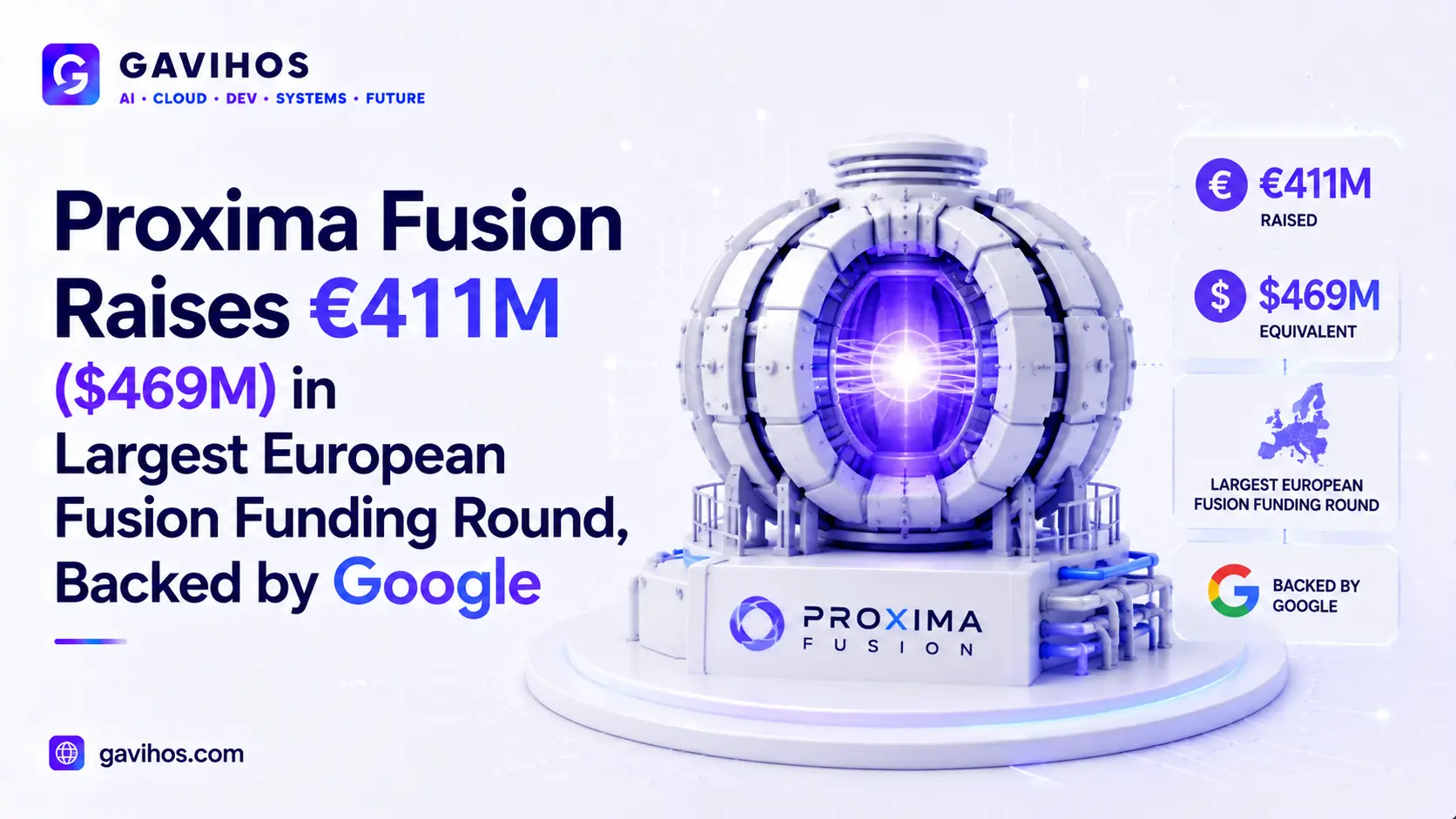
A German fusion energy startup just raised more money in one round than almost any climate-tech company in Europe ever has. On July 7, 2026, Munich-based Proxima Fusion announced it had closed €411 million ($469 million) in new funding, backed in part by Google — a company far better known for search engines and cloud computing than nuclear physics.
The round matters for a reason that goes beyond fusion energy itself. Google’s involvement is a visible sign of something bigger happening across the tech industry right now: the companies building AI are running out of electricity to power it, and they’re starting to write checks to the people trying to solve that problem at its source.
This article explains what happened, why a search and AI company is investing in fusion research, and what it signals about where the AI industry’s next big constraint — energy — is heading.
What Is Proxima Fusion?
Proxima Fusion is a Munich-based fusion energy startup working on stellarator-based fusion reactor designs, aiming to bring commercially viable fusion power to the grid. Fusion energy works by fusing light atomic nuclei together — the same reaction that powers the sun — to release enormous amounts of energy without the long-lived radioactive waste associated with today’s nuclear fission plants. Unlike fission, commercial fusion power has never been achieved at scale; it remains one of the hardest unsolved engineering problems in energy.
Proxima Fusion’s €411M ($469M) round, reported at a €2.4 billion valuation, is described by Bloomberg, CNBC, and Sifted as the largest fusion funding round in European history, with investors including Google, RWE, XTX Ventures, and East X Ventures.
Why Does It Matter?
Fusion energy has been “20 years away” for decades, so a large funding round alone isn’t new. What makes this one notable is who’s writing the check. Google’s participation signals that a major AI and cloud infrastructure company sees direct strategic value in funding next-generation power generation — not as a side philanthropic bet, but as a hedge against a real operational constraint.
For the broader industry, this reflects a shift in how Big Tech thinks about the AI supply chain. It’s no longer just about chips and data centers; the companies racing to build AI infrastructure are increasingly looking upstream, toward the electricity that infrastructure needs to run.
Why Now?
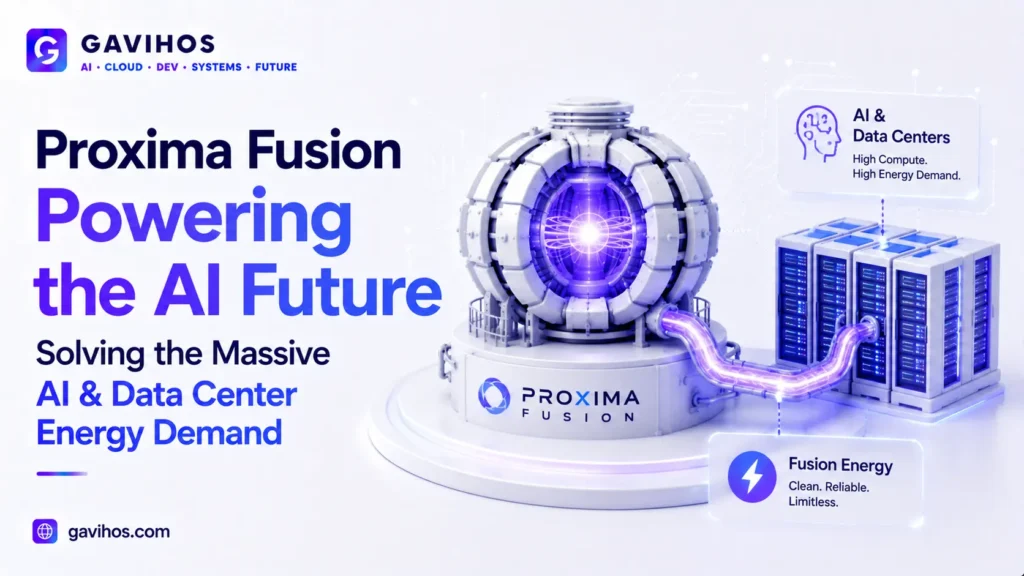
AI compute demand has grown faster than the electrical grid can comfortably supply it. Training and running large AI models requires enormous, sustained amounts of electricity, and data center power demand has become one of the most cited bottlenecks facing AI companies heading into the back half of the decade. Traditional grid expansion is slow, politically complex, and constrained by permitting timelines that don’t move at software speed.
Fusion, if it works at commercial scale, offers something the current grid can’t: a dense, potentially clean, long-term power source that isn’t dependent on weather (unlike solar or wind) or fuel supply chains (unlike fossil fuels). That’s precisely the kind of long-horizon bet a company like Google — which has committed publicly to matching its data center power consumption with carbon-free energy — has reason to make now, even though commercial fusion power remains years away.
Industry Impact
This round adds Proxima Fusion to a small but growing list of energy startups attracting serious Big Tech capital, following a broader pattern of tech giants signing power purchase agreements and making direct investments in nuclear and fusion projects. It reinforces fusion energy’s shift from a purely academic research pursuit to a venture-backed industry with real capital behind competing approaches — Proxima Fusion’s stellarator design is one of several fusion architectures, alongside tokamak-based competitors, being pursued commercially.
For the European tech and energy ecosystem specifically, a €2.4 billion valuation and record funding round is a signal that serious, patient capital is willing to back deep-tech, long-timeline hardware bets out of Europe — a category that has historically struggled to compete with U.S. venture funding at this scale.
Developer Impact
For most software developers, fusion energy itself has no direct day-to-day effect. But the underlying story — AI companies actively investing in future power supply — is a useful signal about where infrastructure constraints are heading. Developers building AI-heavy products should expect compute costs and availability to remain sensitive to energy supply for years to come, which is one more reason large model training and inference continue to concentrate around a handful of well-capitalized providers who can secure both compute and power at scale.
Business Impact
For businesses building on AI infrastructure, the message is indirect but important: the companies you depend on for compute (Google Cloud, and by extension its AI services) are treating energy supply as a strategic risk worth hedging years in advance. That’s generally a positive signal for long-term platform stability, but it also underscores how much of the AI industry’s future cost structure depends on solving problems, like fusion, that remain unsolved today. Businesses evaluating long-term AI vendor relationships should factor in how seriously a provider is investing in its own power supply chain, not just its chip supply.
Future Outlook
Commercial fusion power remains unproven at grid scale, and Proxima Fusion — like every fusion company before it — still has to clear enormous engineering hurdles before any of this translates into electricity on the grid. What this round does confirm is that Big Tech’s appetite for funding speculative, long-horizon energy bets is growing alongside AI compute demand, and Google is unlikely to be the last major AI player to invest directly in power generation research. Expect more of these AI-company-to-energy-startup funding announcements over the next few years, from both fusion and other next-generation power sources.
FAQ
1. How much did Proxima Fusion raise? Proxima Fusion raised €411 million ($469 million), reported at a €2.4 billion valuation.
2. Who invested in Proxima Fusion’s latest round? Investors included Google, RWE, XTX Ventures, and East X Ventures.
3. What does Proxima Fusion do? Proxima Fusion is a Munich-based startup developing stellarator-based fusion reactor technology aimed at commercial fusion power generation.
4. Why is Google investing in a fusion energy startup? Google faces growing electricity demand from AI data centers and has publicly committed to carbon-free energy goals, making long-term investment in next-generation power sources like fusion a strategic hedge.
5. Is this the largest fusion funding round in Europe? Yes — Bloomberg, CNBC, and Sifted all reported it as the largest fusion energy funding round in European history.
6. What is the difference between fusion and fission energy? Fusion combines light atomic nuclei to release energy, similar to the sun, while fission splits heavy atoms; fusion does not produce the same long-lived radioactive waste as fission.
7. Is commercial fusion power available today? No. Commercial fusion power has not yet been achieved at grid scale by any company; it remains an active area of engineering and scientific research.
8. Why does AI need more electricity? Training and running large AI models requires sustained, large-scale computing power, which translates directly into high electricity demand at data centers.
9. What is a stellarator? A stellarator is a type of fusion reactor design that uses twisted magnetic fields to contain plasma, differing from the more common tokamak design used by many other fusion companies.
10. What happens next for Proxima Fusion? The company will use the funding to continue developing its stellarator technology, though no specific commercial timeline has been independently confirmed.
Analyst Perspective
The most important takeaway from this round isn’t the size of the check — it’s who signed it. When a company whose core business is search and cloud computing invests directly in fusion research, it’s a clear signal that energy availability has become a genuine strategic variable in the AI industry, not just an operational line item. That’s a shift worth watching closely, because it means the next constraint on AI progress may not be chips or model architecture, but electrons.
A second-order effect: as more AI companies make similar bets, expect competitive pressure among Big Tech firms to secure future energy supply the same way they’ve competed for chip allocation and data center real estate. Developers should watch this less for the fusion physics and more as an early indicator of how power-constrained AI infrastructure planning is becoming. Businesses evaluating long-term AI infrastructure partners should watch which providers are making credible, funded bets on their own future power supply — it’s a proxy for how seriously they’re planning for AI demand years out, not just quarters out.
Key Takeaways
- Proxima Fusion raised €411M ($469M) at a €2.4B valuation, backed by Google, RWE, XTX Ventures, and East X Ventures.
- Reported as the largest fusion energy funding round in European history, verified across Bloomberg, CNBC, and Sifted.
- Google’s involvement reflects growing Big Tech interest in securing future energy supply for AI data centers.
- Commercial fusion power remains unproven at scale — this is a long-horizon bet, not a near-term solution.
- Expect more direct investment from AI and cloud companies into next-generation energy sources in the coming years.
Continue Learning
- What Is AI for Science?
- AI Export Controls Explained
- What Are AI Agents?
- What Is a Data Catalog? Complete Guide to Metadata Management and Data Lineage
About GAVIHOS
GAVIHOS helps developers, founders and technology enthusiasts understand AI, software engineering and emerging technologies through practical guides, tutorials and industry analysis.
Stay Updated
Follow GAVIHOS for practical AI, technology and developer-focused insights.
External Links
| Source | URL |
|---|---|
| Bloomberg | https://www.bloomberg.com/ |
| CNBC | https://www.cnbc.com/ |
| Sifted | https://sifted.eu/ |
| Google Sustainability — Carbon-Free Energy Commitments | https://sustainability.google/ |