
Scroll through security news for even a week and you’ll see the same three letters again and again: RCE. It’s attached to some of the most severe vulnerabilities ever disclosed — critical flaws in web servers, VPN appliances, AI tools, and enterprise software that get patched immediately because leaving them open is treated as an emergency, not a maintenance item.
Remote Code Execution is exactly what it sounds like: a class of vulnerability that lets an attacker run their own code on a system they don’t own, without physical access to it, often without any valid credentials at all. It’s one of the most consequential categories of software vulnerability that exists, because it collapses the distance between “found a bug” and “fully controls the machine” into a single step.
This guide explains what RCE actually is, why it’s so severe, how attackers typically achieve it, and what separates a well-defended system from a vulnerable one — using real, well-documented vulnerability classes rather than abstractions.
What Is It?
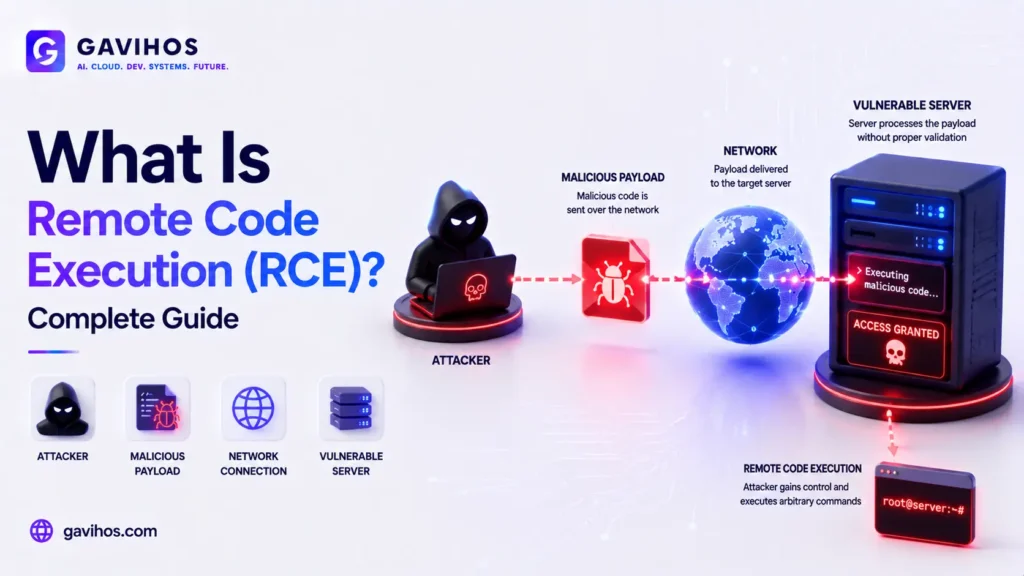
Remote Code Execution (RCE) is a vulnerability that allows an attacker to execute arbitrary code on a target system over a network, without needing physical access to the machine. “Arbitrary” is the key word — it means the attacker isn’t limited to whatever the application was designed to let them do. They can run commands the application’s developers never intended anyone to run.
RCE vulnerabilities are typically split into two categories based on what access the attacker needs before triggering the flaw:
- Unauthenticated RCE — the attacker needs no valid login or credentials at all. They can trigger the vulnerability by sending a crafted request to a public-facing service. This is the most severe form, because the only prerequisite is that the vulnerable service is reachable over the network.
- Authenticated RCE — the attacker needs some level of valid access first (a low-privilege account, an API key) before they can trigger the code execution. Still serious, but it requires the attacker to clear an additional bar first.
A concrete, publicly documented example: CVE-2025-3248 is an unauthenticated RCE in Langflow, an open-source AI workflow tool, affecting versions prior to 1.3.0. According to its official GitHub Security Advisory (GHSA-rvqx-wpfh-mfx7) and NVD record, a specific API endpoint (/api/v1/validate/code) accepted user-supplied input and executed it as code without requiring authentication — meaning anyone who could reach that endpoint over the network could run their own commands on the server. It was assigned a CVSS score in the 9.3–9.8 range (Critical) by GitHub and NVD respectively, and was fixed in Langflow 1.3.0.

Why Does It Matter?
Business impact. An RCE vulnerability on a production system is one of the few security findings that can justify an all-hands, drop-everything incident response. Because the attacker gets arbitrary code execution — not just read access to a database or a single misconfigured file — the potential blast radius includes credential theft, lateral movement to other systems, data destruction, and full server compromise, often within minutes of an automated scan finding the vulnerable service.
Technology impact. RCE vulnerabilities are why “patch immediately” exists as a distinct urgency tier separate from routine software updates. Security teams triage vulnerabilities constantly, but a critical unauthenticated RCE on an internet-facing service typically jumps to the top of every queue, because automated scanning tools (used by both defenders and attackers) can find and exploit these at scale within hours of public disclosure.
Industry impact. As more organizations expose internal tools to the internet — including newer categories like AI workflow platforms, internal APIs, and self-hosted developer tools — the population of software that could contain an unauthenticated RCE has grown. Tools built quickly to meet AI-era demand don’t always get the security review that decades-old enterprise software has accumulated, which is a pattern security researchers are actively watching.
Why Now?
RCE as a vulnerability category isn’t new — it’s one of the oldest and most well-understood classes in security, going back decades. What makes it worth understanding today, specifically, is a shift in where these vulnerabilities are showing up.
AI tooling is expanding the attack surface faster than security review can keep up. Tools like Langflow — AI workflow and agent-orchestration platforms — are being built and adopted rapidly, often self-hosted and exposed to the internet by teams moving quickly to ship AI features. These are exactly the conditions that produce unauthenticated RCE vulnerabilities: new, fast-moving codebases, frequently handling code execution as a core feature (since many AI workflow tools literally need to execute user-provided code or scripts as part of their function), with less battle-testing than mature infrastructure software.
Automated exploitation has gotten faster. Once an RCE is disclosed, mass scanning for vulnerable, internet-facing instances typically begins within hours — sometimes automated by the same kind of scripting and tooling that legitimate security teams use for their own audits, just pointed in the opposite direction.
AI agents are increasingly used on both sides. Security researchers use AI to find vulnerabilities faster; separately, security research has documented cases of AI-assisted or AI-driven exploitation of exactly this kind of vulnerability once disclosed, closing the gap between “patch released” and “someone is actively exploiting the unpatched population” even further.
A few years ago, the population of software exposed to unauthenticated-RCE risk was concentrated in well-understood categories — web servers, CMS platforms, VPN appliances. The rapid growth of self-hosted AI tooling has added a new, less mature category to that list, which is why understanding this vulnerability class from first principles matters now, not just for security specialists but for anyone deploying these tools.
How It Works
Step 1 — The attacker finds an entry point that processes untrusted input. This is usually an API endpoint, a file upload feature, a deserialization routine, or — as in the Langflow case — a feature explicitly designed to execute code (in Langflow’s case, a code-validation endpoint meant to check user-submitted code snippets).
Step 2 — The application fails to properly isolate or sanitize that input before acting on it. In Langflow’s case, per the public GitHub Security Advisory, the vulnerable endpoint executed submitted code without adequately restricting what that code could do or verifying the requester was authorized to run it.
Step 3 — The attacker crafts a malicious payload. This is a piece of code, a command string, or a serialized object designed to do something beyond the application’s intended behavior — anything from reading a file to opening a reverse shell back to the attacker’s own machine.
Step 4 — The attacker sends the payload over the network. For an unauthenticated RCE, this is often as simple as an HTTP request to a public endpoint — no login step required.
Step 5 — The vulnerable code executes the payload with the application’s privileges. Whatever level of access the vulnerable process runs with (which can range from a restricted service account to full administrative rights) is now available to the attacker’s code.
Step 6 — Post-exploitation. Once code is executing, the attacker typically performs reconnaissance (checking what user/permissions they have, what’s on the network), harvests credentials and API keys found on the compromised host, and looks for a path to more valuable systems — a pattern documented across countless real-world RCE exploitation cases, including AI-tooling-specific incidents that used exactly this kind of initial foothold to reach separate, more sensitive production systems.
Architecture / Components
| Component | Role | Why It Matters |
|---|---|---|
| Untrusted input surface | The API endpoint, form field, or file-processing feature the attacker reaches | Every RCE starts here — there’s no path to code execution without a way to submit attacker-controlled data |
| Missing/insufficient validation | The gap that lets attacker input reach a dangerous function (code execution, deserialization, command construction) | This is the actual “bug” — the difference between a normal feature and a vulnerability |
| Execution context / privileges | What the vulnerable process is allowed to do on the host | Determines the blast radius — a low-privilege service account limits damage more than a process running as root/admin |
| Network reachability | Whether the vulnerable service is exposed to the internet or only internal networks | Unauthenticated, internet-facing RCE is exploitable by anyone; internal-only exposure requires the attacker to already be inside the network |
| Patch / fix | The vendor’s corrected code that properly isolates or removes the dangerous execution path | Until applied, every instance running the vulnerable version remains exploitable, regardless of how the vulnerability was disclosed |
Real World Use Cases (Where RCE Shows Up)
1. Web application platforms. Content management systems, admin panels, and web frameworks have historically been common sources of RCE vulnerabilities, often through file upload features or template injection.
2. Network and VPN appliances. Enterprise VPN and firewall appliances have repeatedly been the source of critical unauthenticated RCE vulnerabilities, which is especially severe because these devices sit at the network perimeter by design.
3. AI workflow and agent tooling. As covered above, CVE-2025-3248 in Langflow demonstrates how AI orchestration platforms — which often need to execute code or scripts as a core feature — can introduce unauthenticated RCE if that execution isn’t properly isolated from untrusted requests.
4. Developer and DevOps tools. Self-hosted CI/CD systems, artifact repositories, and internal developer platforms are attractive RCE targets because compromising them often provides a path to source code, secrets, and build pipelines.
5. IoT and embedded devices. Consumer and industrial IoT devices frequently ship with RCE vulnerabilities due to less mature security review processes, and because many remain unpatched indefinitely after deployment.
Benefits (of Understanding This Category)
Faster triage. Recognizing RCE as a distinct, maximum-severity category helps security and engineering teams correctly prioritize it above lower-impact findings during vulnerability management.
Better architecture decisions. Understanding how RCE happens (untrusted input reaching a dangerous execution path) directly informs safer design choices — sandboxing, input validation, and least-privilege execution contexts.
More accurate incident response. Knowing that RCE grants arbitrary code execution — not just a narrow, predictable action — shapes appropriate incident response scope (assume broader compromise, not just the specific bug that was exploited).
Limitations (of Common Mitigations)
Patching alone doesn’t undo prior compromise. Applying a fix closes the vulnerability going forward but does nothing about a system that was already exploited before the patch was applied — which is why disclosure timelines and detection matter as much as the fix itself.
Network segmentation reduces but doesn’t eliminate risk. Keeping a vulnerable service off the public internet significantly reduces exposure, but doesn’t help against an attacker who’s already gained a foothold elsewhere on the internal network — a pattern seen repeatedly where an initial RCE on one system becomes the launchpad to reach a separate, better-defended target.
Not all RCEs require sophisticated exploits. Some of the most damaging RCE vulnerabilities in history required only a simple, well-crafted HTTP request — sophistication of the vulnerability and severity of the impact aren’t always correlated.
Engineering Tradeoffs
What improves with strict input validation and sandboxing: Dramatically reduced RCE risk, since the core mechanism (untrusted input reaching a dangerous execution path) is directly addressed.
What becomes harder: Features that legitimately need to execute user-provided code (like AI workflow tools validating submitted scripts) become more complex to build safely — the team has to design an isolated execution environment instead of just running the code directly.
New complexity introduced: Sandboxing, containerization of untrusted execution, and strict permission scoping all add engineering overhead compared to a naive “just run it” implementation.
Operational costs: Continuous vulnerability scanning, rapid patch deployment processes, and network segmentation all require ongoing investment — not one-time fixes.
When this tradeoff is worth it: Any service that is internet-facing, or that processes genuinely untrusted input (including from lower-trust internal users), should treat this investment as non-negotiable rather than optional — the cost of an actual RCE incident routinely exceeds the cost of preventing one.
Best Practices
Never execute untrusted input directly. If a feature needs to run user-submitted code (as with AI workflow validators), it must do so inside a properly isolated sandbox with no access to the host system, network, or credentials by default.
Patch critical RCE vulnerabilities immediately, not on a routine cycle. A CVSS 9+ unauthenticated RCE on an internet-facing service should bypass normal patch scheduling.
Apply least privilege to every service. If a vulnerable process only has minimal permissions, a successful RCE exploit is contained rather than catastrophic.
Don’t expose internal tools to the public internet by default. Many real-world RCE incidents involve tools that were never meant to be internet-facing, exposed accidentally or for convenience during setup.
Monitor for post-exploitation behavior, not just the vulnerability itself. Credential harvesting, unusual outbound connections, and new scheduled tasks/cron jobs are common signs of successful RCE exploitation worth detecting even if the initial vulnerability goes unnoticed.
Common Mistakes
Assuming authentication alone prevents RCE. Authenticated RCE is still RCE — requiring a login reduces the attacker population but doesn’t eliminate the risk, especially if credentials are easy to obtain or reused elsewhere.
Treating a patch as the end of incident response. If a vulnerable version was exposed to the internet before patching, assume potential prior compromise and investigate, rather than treating the patch alone as sufficient.
Exposing internal or development tools to the internet “temporarily.” Temporary exposure is a common root cause in real-world RCE incidents — attackers scan continuously, and “temporary” often isn’t as short as intended.
Ignoring default credentials on adjacent systems. In real, documented incidents, attackers who gained initial access through an RCE have pivoted to other systems using default or reused credentials found on the compromised host — the RCE is often just the first step, not the whole attack.
What Most People Get Wrong
“RCE only matters if the attacker is a skilled hacker.” Once a vulnerability is public, exploitation is frequently automated — scanning tools can find and exploit vulnerable, internet-facing instances at scale without a human operator crafting each attack individually.
“If it’s authenticated, it’s not that serious.” Authenticated RCE still grants full arbitrary code execution — the only difference is the attacker needs some initial access first, which is often easier to obtain than assumed (leaked credentials, weak passwords, social engineering).
“Patching fixes everything.” Patching prevents future exploitation of that specific vulnerability. It does not retroactively undo any compromise that occurred while the system was vulnerable — that requires separate investigation.
“This only happens to poorly-built software.” RCE vulnerabilities have been found in extremely widely-used, well-resourced software across the industry. Complexity and rapid feature development — including AI tooling built to meet fast-moving demand — create genuine opportunities for this class of bug regardless of the team’s overall skill.
Future Outlook
Expect RCE vulnerabilities to keep appearing in newer categories of software — particularly AI workflow, agent-orchestration, and AI-tooling platforms — as this category of software matures at a pace that doesn’t always match its adoption speed. The Langflow case (CVE-2025-3248) is a documented example of exactly this pattern, and it’s reasonable to expect more.
Expect the gap between disclosure and exploitation to keep narrowing, driven partly by faster automated scanning and partly by AI-assisted exploitation tooling on the attacker side — which raises the practical urgency of rapid patch deployment beyond what routine update cycles have historically provided.
Expect continued investment in sandboxing and isolated execution environments specifically for AI tools that need to run user- or model-generated code, since this is now a demonstrated, real-world attack surface rather than a theoretical concern.
FAQ
1. What is Remote Code Execution (RCE)? RCE is a vulnerability category that lets an attacker execute arbitrary code on a target system over a network, without physical access to the machine — often without valid credentials, in the case of unauthenticated RCE.
2. What’s the difference between authenticated and unauthenticated RCE? Unauthenticated RCE requires no valid login or credentials — the attacker can trigger it directly over the network. Authenticated RCE requires some level of valid access first, which raises the bar slightly but still grants full arbitrary code execution once triggered.
3. Why is RCE considered more severe than other vulnerability types? Because it grants arbitrary code execution rather than a narrow, predictable capability — the attacker isn’t limited to what the application intended to allow, which typically enables credential theft, lateral movement, and full system compromise.
4. What is CVE-2025-3248? CVE-2025-3248 is an unauthenticated RCE vulnerability in Langflow (an open-source AI workflow tool) affecting versions prior to 1.3.0, caused by a code-validation API endpoint that executed submitted code without adequate authentication or isolation. It carries a CVSS score in the 9.3–9.8 (Critical) range and was fixed in Langflow 1.3.0.
5. How do attackers typically find RCE vulnerabilities? Through manual security research, automated fuzzing tools that send malformed input to find crashes or unexpected behavior, and by reviewing publicly disclosed vulnerabilities in similar software to look for related, unpatched issues elsewhere.
6. Does patching fully protect against an RCE vulnerability? Patching prevents future exploitation of that specific flaw, but does not undo any compromise that may have occurred while the system was vulnerable and exposed — that requires separate investigation of logs and system state.
7. Why are AI tools becoming a more common source of RCE vulnerabilities? Many AI workflow and agent-orchestration tools are built to execute code or scripts as a core feature, are adopted and self-hosted rapidly to meet fast-moving demand, and haven’t accumulated the same depth of security review as more mature infrastructure categories.
8. Can RCE vulnerabilities be exploited automatically, without a human attacker? Yes. Once a vulnerability is disclosed, automated scanning and exploitation tools can find and compromise vulnerable, internet-facing instances at scale, often within hours of public disclosure.
9. What’s the single most effective defense against RCE? There isn’t one silver bullet — strict input validation, sandboxed execution for any feature that legitimately needs to run untrusted code, least-privilege service accounts, and rapid patch deployment together form the realistic defense, not any single control alone.
10. If my organization doesn’t run AI tools, does RCE still matter? Yes. RCE is a vulnerability category that spans web applications, network appliances, developer tools, IoT devices, and more — AI tooling is simply one of the newer, faster-growing categories where it’s currently showing up, not the only one.
Analyst Perspective
The most useful way to think about RCE isn’t as a single bug type, but as a consequence — it’s what happens whenever untrusted input is allowed to reach a sufficiently powerful execution path without adequate isolation. That framing explains why RCE keeps showing up in genuinely new categories of software: the specific mechanism changes (a template injection here, a deserialization flaw there, a code-validation endpoint in an AI tool), but the underlying pattern — a gap between “what the application is supposed to do” and “what it actually allows” — is remarkably consistent across decades of software.
The more interesting shift right now isn’t in the mechanism, it’s in where the untrusted-input surface is showing up. AI workflow and agent tools are a genuinely new category of software that, almost by definition, needs to execute code or run automated actions as a core feature — which means the isolation boundary between “code the tool is supposed to run” and “code an attacker tricked it into running” is doing more load-bearing work than it did in traditional web applications. CVE-2025-3248 in Langflow is a clean illustration: a code-validation feature, built to be helpful, became the exact untrusted-input surface that turned into critical RCE.
For teams building or deploying this next generation of AI tooling, the practical takeaway isn’t “avoid these tools” — it’s recognizing that any feature which executes code, scripts, or model-generated actions needs to be treated with the same isolation discipline that mature infrastructure software has slowly earned over decades, rather than assuming a new category of tool gets a pass because it’s new. The tools that get this right early will have a real, durable trust advantage over the ones that treat sandboxing as an afterthought.
Key Takeaways
- Remote Code Execution (RCE) is a vulnerability class that lets an attacker run arbitrary code on a target system over a network, often without valid credentials in the unauthenticated case
- Unauthenticated RCE is more severe than authenticated RCE because it requires no prior access at all — only network reachability
- CVE-2025-3248 (Langflow, CVSS 9.3–9.8, fixed in 1.3.0) is a real, documented example of an unauthenticated RCE in an AI workflow tool, caused by an unprotected code-execution endpoint
- RCE typically enables a broader compromise than the specific bug exploited — credential theft, lateral movement, and full system control commonly follow
- AI workflow and agent-orchestration tools are an emerging, fast-growing source of RCE vulnerabilities because they often need to execute code as a core feature and haven’t accumulated the same security maturity as older infrastructure categories
- Patching prevents future exploitation but does not undo compromise that occurred while a system was vulnerable — assume investigation is needed if an RCE was exposed before patching
- Sandboxed execution, least-privilege service accounts, and rapid patch deployment together form the realistic defense against RCE — no single control is sufficient alone
Continue Learning
- libssh2 CVE-2026-55200: Remote Code Execution Explained
- “Bad Epoll” (CVE-2026-46242): A Use-After-Free in the Linux Kernel’s epoll Subsystem
- Squidbleed (CVE-2026-47729): What Developers Need to Know About the 29-Year-Old Squid Proxy Vulnerability
- Insecure Deserialization Explained
- AI-Accelerated Cyberattacks: How AI Is Shrinking the Defender’s Response Window
About GAVIHOS
GAVIHOS helps developers, founders and technology enthusiasts understand AI, software engineering and emerging technologies through practical guides, tutorials and industry analysis.
Stay Updated
Follow GAVIHOS for practical AI, technology and developer-focused insights.
External Links
| Source | URL |
|---|---|
| NVD — CVE-2025-3248 | https://nvd.nist.gov/vuln/detail/CVE-2025-3248 |
| GitHub Security Advisory — GHSA-rvqx-wpfh-mfx7 | https://github.com/advisories/GHSA-rvqx-wpfh-mfx7 |