Introduction
For most of the past two decades, the security industry operated on an implicit assumption: defenders had time. A vulnerability would be discovered, a CVE would be published, a patch would ship, and enterprises would deploy it — imperfectly, slowly, but eventually. The attacker’s window existed, but it was measured in weeks or months.
That assumption no longer holds.
The Verizon Data Breach Investigations Report 2026 confirmed what security teams have been observing on the ground: vulnerability exploitation has overtaken credential theft as the number one breach vector for the first time. Thirty-one percent of breaches now originate from unpatched vulnerabilities. AI is a significant reason why.
This guide explains how AI is changing the speed and nature of cyberattacks, what it means for the engineering teams responsible for building and operating software, and what defenders need to do differently.
What Is AI-Accelerated Vulnerability Exploitation?
AI-accelerated vulnerability exploitation describes the use of AI tools — primarily large language models and code analysis systems — to speed up the process of finding, understanding, and exploiting security vulnerabilities in software.
Attackers have always invested in automating parts of the attack chain. Scanners, fuzzers, and exploit frameworks like Metasploit are decades old. What changed is the reasoning layer. AI models can now read source code, understand logic, identify unusual memory patterns, and suggest exploit approaches at a pace no human analyst can match.
The result is a compression of the timeline between vulnerability discovery and active exploitation. What previously took a skilled researcher days or weeks can now take hours.
Why Does It Matter?
The traditional security response model is built around a timeline assumption that no longer applies.
Old model: Vulnerability discovered → CVE published → Vendor patches → Enterprise deploys patch → Attackers exploit. Enterprise teams typically had 30 to 90 days between patch availability and meaningful exploitation at scale.
New model: Vulnerability identified by AI-assisted scanning → Exploit prototype generated in hours → Attacks begin before patch exists, or before most organizations have applied it. The window is measured in hours, not weeks.
This affects every organization that runs software — which is every organization. The engineering team that builds a web application, the platform team that runs on-premise Squid Proxy, the security team that triage CVEs on a weekly review cycle — all of them are now operating with a shorter response window than their current processes assume.
Why Now?
AI has been part of security tooling for years. Anomaly detection, SIEM correlation, and behavioral analysis have used machine learning since at least 2015. What changed recently is the capability of large language models to reason about code structure.
Previous AI security tools were pattern-matching systems. They were good at detecting known-bad signatures and flagging statistical anomalies, but they could not reason about why a piece of code was vulnerable or how to construct an exploit.
Modern LLMs can read a function, understand the memory management logic, identify the edge case where a buffer overread occurs, and explain how an attacker could trigger it. Squidbleed — a 29-year-old memory vulnerability in Squid Proxy disclosed in June 2026 — was discovered by security researchers using Claude Mythos Preview to audit the codebase. A bug that survived human code review for nearly three decades was found by an AI model working through the source code systematically.
This is the key shift: AI finds patterns across large codebases at a scale and speed humans cannot. Both defenders and attackers can use this capability. The question is who uses it first and who responds faster.
How the AI-Accelerated Attack Chain Works
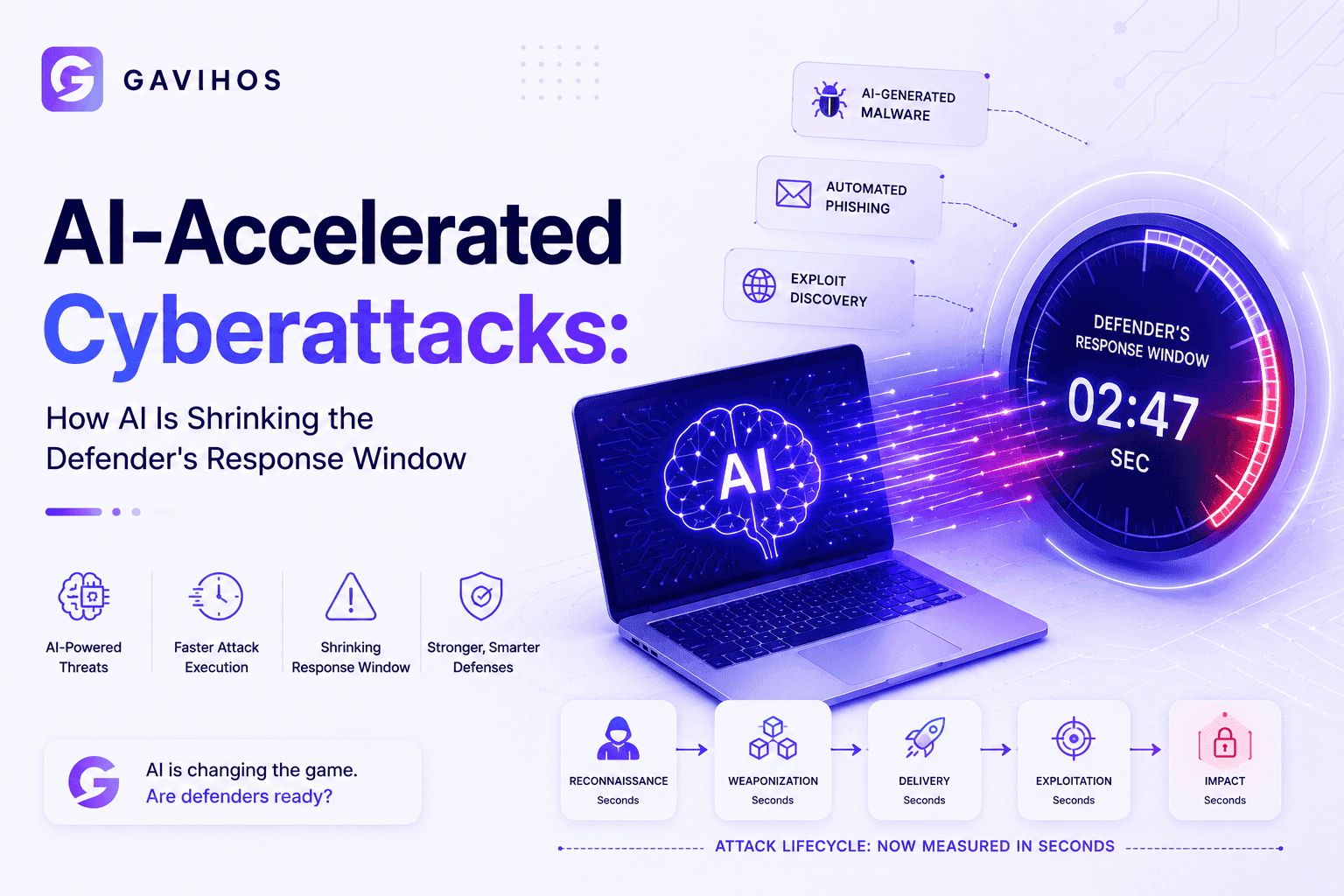
A modern AI-assisted attack follows a compressed version of the traditional kill chain:
Step 1 — Reconnaissance at scale. AI tools scan publicly available source code repositories, dependency manifests, and version strings exposed by servers. What previously required manual enumeration across thousands of targets can now be automated with AI-assisted parsing.
Step 2 — Vulnerability identification. An LLM or static analysis tool reasons about code paths, memory management, input validation, and authentication logic. It flags candidates — areas where the logic looks unusual or where a well-known vulnerability class might apply.
Step 3 — Exploit prototype generation. Given a vulnerability candidate, an AI system can suggest how to trigger the flaw — what input to send, which protocol path to follow, what conditions must be met. This is not always correct, but it produces a working starting point far faster than a human researcher working from scratch.
Step 4 — Weaponization and deployment. The attacker tests the prototype, refines it, and begins scanning for vulnerable targets. Because the earlier steps were accelerated by AI, this phase begins much sooner after a vulnerability’s disclosure — or, in cases where attackers find the vulnerability before defenders, before any public disclosure exists.
Real-World Use Cases
1. Corporate Proxy Networks Organizations running Squid Proxy in default configuration are exposed to Squidbleed (CVE-2026-47729). An attacker with access to the corporate network who controls an FTP server can trigger the heap overread, capturing HTTP request data from other users — including API keys, session tokens, and authorization headers. The AI-assisted discovery of this vulnerability means organizations cannot assume legacy infrastructure is safe simply because no one has looked at it recently.
2. Dependency Scanning in Supply Chains AI tools can rapidly audit the entire dependency tree of an application — including transitive dependencies — for known vulnerability patterns. Attackers use the same capability offensively, finding vulnerable library versions in production applications before the organization’s own scanning tools flag them.
3. Authentication Logic Review LLMs are particularly effective at finding authentication bypass vulnerabilities — logic errors in session management, token validation, or permission checks. These bugs often survive human code review because they require holding the entire authentication flow in mind simultaneously.
4. Zero-Day Discovery in Open-Source Infrastructure High-value open-source projects — web servers, proxies, databases, message queues — are now being systematically audited by both security researchers and threat actors using AI tools. Code that has been in production for decades without incident is being reviewed with fresh capability.
5. Accelerated CVE Weaponization When a CVE is published with technical details, AI tools can generate a working exploit proof-of-concept within hours. Organizations that previously had days or weeks to patch before exploitation became widespread now have hours. The assumption that “we’ll patch on next Tuesday’s maintenance window” is no longer defensible for critical vulnerabilities.
Benefits of Understanding This Shift
Faster internal red-teaming. Security teams that use AI-assisted code auditing defensively find their own vulnerabilities faster than attackers do. This is the most direct response to the attacker capability gap.
Better vulnerability prioritization. AI tools can assess exploitability — not just severity scores — helping security teams focus patching effort on vulnerabilities that are actively being targeted, not just theoretically dangerous ones.
Scaled coverage for large codebases. Human security reviewers cannot audit millions of lines of legacy code systematically. AI-assisted auditing makes it tractable.
Limitations
AI-generated exploits are often wrong. AI tools produce plausible-looking exploit suggestions that fail in practice due to environmental factors, mitigations (ASLR, stack canaries, sandboxing), or incorrect assumptions about the target configuration. Attackers still need skilled engineers to turn AI suggestions into working exploits.
AI does not replace understanding. An organization that deploys AI security tools without engineers who understand the underlying vulnerability classes will miss the context needed to prioritize and remediate effectively.
Attackers and defenders have the same tools. AI does not give attackers a permanent advantage — it raises the floor for both sides. Defenders who adopt AI-assisted auditing can use the same capability advantage.
Engineering Tradeoffs
Adopting AI-assisted security tooling improves vulnerability discovery speed but introduces new complexity:
What improves: Coverage, speed of finding known vulnerability classes, scale across large codebases.
What becomes harder: Signal-to-noise ratio. AI tools produce false positives. Security teams spend time triaging AI-generated findings that do not represent real vulnerabilities.
What new complexity is introduced: AI security tools require integration into CI/CD pipelines, careful scoping to avoid exposing source code to third-party AI services, and human review processes that can evaluate AI output critically.
What operational costs increase: Security engineering time for triage and validation increases as AI tooling scales up findings volume.
When this approach should not be used: AI-assisted auditing is not a substitute for secure design. Reviewing insecure architecture with AI tools will surface implementation bugs but will not fix the underlying design problems.
Best Practices
Treat patch deployment speed as a security control. If the window between vulnerability disclosure and exploitation is now measured in hours, the time to apply critical patches must be measured in hours — not the next maintenance window. Automate patch deployment for known-critical CVEs in non-production environments as a baseline.
Run AI-assisted audits on your highest-risk dependencies. Identify the components in your stack with the largest blast radius — proxy infrastructure, authentication services, API gateways — and run systematic AI-assisted code audits on them regularly.
Disable features you do not use. Squidbleed’s mitigation is disabling FTP in Squid. Most corporate Squid deployments carry almost no FTP traffic. The attack surface exists only because a legacy feature is enabled by default. Audit your software configurations for enabled-but-unused features and disable them.
Implement network segmentation to limit lateral movement. Compression of the initial exploit timeline makes it more important — not less — to slow attacker movement after initial access. Lateral movement still requires time. Zero-trust network architecture and least-privilege access controls limit what an attacker can do after a single system is compromised.
Log at the network layer, not only the application layer. AI-accelerated attacks may succeed before application-level logging captures evidence. Network-layer logging (DNS queries, connection patterns, unusual protocol usage) provides earlier detection signals.
Common Mistakes
Relying on CVE severity scores for patch prioritization. CVSS scores measure theoretical impact, not active exploitation likelihood. A 9.8 CVSS vulnerability in software you do not run is lower priority than a 7.0 CVSS vulnerability in software that is directly internet-facing. Use exploitability data, not just severity scores.
Treating legacy infrastructure as low-risk because it has not been attacked. Squidbleed was in production code for 29 years. “Nothing has exploited this before” is not evidence of safety — it may be evidence that no one had looked carefully until now.
Running AI security tools without engineering review. AI-generated vulnerability findings require human judgment to evaluate. Treating all AI-flagged items as real vulnerabilities wastes engineering time. Treating all AI-flagged items as false positives defeats the purpose.
What Most People Get Wrong
“We will patch it when we have time.” The 2026 threat landscape does not accommodate weekly patch cycles for critical vulnerabilities. This is not a matter of organizational discipline — it is a matter of the attacker timeline now moving faster than most organizations’ patch processes.
“AI hacking is a future problem.” Squidbleed was found using AI in June 2026. The Verizon DBIR 2026 measured the impact of AI-accelerated exploitation in 2025 breach data. This is the present, not a projection.
“Only large organizations are targeted.” AI-assisted scanning is cheap and scalable. Attackers can scan millions of hosts for vulnerable Squid Proxy versions as easily as they can scan thousands. Smaller organizations are not protected by obscurity when scanning is automated.
“Open-source software is more secure because many eyes review it.” Many eyes means many people assumed someone else had reviewed it. Squidbleed’s 1997 commit went unreviewed for 29 years in one of the most widely deployed open-source proxy servers in the world.
Future Outlook
Three developments will define the next 24 months in this space:
AI-assisted patching will emerge as a countermeasure. The same AI capability that finds vulnerabilities can suggest patches. Several projects are already working on AI-generated security patches validated against test suites. If this matures, it could compress the time from vulnerability discovery to patch availability — restoring some of the defender’s response window.
Governments will mandate faster patch timelines. The EU AI Act, the U.S. AI Executive Order, and national cybersecurity directives are all moving toward requiring demonstrably fast remediation of critical vulnerabilities in high-risk systems. Compliance pressure will force organizations to build the internal processes for rapid patch deployment they should have already built.
The vulnerability discovery market will shift. Bug bounty programs and security research firms that invest in AI-assisted code auditing will find vulnerabilities faster than those that do not. The supply of discovered vulnerabilities will increase, which will increase pressure on vendors to patch faster and on enterprises to deploy patches faster. A faster vulnerability discovery market is better for defenders in the long run — but the transition period is dangerous.
FAQ
Q: What is vulnerability exploitation, and how does it differ from credential theft? Vulnerability exploitation means an attacker takes advantage of a bug in software to gain unauthorized access or execute code. Credential theft means an attacker uses a stolen or guessed username and password. The Verizon DBIR 2026 found exploitation now causes 31% of breaches vs 13% for credential theft — a reversal of the historical pattern.
Q: How fast can AI generate an exploit after a vulnerability is disclosed? For well-understood vulnerability classes with public proof-of-concept code, AI tools can generate working exploit prototypes within hours. More complex or novel vulnerabilities require more time, but even these are accelerated significantly compared to manual research timelines.
Q: What is Squidbleed and why is it relevant here? Squidbleed (CVE-2026-47729) is a 29-year-old heap buffer overread vulnerability in Squid Proxy disclosed in June 2026. It was discovered by security researchers using Claude Mythos Preview — a direct example of AI-assisted vulnerability discovery. It demonstrates that AI can find bugs in widely deployed software that survived decades of human code review.
Q: Do I need to patch Squid Proxy immediately? If your organization runs Squid Proxy and uses FTP proxying, yes. The patch ships in Squid 7.7 (not 7.6 — the 7.6 fix was incomplete per the maintainer’s correction). The immediate mitigation is to disable FTP in Squid configuration, which eliminates the attack surface for most deployments.
Q: What is the Verizon DBIR and why should developers care about it? The Verizon Data Breach Investigations Report is an annual analysis of thousands of confirmed security incidents. It is the most comprehensive empirical dataset on breach causes available to the public. The 2026 report finding — vulnerability exploitation overtaking credential theft — means developers’ primary defensive obligation has shifted from “protect your credentials” to “patch your vulnerabilities faster.”
Q: Are defenders using AI too, or is this only an attacker advantage? Both. Defenders use AI for threat detection, vulnerability scanning, code auditing, and log analysis. The Squidbleed discovery itself was an example of defensive use — security researchers using AI to find a bug before attackers weaponized it. The key is that defenders who adopt AI-assisted tooling can match the attacker’s capability advantage; those who do not fall progressively further behind.
Q: How should a small engineering team prioritize security in this environment? Three priorities: first, reduce your attack surface by disabling features and services you do not use. Second, automate patch deployment for your most critical dependencies. Third, run AI-assisted scanning on your highest-risk components — the code that handles authentication, processes external input, or runs with elevated privileges.
Q: What does “compression of the response window” mean in practice? It means the time between when a vulnerability becomes known (or is discovered by attackers) and when active exploitation begins is shorter. Previously, organizations had weeks to patch before facing meaningful attack volume. Now, for a well-understood vulnerability class, that window can be hours. Your patching processes need to match this timeline for critical vulnerabilities.
Q: Is legacy infrastructure at higher risk? Yes. Legacy code has had less security-focused review, was written before modern secure coding practices, and often contains features (like FTP support in Squid) that are enabled by default but carry risk. AI-assisted auditing is revealing vulnerabilities in legacy codebases that human reviewers overlooked for years.
Q: What is the single most important thing an engineering team can do today? Inventory your most critical infrastructure components, check their current patch status, and establish a process for same-day or next-day patching of CVEs rated critical in those components. Everything else builds on having that operational capability in place.
Analyst Perspective
The most important thing to understand about AI-accelerated cyberattacks is not the AI. It is what the AI reveals about the security posture most organizations have been comfortable with.
Patch cycle windows of 30-90 days were always insufficient — attackers have always moved faster than those timelines allowed for opportunistic exploitation. AI is not introducing a new problem; it is exposing how much the old “comfortable” window depended on attacker resource constraints that are now gone.
The second-order effect that most commentary misses: as AI-assisted vulnerability discovery scales, the total volume of disclosed vulnerabilities will increase significantly. More bugs will be found, in more software, faster. Security teams that are already overwhelmed by the current CVE volume will face substantially more triage work. This is not manageable by adding headcount alone — it requires architectural changes (smaller attack surfaces, automated patching, defense in depth) that reduce the consequence of any single unpatched vulnerability.
The businesses that should be watching this most carefully are those running shared infrastructure — ISPs, universities, managed service providers, SaaS platforms. These environments are where attacker access to one system exposes many users’ data. Squidbleed is a direct example: a corporate proxy leaks traffic from every user on that proxy. One unpatched server, many victims. That threat model becomes significantly worse in an environment where bugs are found and exploited faster.
Key Takeaways
- Verizon DBIR 2026 confirmed vulnerability exploitation is now the leading breach vector (31% of breaches), overtaking credential theft (13%) for the first time.
- AI tools accelerate the attack kill chain — reconnaissance, vulnerability identification, and exploit prototype generation — compressing the window between vulnerability discovery and active exploitation from weeks to hours.
- The Squidbleed disclosure (CVE-2026-47729, June 2026) is a direct example: a 29-year-old Squid Proxy vulnerability found using Claude Mythos Preview demonstrates AI’s ability to audit legacy codebases systematically.
- Defenders can use the same AI capability — AI-assisted code auditing, automated vulnerability scanning, and AI-enhanced threat detection are the defensive counterparts to AI-assisted exploitation.
- The most important operational response is shortening patch deployment timelines for critical vulnerabilities, particularly in internet-facing and shared infrastructure.
- Disable features you do not use. Most legacy software exposes attack surface through default-enabled features that carry no operational benefit for the current deployment.
Continue Learning
About GAVIHOS
GAVIHOS helps developers, founders and technology enthusiasts understand AI, software engineering and emerging technologies through practical guides, tutorials and industry analysis.
Stay Updated
Follow GAVIHOS for practical AI, technology and developer-focused insights.