Introduction
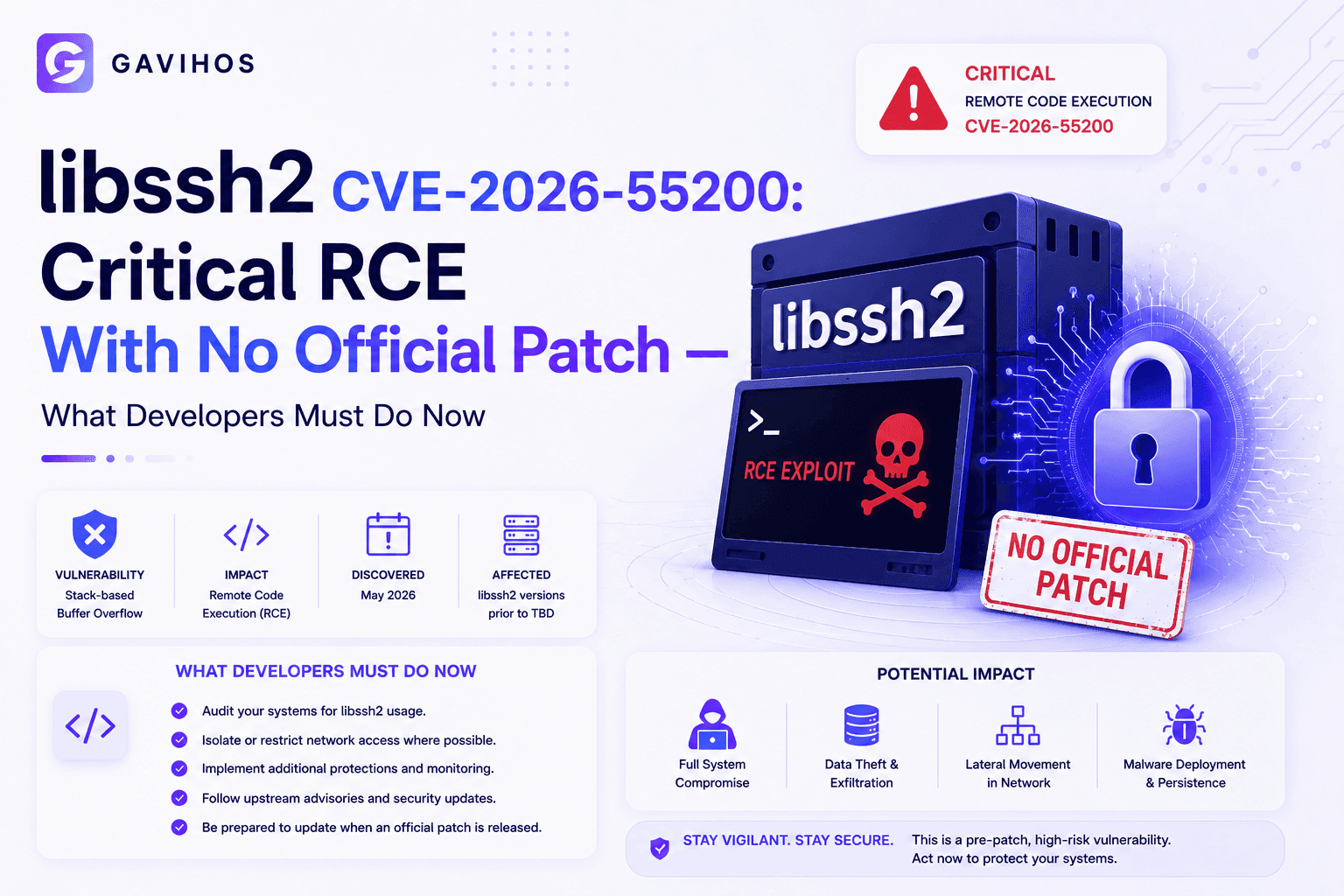
On June 23, 2026, researchers disclosed CVE-2026-55200 — a CVSS 9.2 remote code execution vulnerability in libssh2, the SSH library embedded in curl, PHP, Python, Ruby, and hundreds of other applications that handle SSH connections in production software.
The vulnerability requires no authentication, no privileges, and no user interaction. An attacker who can cause a vulnerable application to process a malicious SSH packet can execute arbitrary code on the affected system.
Every version of libssh2 through 1.11.1 is affected.
There is no official patched release. The maintainers merged fixes into GitHub, but no new version has shipped. Standard package manager updates will not protect you.
This article explains exactly what the vulnerability is, who is exposed, and what to do right now.
What Happened
CVE-2026-55200 is an out-of-bounds write vulnerability in ssh2_transport_read() — the function in libssh2’s transport.c that reads incoming SSH protocol data.
The function processes a packet_length field sent by the SSH server in each incoming packet. This field tells libssh2 how many bytes to read. The bug: the function does not validate packet_length against an upper bound.
An attacker sends an SSH packet with an excessively large packet_length value. libssh2 attempts to read that many bytes into a buffer allocated for a small packet. The read goes past the end of the buffer, overwriting adjacent heap memory with attacker-controlled data. This is a heap out-of-bounds write — the direct path to remote code execution.
The technical classification is CWE-680: integer overflow leading to buffer overflow. It is a known, well-understood vulnerability class with established exploit development techniques.
Attack requirements:
- No authentication
- No privileges
- No user interaction
- Network access sufficient to cause a vulnerable application to connect to an attacker-controlled SSH server, or to inject malicious SSH packets into an existing connection
A second vulnerability, CVE-2026-55199 (CVSS 8.2), causes denial-of-service through a related code path. Both were disclosed simultaneously on June 23, 2026.
Patch status: libssh2 maintainers merged fixes in GitHub commits 97acf3d and 1762685. No official libssh2 release contains these fixes as of June 25, 2026. Running apt upgrade or pip install --upgrade will not install a fix.
Why It Matters
libssh2 is not a niche library. It is foundational infrastructure embedded in software running on most server environments on the internet.
curl — the most widely used internet transfer library — uses libssh2 for SCP and SFTP operations. curl is installed on virtually every Linux server.
PHP — through the ssh2 PECL extension.
Python — through libssh2-python bindings.
Ruby — through net-ssh2 and related gems.
Embedded devices and appliances — routers, NAS devices, IoT systems that use SSH for management often link libssh2 because it is lightweight and portable.
The blast radius is not one application. It is every application that uses libssh2, directly or through dependencies, where an attacker can cause the library to process a malicious SSH packet.
The absence of an official patch makes this significantly worse than a standard CVE. With a normal vulnerability, the response is: update the package. Here, there is no package to update to. Every affected organization must independently apply GitHub commits from source, implement network controls, or accept the risk while waiting.
This follows Squidbleed (CVE-2026-47729), disclosed two days earlier on June 23. Both are memory vulnerabilities in widely deployed C network libraries. Both suggest that AI-assisted code auditing is now surfacing legacy bugs faster than the security community can patch them.
Industry Impact
Package managers are not sufficient. Debian, Ubuntu, RHEL, and other Linux distributions ship libssh2 as a system package. Until distribution maintainers backport the fix and push it to their repositories, apt upgrade and yum update will not resolve this vulnerability. Enterprise patch management processes that depend on repository updates will lag behind a timeline the CVSS 9.2 score does not justify.
Embedded and appliance deployments cannot be patched by users. A NAS device or router running libssh2 in its management interface can only be patched through vendor firmware updates. Some vendors will respond quickly. Others will take months. Some will never release a fix.
CI/CD pipelines are a specific high-value target. Many CI/CD systems execute SSH-based operations — deploying to servers, running remote commands, checking out repositories over SSH — using tooling that links libssh2. These systems often run on network-accessible infrastructure with elevated permissions. An attacker who can cause a CI/CD runner to process a malicious SSH server response has a high-value entry point.
SBOM gap is immediately visible. Organizations without a software bill of materials will spend days auditing their software portfolio to determine which systems use libssh2. Organizations with an SBOM have the answer in minutes.
Developer Impact
Step one: find your exposure.
Check if libssh2 is installed on Linux:
# Debian / Ubuntu
dpkg -l | grep libssh2

# RHEL / CentOS / Fedora
rpm -qa | grep libssh2

# Find which processes are currently using libssh2
lsof | grep libssh2
Find applications linking libssh2 in your environment:
find /usr /opt /app -type f -executable -exec ldd {} 2>/dev/null \; | grep libssh2
Check if your curl build uses libssh2:
curl --version
# Look for libssh2 in the Libs line
Step two: assess the attack surface.
Not every application that links libssh2 is directly exploitable from the internet. The vulnerability triggers in ssh2_transport_read() — the function that parses incoming SSH packets from a server. For exploitation to succeed, an attacker must either:
- Control an SSH server that your application connects to (e.g., via user-supplied server address)
- Be positioned to inject malicious data into an existing SSH connection (man-in-the-middle)
High-risk scenarios: Web applications that accept user-supplied SSH server addresses; CI/CD systems that SSH to deployment targets over untrusted networks; scripts that SCP or SFTP to external servers.
Step three: apply available mitigations.
If you build libssh2 from source, apply commits 97acf3d and 1762685 from the libssh2 GitHub repository and rebuild.
If you use distribution packages, monitor your distro’s security tracker:
- Debian: https://security-tracker.debian.org
- Ubuntu: https://ubuntu.com/security/cves
- RHEL/CentOS: https://access.redhat.com/security/cve/CVE-2026-55200
Network-level mitigations while waiting for an official patch:
- Block outbound SSH connections from application servers to untrusted hosts at the firewall. This prevents applications from connecting to attacker-controlled SSH servers.
- Apply strict egress filtering — allow SSH outbound only to known, trusted IP ranges.
- Consider disabling SCP/SFTP in curl if your applications do not use these protocols. You can rebuild curl
--without-libssh2.
Business Impact
CVSS 9.2 triggers mandatory response in regulated environments. Security teams at finance, healthcare, and government organizations will need to document their response, demonstrate a mitigation timeline, and in some cases notify compliance teams. The absence of an official patch complicates the standard “apply vendor patch” response documented in most incident response plans.
Vendors shipping software that links libssh2 have a disclosure obligation. If your company ships a product that includes libssh2, you need to assess exposure, apply the GitHub commits to your build, release an update, and communicate clearly to customers about the fix.
The libssh2 incident demonstrates the SBOM value proposition concretely. Organizations without a software bill of materials discovered their libssh2 exposure through manual audit — a process measured in days. Organizations with an SBOM queried it and had an answer in minutes. This is the business case for SBOM adoption made tangible.
Future Outlook
An official libssh2 release with the patch will ship. The GitHub commits are merged. Given the CVSS 9.2 severity, a release is likely within days to weeks. Monitor https://github.com/libssh2/libssh2/releases.
Distribution packages will follow quickly once the official release is cut. Debian, Ubuntu, and RHEL maintainers typically backport critical security fixes rapidly when an official upstream release is available. This is the standard that will protect most server deployments.
Embedded device exposure will persist for years. Firmware updates for network appliances and IoT devices that embed libssh2 depend entirely on vendor responsiveness. Devices from vendors who no longer support older hardware will remain vulnerable indefinitely.
AI-assisted vulnerability discovery will produce more disclosures like this one. Squidbleed was found using Claude Mythos Preview. CVE-2026-55200 represents the same class of vulnerability in a different library. The pattern is accelerating: AI tools are auditing legacy C codebases systematically and finding bugs that human reviewers missed for decades. Security teams should treat this as a new baseline expectation, not an exceptional event.
FAQ
Q: What is libssh2 and why is it in so many applications? libssh2 is a lightweight C library implementing the SSH2 protocol. It has been available since 2004, is small, portable, and has a simple API. When curl needed SSH functionality, it used libssh2. When PHP developers needed SSH access, the ssh2 extension used libssh2. That decision, made across thousands of projects over twenty years, is why one library vulnerability affects so much software.
Q: Which versions are affected? All versions of libssh2 through 1.11.1. There is no current official release containing the fix. The fix exists only in GitHub commits 97acf3d and 1762685.
Q: Will running apt upgrade or yum update fix this? Not yet. Distribution package maintainers must backport the fix and push updated packages to their repositories. This process takes days to weeks after an official upstream release. Until then, standard package manager updates will not install a fix.
Q: Does this affect OpenSSH? No. CVE-2026-55200 is specific to libssh2. OpenSSH is an independent codebase. Systems using OpenSSH as their SSH client and server are not affected.
Q: How do I check if my curl uses libssh2? Run curl --version. If the output includes libssh2 in the Libs line, your curl build links libssh2 and is affected.
Q: What is the actual exploit path? An attacker must cause a vulnerable application to connect to an SSH server they control, or inject malicious packets into an existing SSH connection. The server sends a packet with an excessively large packet_length value. libssh2 attempts to read that amount of data into a small buffer, overwriting adjacent heap memory. This heap corruption is then leveraged for remote code execution.
Q: Is blocking port 22 inbound sufficient protection? No. The vulnerability is in the libssh2 client code — it triggers when your application connects to a malicious SSH server, not when someone connects to your SSH server. Blocking inbound port 22 does not prevent outbound SSH connections to attacker-controlled servers. Restricting outbound SSH to trusted hosts is the relevant network control.
Q: How does this compare to Squidbleed? Squidbleed (CVE-2026-47729) had a patch available in Squid 7.7 and a clear mitigation (disable FTP). CVE-2026-55200 has a higher CVSS score, no official patch release yet, and a larger blast radius — libssh2 is embedded in curl and PHP, which are far more ubiquitous than Squid Proxy.
Q: What is a CVSS 9.2 score in practical terms? CVSS scores run 0–10. 9.2 is Critical (9.0–10.0). The factors: network-accessible, low complexity, no privileges required, no user interaction required, high impact on confidentiality, integrity, and availability. Practically: if an attacker can reach your libssh2-using application and trigger malicious SSH packet processing, they can execute code with that application’s permissions.
Q: When will the official patch release? No official date has been announced. Given the CVSS 9.2 severity, expect a release within days to weeks. Monitor https://github.com/libssh2/libssh2/releases.
Analyst Perspective
CVE-2026-55200 and Squidbleed two days before it are not independent events. They are early data points in what will be a sustained wave of AI-discovered vulnerabilities in legacy C network software.
The mechanism is consistent: an AI model auditing a C codebase for memory safety patterns identifies an edge case that human reviewers missed because it requires holding multiple non-obvious conditions in mind simultaneously — a specific function call, the memory layout at that point, the absence of a bounds check. Humans reviewing code focus on what the code is supposed to do. AI can hold the full mechanical behavior in context and find gaps that do not fit the intended behavior.
Every critical piece of network infrastructure written in C before 2015 is now a candidate for this kind of audit. curl, Apache, Nginx, BIND, Postfix — all of them have code written before current memory safety practices and reviewed by engineers with finite time and attention. The pipeline that finds Squidbleed and libssh2 bugs will find more.
The business implication is uncomfortable: security debt in legacy infrastructure, which organizations have been deferring for years on the assumption that no one had found the bugs, is now being called. The assumption was always wrong. It just required a capability that is now available to both researchers and attackers.
Key Takeaways
- CVE-2026-55200 is a CVSS 9.2 remote code execution vulnerability in libssh2, affecting all versions through 1.11.1. Disclosed June 23, 2026.
- There is no official patched release. Standard package manager updates will not fix this. Monitor https://github.com/libssh2/libssh2/releases for the official release.
- libssh2 is embedded in curl, PHP, Python bindings, Ruby gems, and hundreds of production applications. Blast radius is very large.
- Immediate actions: audit which systems use libssh2 (via
lsof | grep libssh2andlddscanning), apply GitHub commits97acf3dand1762685if building from source, restrict outbound SSH connections to trusted hosts at the firewall. - The attack requires no authentication, no privileges, no user interaction — only the ability to cause a vulnerable application to process a malicious SSH packet.
- Organizations without a software bill of materials will spend days on exposure assessment. This is the SBOM value proposition made concrete.
Continue Learning
- AI-Accelerated Cyberattacks: How AI Is Shrinking the Defender’s Response Window
- Squidbleed CVE-2026-47729: What Developers Need to Know
- What is MCP? Model Context Protocol Explained
- What is RAG? Retrieval-Augmented Generation Explained
About GAVIHOS
GAVIHOS helps developers, founders and technology enthusiasts understand AI, software engineering and emerging technologies through practical guides, tutorials and industry analysis.
Stay Updated
Follow GAVIHOS for practical AI, technology and developer-focused insights.