
Introduction
On June 24, 2026, OpenAI announced Jalapeño — its first custom LLM inference accelerator, built with Broadcom. OpenAI is not the first to do this. Google has run TPUs since 2016. Meta ships MTIA chips. Amazon built Trainium and Inferentia. Every major AI lab is now building hardware it owns rather than buying it from NVIDIA.
This is not a coincidence or a trend. It is a rational response to a specific engineering problem: NVIDIA GPUs were never designed for LLM inference, and the mismatch between what GPUs do well and what inference actually requires has become expensive enough to justify building something better.
This guide explains the technical reason custom inference chips exist, how they work, and what it means for developers building on top of AI APIs.

What Are Custom AI Inference Chips?
Custom AI inference chips are purpose-built processors designed specifically to run trained AI models and generate outputs — answering prompts, producing tokens, processing requests. They are not general-purpose. They are optimized for one class of workload: running transformer-based language models at production scale.
This distinguishes them from NVIDIA GPUs, which are general-purpose parallel processors designed for high-throughput matrix operations. GPUs handle inference, but they were designed for training and for graphics — inference is something they do adequately, not something they were built for.
The major custom inference chips in production:
- Google TPU (v4, v5e, v5p) — Tensor Processing Unit. Designed for both training and inference. Powers Gemini API traffic internally.
- Meta MTIA — Meta Training and Inference Accelerator. Initially built for recommendation model inference; now adapted for generative AI.
- Amazon Inferentia — AWS inference chip. Available through EC2 Inf2 instances.
- OpenAI Jalapeño — Announced June 24, 2026. Built with Broadcom. First custom OpenAI inference silicon.
Why Does It Matter?
Inference is where AI cost is incurred at scale. Training a model happens once. Inference runs billions of times per day across every user request, every API call, every automated pipeline.
At the volume of OpenAI, Google, or Anthropic, the efficiency of the inference hardware directly determines three things developers care about:
API pricing. Lower cost per token means either lower prices or sustainable margins at competitive prices. The inference cost declines developers have observed since 2022 are partly driven by hardware improvements.
Latency. How quickly a model responds is largely a function of how fast the hardware moves data through computation. Custom chips designed for the specific memory patterns of transformer inference can reduce time-to-first-token meaningfully.
Availability. A lab that owns its inference substrate does not compete with other cloud customers for GPU allocation. Supply constraints that affect GPU-dependent deployments do not apply.
Why Now?
Custom inference chips were not feasible until recently because three conditions had to be true simultaneously, and they only became true in the last two to three years.
Scale crossed the economic threshold. Designing a custom ASIC costs hundreds of millions of dollars before a chip ships. At the scale of billions of API calls per day, even small efficiency gains per token generate returns that justify the investment. Before that scale existed, the math did not work.
The inference workload became stable enough to design for. The transformer architecture has dominated AI since 2017. Labs running it at scale for five years have precise empirical data on where time is spent, what memory access patterns look like, and what optimizations produce the most benefit. You cannot design a chip for a workload you do not understand thoroughly.
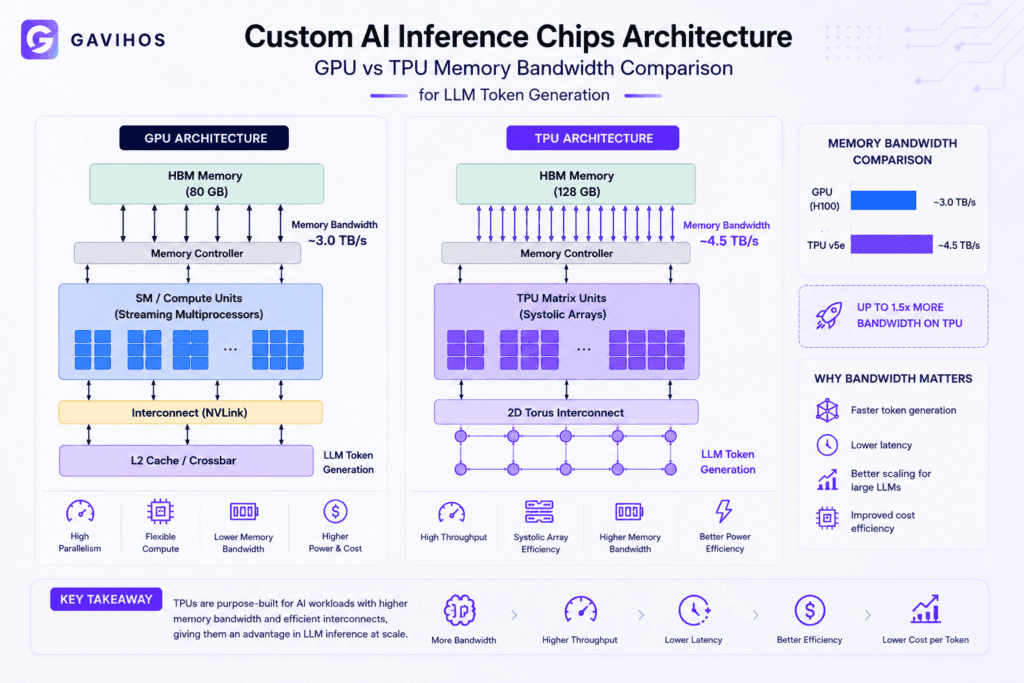
The bottleneck became clear. LLM inference is memory-bandwidth-bound during token generation. The critical insight is that generating each token requires reading the model’s full weights from memory. For a 70B parameter model, that is roughly 140GB of data read per token batch. NVIDIA GPUs have enormous compute capacity but relatively limited memory bandwidth per unit of compute for this specific pattern. A chip designed specifically for this can trade raw FLOPS for memory bandwidth and win decisively on inference throughput and cost.
How AI Inference Works
Understanding why custom chips help requires understanding the two phases of LLM inference:
Prefill — processing the prompt. When a user sends a prompt, the model processes all input tokens simultaneously. This is compute-dense, parallel, and resembles training in its resource profile. GPUs handle this well.
Decode — generating the response. After the prompt is processed, the model generates output tokens one at a time. Each token requires reading the entire model’s weights from memory, plus the KV cache — the stored attention keys and values for all previous tokens in the context. This phase is almost entirely bottlenecked by how fast data can be moved from memory to compute.
In the decode phase, a GPU running a large model may be idle on memory reads more than 80% of the time, with compute units waiting for data. Adding more FLOPS does not improve throughput here. Adding memory bandwidth does. Custom inference chips address this directly.
Architecture and Components
| Component | GPU (NVIDIA H100) | Custom Inference Chip Target |
|---|---|---|
| Primary optimization | Training throughput (FLOPS) | Decode throughput (memory bandwidth) |
| Memory | HBM3 off-chip | More HBM, on-chip SRAM, or both |
| Precision focus | FP32, BF16, FP8 | INT8/INT4 focused for inference |
| Software ecosystem | CUDA (dominant) | Custom compilers, catching up |
| Power efficiency | General-purpose | Inference-workload optimized |
KV Cache management is one of the primary engineering challenges custom chips address. As context windows grow — some models now support 1M tokens — the KV cache can be tens of gigabytes per active session. Chips with higher on-chip memory bandwidth, or purpose-built KV cache management hardware, handle this more efficiently than GPUs.
Precision. Inference tolerates lower precision than training. Running a model in INT8 instead of FP32 uses roughly one-quarter of the memory bandwidth for comparable quality output. Custom inference chips often focus on INT8 and INT4 execution pathways that GPUs support but are not optimized for.
Real-World Use Cases
1. Frontier Lab Internal Serving Google routes Gemini API traffic through TPUs for production serving. At billions of daily requests, TPU efficiency versus GPU alternatives translates directly to operating cost. The same calculus applies to Meta’s MTIA for serving recommendation models to billions of users.
2. Reduced API Latency for Developer Applications Groq’s LPU (Language Processing Unit) stores model weights in on-chip SRAM, eliminating the memory bottleneck almost entirely for supported model sizes. The result is sub-100ms time-to-first-token for models that take 300–500ms on equivalent GPU infrastructure. For real-time applications — voice agents, interactive coding assistants — this latency difference is user-visible.
3. Cost-Competitive API Pricing When a lab controls its inference substrate, efficiency gains reduce cost per token. Developers building on top of AI APIs have seen consistent price declines. Custom silicon is one of the structural reasons those declines are sustainable rather than margin-burning.
4. Enterprise Private Cloud Deployment AWS Inferentia and Google Cloud TPUs give enterprise teams access to custom inference silicon without building their own chips. Organizations running AI models in private cloud environments can use Inferentia instances for inference workloads rather than competing for H100 GPU availability.
5. Edge and Device Inference Apple’s Neural Engine demonstrates the custom chip approach at device scale — running foundation models locally on iPhones and Macs at latencies and power budgets cloud inference cannot match. On-device inference for privacy-sensitive applications, offline operation, and low-latency interaction all depend on purpose-built inference hardware.
Benefits
Memory bandwidth efficiency. Custom chips outperform GPUs in the decode phase not because of more compute, but because of better memory architecture for this specific workload.
Cost at scale. Once development investment is amortized, custom chips running inference at scale are cheaper per token than equivalent GPU capacity.
Strategic supply independence. Labs that own inference hardware are not subject to NVIDIA’s allocation priorities, pricing changes, or production constraints.
Hardware-software co-design. Owning both the chip and the model serving software allows optimizations that are impossible when the hardware is a third-party product designed for multiple use cases.
Limitations
Enormous upfront investment. Custom ASIC design and manufacturing costs hundreds of millions of dollars before production. Only organizations running inference at extraordinary scale can justify this.
CUDA ecosystem gap. NVIDIA’s competitive moat is its software ecosystem — CUDA, cuDNN, and thousands of tools built on top of them. Custom chips require rebuilding or porting this entire stack. Google’s XLA and Meta’s compiler work represent years of investment to close this gap.
Architecture risk. A chip designed for transformer attention may be poorly suited to future model architectures. If the field moves to a fundamentally different design — state-space models, for example — custom chips built for today’s workloads become expensive legacy hardware.
Engineering Tradeoffs
What improves: Memory bandwidth per watt for transformer decode, cost per token at scale, latency for memory-bound inference phases, independence from third-party hardware supply chains.
What becomes harder: Software portability. Code optimized for CUDA does not run on TPUs, Inferentia, or Jalapeño without porting work.
What new complexity is introduced: Multi-chip coordination for models too large to fit on a single chip. Pipeline parallelism and tensor parallelism become more complex on lab-specific interconnects than on NVLink.
What operational costs increase: Custom chips require custom expertise. Teams running TPU or Inferentia workloads need engineers who understand those specific programming models, not just general GPU optimization.
When not to use: Custom AI inference chips are not a startup strategy. For organizations not running inference at massive scale, cloud GPU instances remain the correct choice. The development cost of custom silicon only makes sense after the scale at which it pays for itself has been reached and sustained.
Best Practices
Benchmark on your real workload, not peak specs. Published chip benchmarks often measure theoretical FLOPS or bandwidth. What matters is end-to-end latency and throughput at your specific model size, batch size, and sequence length distribution.
Separate training and inference hardware decisions. The optimal chip for training is often not optimal for serving. Plan them independently.
Monitor memory bandwidth utilization, not just GPU utilization. High GPU utilization with low throughput during inference is a sign the workload is memory-bound — the signal that custom hardware or quantization would help most.
Account for software stack migration cost. Moving to TPUs, Inferentia, or future platforms requires porting model serving code. This cost is real and often underestimated.
Common Mistakes
Conflating training benchmarks with inference performance. A chip that trains faster is not necessarily faster at serving. The workload profile is fundamentally different.
Using GPU utilization percentage as an efficiency metric. A GPU at 95% utilization during decode may be waiting on memory reads 80% of that time. Utilization alone does not tell you whether the hardware matches the workload.
Underestimating the software ecosystem switching cost. Teams that have adopted custom inference chips and returned to NVIDIA consistently cite software tooling and debugging capability as the reason, not hardware performance.
What Most People Get Wrong
“Custom chips compete with NVIDIA on FLOPS.” They do not. Custom inference chips target the memory bandwidth bottleneck in the decode phase. FLOPS are largely irrelevant to that problem.
“NVIDIA will build a better inference chip and solve this.” NVIDIA does improve inference performance generation over generation. But NVIDIA must design chips that also train models — its customers need both. Labs building inference-only chips do not have this constraint and can optimize more aggressively for the inference workload.
“This only matters to the big labs.” It matters to every developer building on AI APIs because it determines the long-term pricing and latency trajectory of those APIs. A lab that controls its inference substrate has cost flexibility that a lab renting GPU capacity does not.
Future Outlook
Specialization will deepen. Chips optimized for attention-heavy transformer workloads will diverge further from general-purpose processors. New architectures — Mamba, RWKV variants — have different computational profiles. If they become dominant, today’s inference hardware will need to adapt.
The software ecosystem gap will narrow. The OpenXLA initiative, Torch-XLA improvements, and compiler-based approaches are gradually making custom hardware more accessible. In two to three years, porting a model serving stack to non-NVIDIA hardware will be meaningfully easier than today.
More labs will build custom silicon. Any AI provider that reaches sufficient inference scale will eventually face the same economic calculation. NVIDIA’s inference market share will decline over the next five years — slowly at first, then faster as software ecosystem gaps close.
FAQ
Q: What is the difference between AI training and inference hardware? Training hardware maximizes FLOPS and large memory for storing gradients. Inference hardware maximizes memory bandwidth for reading model weights quickly during token generation. The optimal chip design differs for each.
Q: What is OpenAI Jalapeño? Jalapeño is OpenAI’s first custom LLM inference accelerator, announced June 24, 2026, built in partnership with Broadcom. It is designed to run OpenAI models more efficiently than NVIDIA GPUs for inference workloads.
Q: Why is LLM inference memory-bandwidth-bound? Each generated token requires reading the model’s full weights from memory. For a 70B parameter model at BF16 precision, that is roughly 140GB read per token batch. GPU compute units wait on these memory reads. More FLOPS do not help. More memory bandwidth does.
Q: What is a TPU and how does it differ from a GPU? A TPU is Google’s custom chip for AI workloads. Its systolic array architecture is optimized for the matrix multiplications in transformer layers. Unlike GPUs, which are general-purpose programmable processors, TPUs are less flexible but more efficient for the specific operations they target.
Q: Does custom inference hardware affect API pricing? Yes, over time. Lower cost per token gives labs more pricing flexibility. Consistent API price declines since 2022 reflect both software and hardware improvements. Custom silicon accelerates the hardware component.
Q: Can developers access custom AI inference hardware? Through cloud platforms — Google Cloud TPUs, AWS Inferentia. Setup requires more configuration than GPU instances but is accessible without building your own chips.
Q: Why does NVIDIA still dominate if custom chips are more efficient for inference? CUDA ecosystem lock-in. Thousands of AI frameworks and tools are built for CUDA. Moving to custom hardware means porting your software stack — a significant engineering investment.
Q: What is the KV cache? The KV cache stores attention keys and values computed for all previous tokens in a context window. As context windows grow, the KV cache can be tens of gigabytes per active session. Managing it efficiently is a primary challenge in LLM inference serving.
Q: What is Groq’s LPU and why is it fast? Groq’s Language Processing Unit stores model weights in on-chip SRAM rather than off-chip HBM. On-chip SRAM has dramatically higher bandwidth, eliminating the memory bottleneck in decode. The tradeoff: SRAM is expensive per byte, limiting supported model sizes.
Q: What does this mean for developers building AI applications? Near-term: no direct impact — you still use the same APIs. Medium-term: API pricing will continue declining. Long-term: multi-provider inference routing — sending requests to whichever platform is cheapest or fastest at a given moment — will become a standard infrastructure pattern.
Analyst Perspective
The Jalapeño announcement is less interesting as a product than as a signal about market structure.
NVIDIA’s GPU dominance in AI was always contingent on two conditions: that no one had sufficient scale to justify building alternatives, and that CUDA switching costs remained prohibitive. The first condition is now false for at least five organizations. The second is eroding as compiler infrastructure matures.
The second-order effect most coverage misses: as frontier labs move inference off NVIDIA, NVIDIA’s revenue becomes more concentrated in training — a market with fewer buyers, lower frequency purchasing, and increasing price sensitivity as training costs rise. NVIDIA’s inference revenue, which grew substantially as model deployment scaled, will face competitive pressure from every direction simultaneously.
For developers, the practical conclusion is simple: AI API pricing is structurally deflationary. Custom inference silicon accelerates the cost decline curve. What costs $10 per million tokens today will cost $1 within two to three years — not because models get worse, but because the infrastructure running them gets more efficient. Build with that trajectory in mind.
Key Takeaways
- LLM inference is memory-bandwidth-bound during token generation — custom chips outperform GPUs here by targeting the memory bottleneck, not compute.
- Google, Meta, Amazon, and OpenAI are all running or building custom inference silicon. This is a structural industry shift, not isolated experimentation.
- NVIDIA’s real moat is CUDA and its software ecosystem, not hardware performance. Custom chips require years of software investment to match this.
- For developers, this determines the long-term pricing and latency trajectory of the AI APIs they build on. Custom inference silicon makes APIs cheaper over time.
- The decode phase of LLM inference — generating each token — is the bottleneck custom chips address. Understanding this is the key to reasoning about hardware, latency, and cost.
Continue Learning
- What is Claude Fable 5?
- What is RAG? Retrieval-Augmented Generation Explained
- What is MCP? Model Context Protocol Explained
About GAVIHOS
GAVIHOS helps developers, founders and technology enthusiasts understand AI, software engineering and emerging technologies through practical guides, tutorials and industry analysis.
Stay Updated
Follow GAVIHOS for practical AI, technology and developer-focused insights.