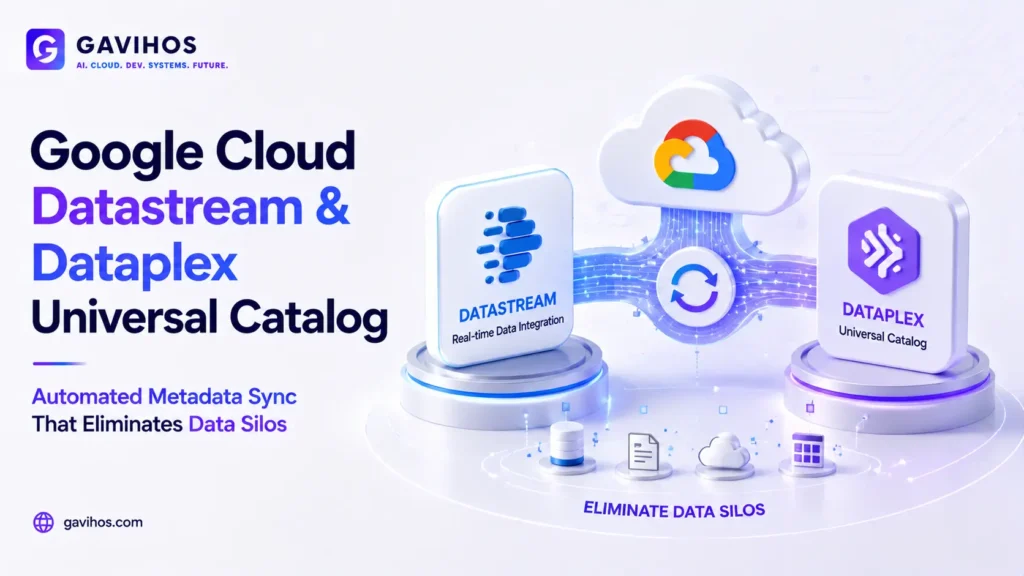
On July 2, 2026, Google Cloud announced that Datastream, its change-data-capture and replication service, now integrates directly with Dataplex Universal Catalog, automating the metadata sync between the two. In practical terms: as data flows through Datastream pipelines, Dataplex Universal Catalog registers and tracks that data automatically, instead of requiring a separate manual cataloging step.
This is a small-sounding feature with a genuinely useful purpose — it targets one of the most persistent, unglamorous problems in enterprise data engineering: data silos, where datasets exist without being discoverable, documented, or governed by the rest of the organization.
This analysis covers what was announced, why the integration matters more than it might initially appear, and what it means for data engineers and organizations relying on Google Cloud’s data platform.
What Happened
Google Cloud confirmed, via its official blog, that Datastream now feeds metadata directly into Dataplex Universal Catalog as part of its July 2026 platform updates. According to the announcement, this integration is designed specifically to eliminate data silos by keeping the catalog automatically current with data as it moves through connected pipelines, rather than depending on manual registration.
This update was part of a broader set of July 2026 Google Cloud platform changes that also included Gemini 3.1 Pro entering preview on Vertex AI and a new Workbench Notebooks IDE extension — but the Datastream-to-Dataplex Universal Catalog integration is the most directly relevant to data engineering teams specifically, as distinct from AI model access changes.
A note on sourcing: this update was surfaced through Google Cloud’s general “What’s New” blog roundup rather than a specific, isolated announcement post. The core claim — that this integration exists and reached this milestone around July 2, 2026 — is confirmed via Google’s own official blog, which meets GAVIHOS’s Priority 1 sourcing standard. Readers building on this specific feature should confirm current documentation directly at cloud.google.com, since exact rollout details can change between a platform update announcement and general availability.
Why It Matters
Automated cataloging addresses catalogs’ most common failure mode. Historically, data catalog initiatives fail not because the catalog software doesn’t work, but because keeping it updated depends on humans remembering to register new data assets — a discipline that reliably degrades under normal engineering pressure. Connecting cataloging directly to a data movement service removes that dependency: the catalog updates because the data can’t move through the pipeline without it being seen.
This is a concrete instance of a broader industry pattern. Cloud providers are increasingly integrating governance and cataloging directly into their core data infrastructure products, rather than treating cataloging as a separate, bolt-on tool. This changes how organizations should evaluate data platform vendors — cataloging capability is becoming a built-in expectation, not an add-on purchase decision.
Data silos have measurable costs that this directly targets. Duplicated engineering effort, slow compliance responses, and unreliable AI training-data governance are all downstream effects of undiscoverable data. A feature that keeps a catalog automatically synchronized with actual data movement is a direct, practical mitigation for all three.
Industry Impact
This update reinforces a trend visible across major cloud data platforms: the boundary between “data movement” tooling (streaming, replication, ETL) and “data governance” tooling (cataloging, lineage, classification) is narrowing. Competing platforms are likely to face pressure to offer similarly tight integration between their CDC/streaming services and their metadata/catalog products, rather than requiring customers to stitch these together with third-party tools.
For organizations evaluating cloud data platforms, native catalog integration is likely to become a more prominent evaluation criterion going forward — not because cataloging itself is new, but because automated, always-current cataloging removes a maintenance burden that has historically undermined the category’s practical value.
Developer Impact
For data engineers already on Google Cloud: This integration reduces the operational burden of keeping a data catalog current — new data assets flowing through Datastream should appear in Dataplex Universal Catalog without a separate manual cataloging step, assuming the pipelines are properly connected.
For teams evaluating cloud data platforms: This is a useful data point when comparing how seriously different providers have integrated governance into their core data movement tooling, versus treating cataloging as a separate purchase or open-source add-on.
For teams building AI/ML pipelines on Google Cloud: Automated, current metadata and lineage tracking directly supports the increasingly common requirement to document where AI training data came from and how it has been governed — a requirement that’s becoming both a best practice and, in some jurisdictions, a compliance expectation.
Business Impact
For enterprises with compliance obligations: Automated lineage and cataloging make it faster and more defensible to answer “where does this data live and how is it used” — a question that regulators and auditors increasingly expect organizations to answer quickly and accurately, not reconstruct manually.
For Google Cloud competitively: Tighter native integration between data movement and governance tooling is a meaningful differentiator in enterprise data platform evaluations, where the operational cost of maintaining a catalog has historically been a real, if underappreciated, factor in total cost of ownership.
For organizations with significant legacy, undocumented data estates: This kind of integration is most valuable going forward — it doesn’t retroactively catalog existing undocumented pipelines, so organizations with substantial legacy data debt will still need a separate, deliberate effort to bring existing assets into the catalog.
Future Outlook
The most direct thing to watch is how completely this integration covers Google Cloud’s broader data ecosystem — whether it extends beyond Datastream-sourced data to other ingestion paths, and how quickly it moves from Public Preview toward general availability.
More broadly, expect competing cloud data platforms to pursue similar native integrations between their CDC/streaming and cataloging products over the coming months, following the same underlying logic: catalogs that depend on manual maintenance underperform catalogs wired directly into how data actually moves.
FAQ
1. What did Google Cloud announce on July 2, 2026? Google Cloud confirmed that Datastream, its change-data-capture service, now integrates directly with Dataplex Universal Catalog, automating metadata sync to help eliminate data silos.
2. What is Datastream? Datastream is Google Cloud’s change-data-capture and replication service, used to detect and move data changes from source systems into destination systems or pipelines.
3. What is Dataplex Universal Catalog? Dataplex Universal Catalog is Google Cloud’s managed data catalog and governance product, used to discover, document, and govern data assets across an organization’s data estate.
4. What problem does this integration solve? It addresses data silos and stale catalogs by automatically registering and tracking metadata as data flows through Datastream pipelines, rather than requiring manual cataloging.
5. Does this replace the need for manual data documentation entirely? No. Automated metadata extraction covers schema, lineage, and movement, but business context (why a dataset exists, who depends on it) generally still requires human input.
6. Is this feature generally available? As announced, this integration is part of Google Cloud’s July 2026 platform updates; readers should confirm current availability status directly via Google Cloud’s official documentation, since features can move from preview to general availability over time.
7. How does this relate to AI and machine learning governance? Automated, current lineage tracking makes it easier to document where AI training data originated and how it has been governed — an increasingly important requirement for responsible AI development.
8. Does this only benefit large enterprises? The benefit scales with data complexity and cross-team dependency rather than company size specifically — any organization with multiple interdependent data pipelines benefits from reduced manual cataloging overhead.
9. What’s the broader industry trend this fits into? Cloud data platforms are increasingly integrating cataloging and governance directly into core data movement products, rather than treating cataloging as a separate, bolt-on tool.
10. Where can I find official documentation on this? Google Cloud’s official blog and Dataplex documentation at cloud.google.com are the authoritative sources — confirm current details there before implementing.
Analyst Perspective
The specific feature here is modest — connecting one service (Datastream) to another (Dataplex Universal Catalog) — but the underlying logic is worth paying attention to independently of Google Cloud specifically. Data catalog initiatives have a long history of underdelivering relative to their promise, and the recurring reason is almost always the same: the catalog depended on someone remembering to keep it updated, and that discipline didn’t survive contact with real engineering workloads.
Wiring cataloging directly into a data movement service changes that failure mode structurally rather than trying to fix it with better catalog UX, more thorough documentation processes, or organizational mandates to “keep the catalog updated.” If the catalog only knows what the data movement layer tells it, and the data movement layer is unavoidable — you can’t get data from a source to a destination without going through it — then the catalog’s currency stops depending on voluntary human behavior.
The more consequential trend this points toward is what happens to the AI training-data governance conversation as automated lineage becomes the default rather than the exception. Organizations that can trace their AI training data’s provenance automatically will find increasingly common transparency and compliance requests inexpensive to answer. Organizations that can’t will find those same requests expensive, slow, and increasingly difficult to avoid as regulatory expectations rise. This single feature is a small piece of that larger shift, but it’s evidence of where the major cloud platforms are placing their bets.
Key Takeaways
- Google Cloud confirmed on July 2, 2026 that Datastream now integrates directly with Dataplex Universal Catalog, automating metadata sync to reduce data silos
- The integration addresses data catalogs’ most common failure mode: dependence on manual, voluntary maintenance that degrades over time
- This fits a broader industry pattern of cloud providers integrating governance/cataloging directly into core data movement infrastructure
- The feature is most valuable for data flowing through Datastream going forward — it does not retroactively catalog existing undocumented legacy pipelines
- Automated lineage tracking directly supports increasingly common AI training-data governance and compliance requirements
- Confirm current availability and scope directly via Google Cloud’s official documentation before building on this specific feature
Continue Learning
- AI Export Controls Explained: How Government Policy Shapes Model Access
- What Is AI for Science? Complete Guide to AI Research Workbenches
- Vercel AI SDK Complete Guide: How to Build AI Applications in TypeScript
- What is RAG? Complete Guide to Retrieval-Augmented Generation
About GAVIHOS
GAVIHOS helps developers, founders and technology enthusiasts understand AI, software engineering and emerging technologies through practical guides, tutorials and industry analysis.
Stay Updated
Follow GAVIHOS for practical AI, technology and developer-focused insights.
External Links
| Source | URL |
|---|---|
| Google Cloud Blog — What’s New | https://cloud.google.com/blog/topics/inside-google-cloud/whats-new-google-cloud |
| Google Cloud — Dataplex Universal Catalog Documentation | https://cloud.google.com/dataplex/docs/universal-catalog-overview |