Introduction
On June 26, 2026, OpenAI announced three new models — Sol, Terra, and Luna — under the GPT-5.6 family. The announcement is significant not because it follows a new model release, but because of what it reveals about where AI model development is heading: deliberate product differentiation by capability tier, active government involvement in frontier model access, and a continued shift toward models built specifically for agentic workloads.
For developers, OpenAI GPT-5.6 is not just a performance upgrade. It is a pricing and architecture decision point. Understanding why OpenAI released three variants instead of one — and what each is optimized for — matters for every team building on the OpenAI API.
What Happened
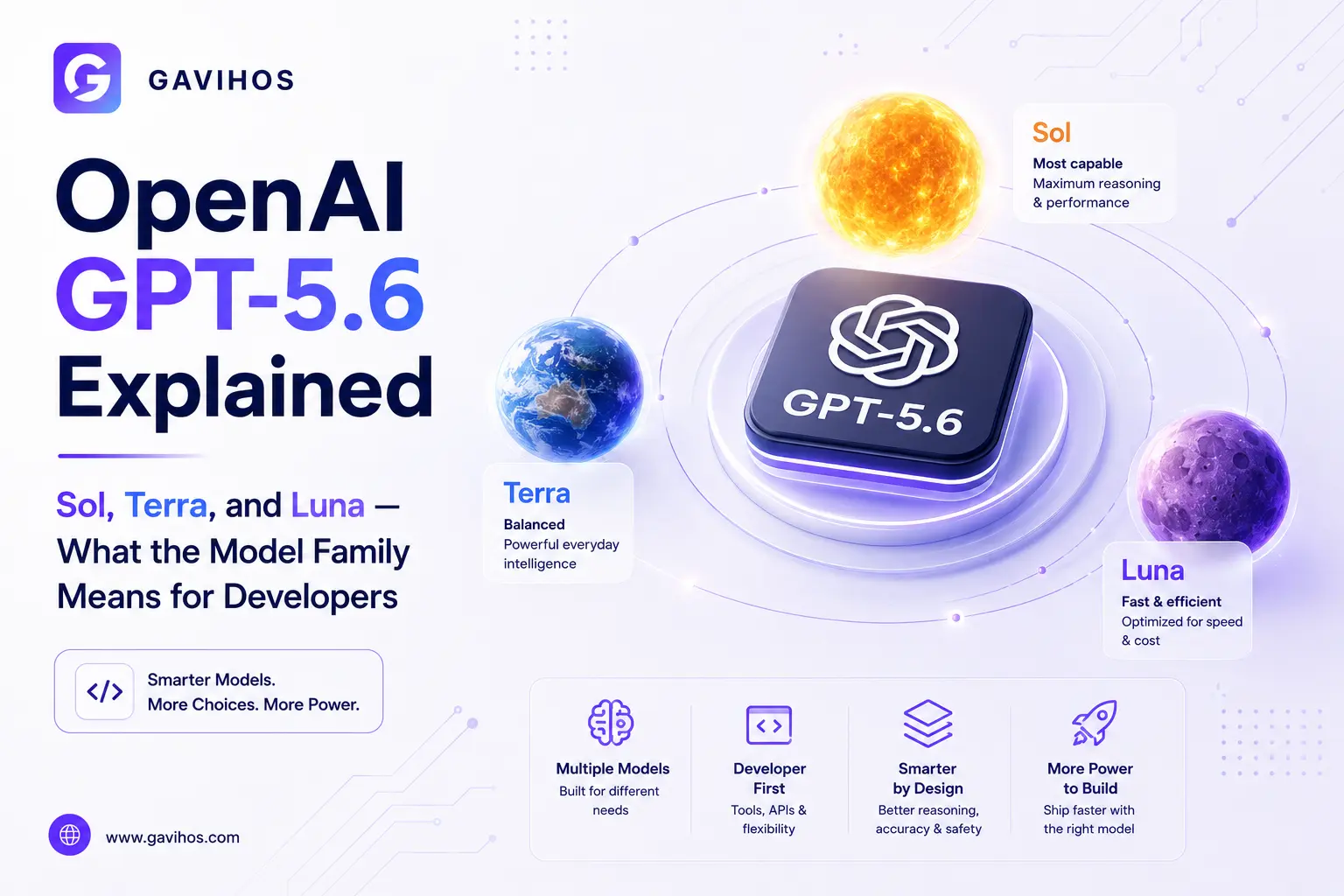
OpenAI began a limited preview of GPT-5.6 on June 26, 2026. The preview includes three distinct models:
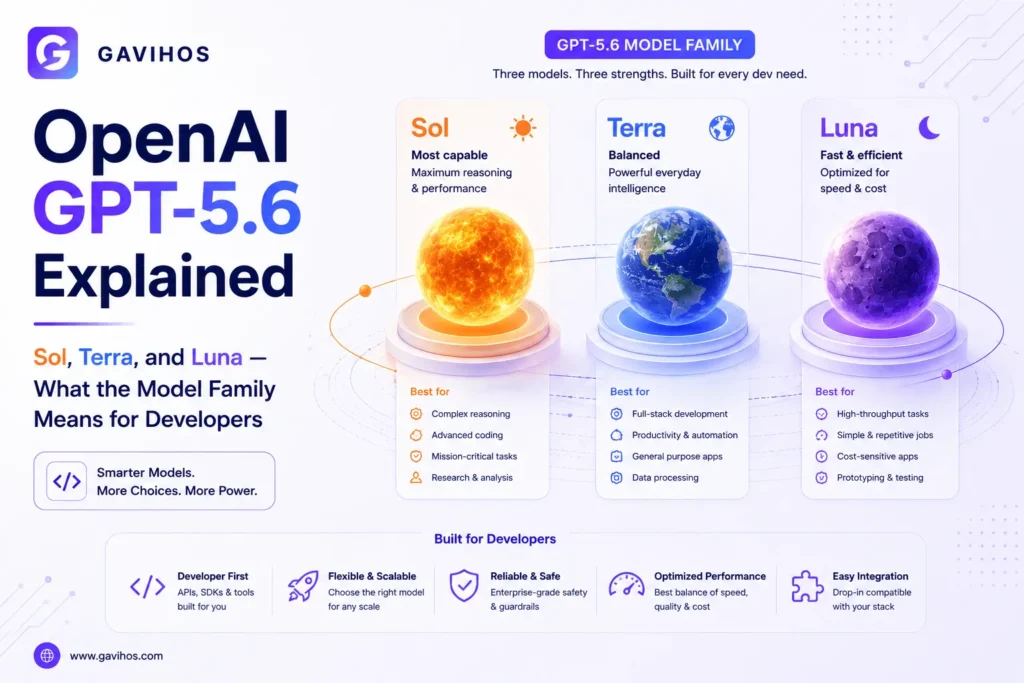
Sol is the flagship model in the family. It is positioned for the most demanding tasks: complex multi-step reasoning, long-horizon agentic workflows, advanced coding, and security-focused applications. Pricing is $5.00 per million input tokens and $30.00 per million output tokens — in line with frontier model pricing but significantly higher than GPT-5.5.
Terra is positioned as a balanced everyday model. OpenAI describes its performance as competitive with GPT-5.5 while being 2x cheaper to run. It is the practical choice for applications that need strong general capability without the cost overhead of Sol.
Luna is the fastest and most affordable model in the family. It is tuned for speed and low cost, suited for high-frequency inference tasks where response latency matters more than frontier reasoning depth.
Access to all three models is initially restricted to roughly 20 companies whose participation was approved by the US government. OpenAI has stated it plans broader availability “in the coming weeks.” GPT-4.5 was simultaneously deprecated from ChatGPT, with existing conversations migrating to GPT-5.5.
Why It Matters
The Three-Tier Model Strategy Is Now Standard
This is not the first time a major AI lab has released a tiered model family. Anthropic ships Haiku, Sonnet, and Opus. Google ships Flash, Pro, and Ultra. But the GPT-5.6 release makes the three-tier pattern universal across the top providers, and the terminology is settling: fast/cheap, balanced, and frontier.
This matters because it changes how developers architect AI applications. The question is no longer “which model do I use?” — it is “which tier is appropriate for this step in my pipeline?” A complex agentic workflow might use Sol for planning and reasoning, Terra for execution steps, and Luna for high-frequency tool calls or retrieval. Routing between tiers is becoming a standard design pattern, not an optimization.
Government Approval as Access Control Is a New Development
The more structurally significant aspect of the GPT-5.6 release is the government approval requirement for access. OpenAI’s Sol is not available to developers directly — it is available to a set of organizations whose participation was approved by the US government.
This is a meaningful departure from how AI model releases have worked. Historically, a new OpenAI model became available to API customers when it was ready. GPT-5.6 Sol introduces a gating mechanism where government approval is required before commercial access is granted.
This follows a pattern that also appeared with Anthropic’s Claude Mythos 5, which was restricted and then restored to US critical infrastructure organizations in June 2026 with explicit government notification. Two separate labs introducing government-mediated access controls for their most capable models in the same week is not a coincidence — it is the early shape of AI governance infrastructure.
Sol Is Built for Agentic Workloads
The specific capabilities OpenAI highlights for Sol — long-horizon planning, extended coding sessions, agent-driven workflows — indicate that frontier model design is now primarily oriented toward agentic use rather than single-turn chat. Sol is not just a more capable model. It is a more capable agent execution environment.
This matters for teams building autonomous systems. Models that reason over long contexts, maintain state across steps, and execute multi-part plans without losing coherence are the critical component in agentic architectures. Sol is positioned as the planning and reasoning core that other tools and models can be orchestrated around.
Industry Impact
The simultaneous release of three models instead of one signals that OpenAI is competing across price segments simultaneously. This is a direct response to competition from Anthropic (which had already established three-tier pricing) and Google (whose Gemini Flash was already GA at competitive prices while Pro remained delayed).
For the AI API market, three-tier families create new competitive dynamics. The race is no longer purely for frontier performance — it is for price-performance ratio at each tier. Terra competing with GPT-5.5 at 2x lower cost means GPT-5.5 will see reduced usage immediately. Luna competing on speed creates pressure on flash-class models from other providers.
The government access mechanism for Sol also creates a division in the market: organizations with government relationships or regulatory standing get frontier access first. This may accelerate enterprise AI adoption among defense contractors, critical infrastructure operators, and government agencies while other developers wait for the broader rollout.
Developer Impact
For teams using the OpenAI API, GPT-5.6 introduces decisions that did not exist before.
Routing decisions become architectural. If Sol, Terra, and Luna all remain in production after general availability, developers will need to decide which model to use for each step in their pipeline — and why. This is the same decision AWS developers make with EC2 instance families: right-sizing matters. Using Sol for every call the way some teams used GPT-4 for everything will be expensive. Using Luna for tasks that require multi-step reasoning will produce worse results.
GPT-4.5 deprecation has an immediate effect. GPT-4.5 is no longer available in ChatGPT as of June 26. Developers who built custom GPTs or API integrations on GPT-4.5 need to migrate. OpenAI is routing those calls to GPT-5.5, but behavior differences may exist.
Limited preview creates a planning gap. GPT-5.6 Sol is not available to most developers yet. Teams that want to build on it need to plan for a rollout window of weeks rather than days. During this period, GPT-5.5 remains the accessible frontier model.
Sol pricing requires cost modeling. At $5/$30 per million tokens, Sol is expensive at scale. A production application making 10 million output tokens per day would spend $300,000 per day on Sol alone. That cost structure is appropriate for certain enterprise workflows — it is not appropriate for consumer products or high-volume pipelines where Terra or Luna would perform adequately.
Business Impact
For organizations planning AI strategy, GPT-5.6 reinforces several decisions that have been building for months.
Model selection is now a cost center, not just a technical choice. The 10x price difference between Luna and Sol means that choosing the wrong tier for a workload can produce significant cost overruns at scale. Finance teams at organizations deploying AI at volume are now asking the same questions that cloud infrastructure teams have asked for a decade: what is the minimum compute required to meet SLA?
The government access pathway is worth understanding. Organizations in defense, critical infrastructure, and regulated industries that can access Sol before general availability have a potential competitive window. Building on Sol during limited preview — even at higher cost — may allow capabilities that competitors cannot replicate until broader access is granted.
IPO and funding context. OpenAI’s model release cadence is also a signal of its fundraising and IPO preparation posture. Multiple model tiers across multiple price points allows OpenAI to demonstrate revenue diversity and addressable market breadth to investors. The GPT-5.6 family is a product strategy as much as a technical strategy.
Future Outlook
The immediate near-term event is general availability. OpenAI said “coming weeks” — most likely July 2026. When GA happens, the first wave of developer adoption will reveal whether Sol’s capabilities justify its pricing at scale or whether Terra becomes the de facto standard the way GPT-4-turbo did after GPT-4.
The more significant trend is the consolidation of three-tier model families as an industry standard. Within six months, every major AI lab will have a fast/cheap, balanced, and frontier tier in production. The differentiation will shift from “which lab’s model is better?” to “which lab’s three-tier family offers the best routing flexibility, pricing structure, and API reliability?”
The government access mechanism for frontier models is likely to expand. If Sol proves commercially successful with the initial approved cohort, other governments — EU, Japan, UK — will likely develop their own frameworks for accessing frontier models before general release. This creates a new kind of market stratification: government-approved early access tier above the commercial GA tier.
For developers, the practical implication is to build architectures that are model-agnostic at the call level — not locked to a specific model, but routing to the appropriate tier based on the task. That architecture is more complex to build but dramatically more resilient to the model releases, deprecations, and pricing changes that are now happening every few months.
FAQ
1. What is GPT-5.6 Sol? Sol is OpenAI’s flagship model in the GPT-5.6 family, built for complex reasoning, long-horizon agentic tasks, and advanced coding. It is priced at $5 per million input tokens and $30 per million output tokens and is currently in limited preview for government-approved organizations.
2. What is the difference between GPT-5.6 Sol, Terra, and Luna? Sol is the frontier model — highest capability, highest cost. Terra is the balanced model — GPT-5.5-level performance at 2x lower cost. Luna is the fastest and cheapest model in the family, optimized for speed and affordability.
3. When will GPT-5.6 be available to all developers? OpenAI has stated general availability is coming “in the coming weeks” as of June 26, 2026. No specific date has been committed publicly.
4. Why does GPT-5.6 require government approval? OpenAI is running a limited preview specifically for organizations approved by the US government, citing the model’s advanced capabilities and safety considerations. This follows a similar pattern with Anthropic’s Claude Mythos 5 being restricted and then restored with government notification.
5. What happened to GPT-4.5? GPT-4.5 was deprecated from ChatGPT on June 26, 2026. Existing conversations continue on GPT-5.5. Developers using GPT-4.5 via the API should plan migration.
6. How does GPT-5.6 Sol pricing compare to GPT-5.5? Sol is priced at $5/$30 per million input/output tokens. GPT-5.5 pricing is lower — Terra is positioned as 2x cheaper than GPT-5.5, which provides a reference point for the relative cost.
7. Should I use Sol, Terra, or Luna for my application? It depends on the task. Sol is appropriate for complex reasoning, planning, and agentic workflows where accuracy is critical. Terra is appropriate for general-purpose tasks where cost matters. Luna is appropriate for high-frequency, latency-sensitive calls where speed and cost efficiency matter most.
8. Is GPT-5.6 available in ChatGPT? As of the June 26 announcement, GPT-5.6 is only available in API limited preview for approved organizations — it is not in the consumer ChatGPT product yet.
9. What does “long-horizon agentic work” mean for Sol? It means Sol is specifically optimized for tasks where an AI needs to maintain context and execute a plan across many steps — like writing and debugging a complex codebase, running a multi-stage research workflow, or managing a series of tool calls across an extended session without losing track of the goal.
10. How does GPT-5.6 compare to Anthropic’s Claude Opus 4.8? Both are positioned as frontier models for complex reasoning and agentic tasks. Direct benchmark comparisons are not yet publicly available for GPT-5.6 Sol vs Claude Opus 4.8. Both are in the same price range and capability tier. Developers evaluating them should run task-specific evaluations relevant to their use case rather than relying on general benchmarks.
Analyst Perspective
The government approval mechanism is the most significant signal in this announcement, and it is receiving far less attention than the model capabilities.
Two major AI labs — OpenAI and Anthropic — introduced government-mediated access controls for their most capable models within the same week. This is the first time the US government has acted as a gatekeeper for commercial AI access. It will not be the last.
The pattern that is forming: frontier AI models are being treated more like regulated dual-use technology than commercial software. This is functionally similar to how export controls work in semiconductors and defense electronics — the most capable versions require approval, while commodity versions remain freely available.
For developers, the near-term effect is limited — Sol will reach general availability soon. The long-term effect is more consequential. If this pattern holds, the AI capability frontier will be accessible first to organizations with government relationships, creating an asymmetric advantage in applications that require maximum model capability. Organizations that have not thought about their relationship with government approval processes for AI access should start.
What most coverage is missing: Terra is probably the more important model. Sol will get the headlines. Terra — competitive with GPT-5.5 at 2x lower cost — is what will actually shift developer behavior at scale. If Terra delivers on that positioning, it makes GPT-5.5 obsolete for most use cases almost immediately.
Key Takeaways
- GPT-5.6 introduces three models — Sol (frontier), Terra (balanced), Luna (fast/cheap) — normalizing three-tier model families as the industry standard
- Sol requires government approval for access during limited preview, marking a new phase in AI governance where governments mediate frontier model access
- Sol is priced at $5/$30 per million tokens and is optimized for long-horizon agentic workflows and complex reasoning
- Terra is positioned as 2x cheaper than GPT-5.5 with competitive performance — this may make GPT-5.5 effectively obsolete for most use cases
- GPT-4.5 has been deprecated from ChatGPT; developers on GPT-4.5 should plan migration to GPT-5.5 or Terra when available
- General availability of all three GPT-5.6 models is expected in the coming weeks
Continue Learning
- What is Claude Fable 5? Complete Guide to Anthropic’s Latest AI Model
- Claude Extended Thinking Mode Is Now Generally Available: What Developers Need to Know
- What Are AI Agents? Architecture, Memory, Tools and Real-World Use Cases
- What is Agentic AI? How Autonomous AI Systems Think and Act
About GAVIHOS
GAVIHOS helps developers, founders and technology enthusiasts understand AI, software engineering and emerging technologies through practical guides, tutorials and industry analysis.
Stay Updated
Follow GAVIHOS for practical AI, technology and developer-focused insights.
External Links
| Source | URL |
|---|---|
| OpenAI GPT-5.6 Official Announcement | https://openai.com/index/previewing-gpt-5-6-sol/ |