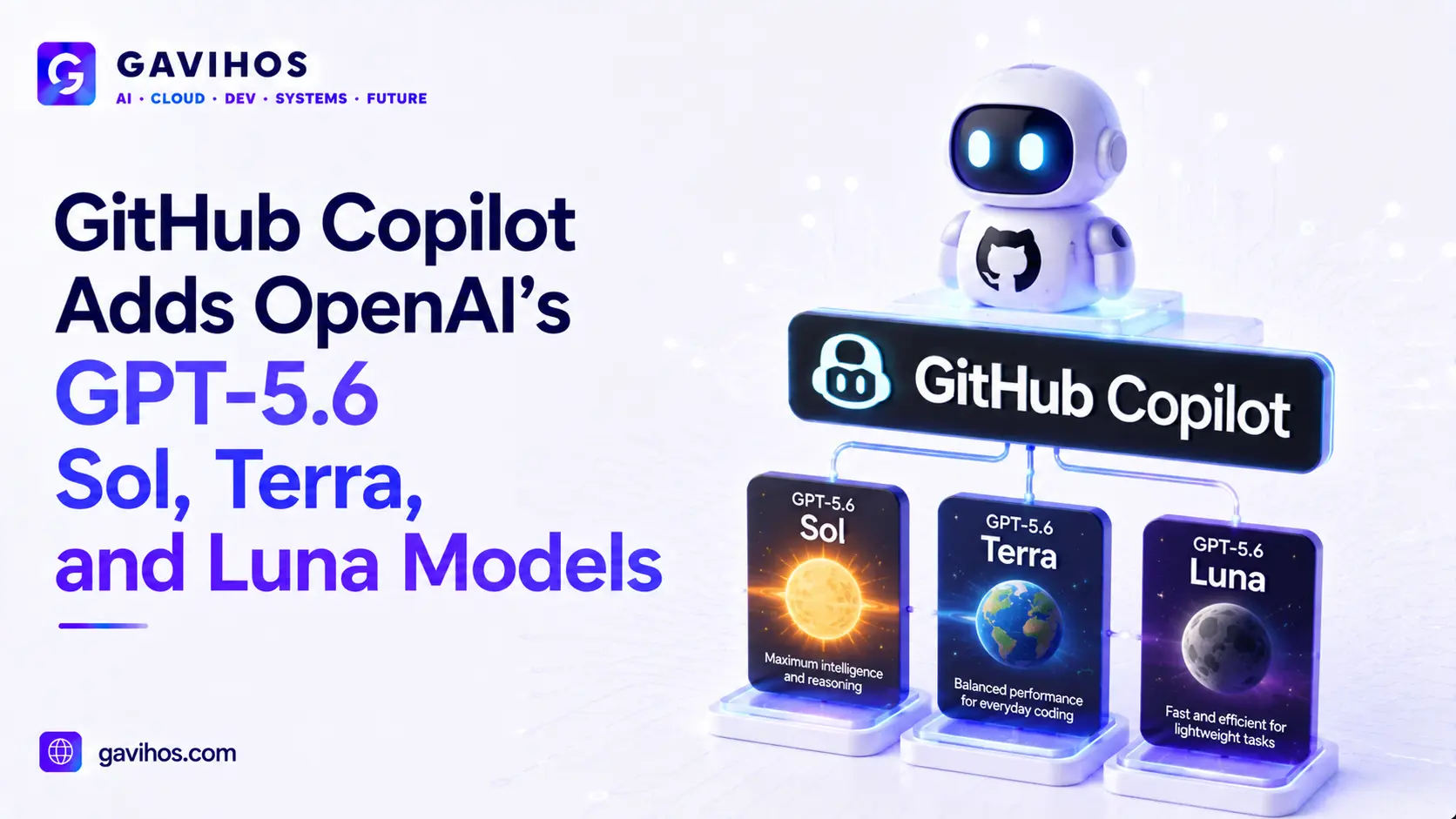
Millions of developers open GitHub Copilot every day without thinking much about which AI model is actually answering them. That changed again this week. On July 9, 2026, GitHub confirmed that OpenAI’s GPT-5.6 family — three separate models named Sol, Terra, and Luna — is now available inside Copilot, giving developers an explicit choice between a heavyweight reasoning model, a balanced everyday option, and a fast, low-cost one.
It’s a small-sounding changelog entry with a real consequence: the model you pick now directly affects how Copilot reasons about your code, how fast it responds, and what it costs your organization. This article explains exactly what GitHub announced, why a three-way model split matters more than a typical version bump, and what it means for developers and the teams that pay for Copilot seats.
What Is GitHub Copilot’s GPT-5.6 Rollout?
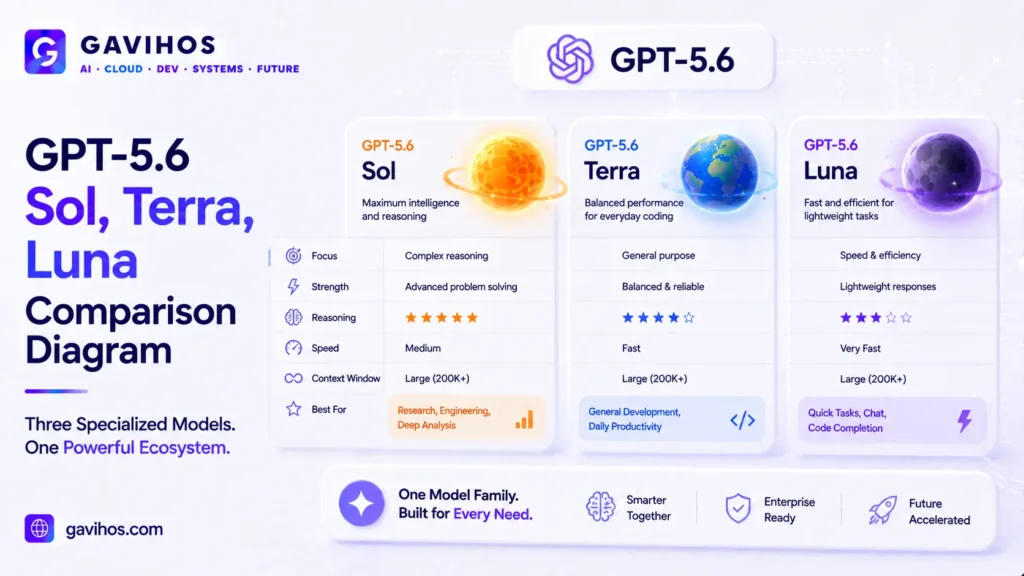
GitHub’s official changelog states that OpenAI’s GPT-5.6 Sol, Terra, and Luna are now available in GitHub Copilot, giving developers a choice of model tuned to different kinds of work rather than a single, one-size-fits-all model. According to GitHub’s description, GPT-5.6 Sol has the highest reasoning ceiling in the family, aimed at complex reasoning over large codebases and demanding, long-running agentic work. GPT-5.6 Terra is positioned as the balanced default — a strong all-round choice for everyday interactive and agentic coding. GPT-5.6 Luna is the lightweight, cost-efficient variant, intended for smaller, faster tasks, and is also the lowest-cost option in the family.
Plan availability differs by tier: GPT-5.6 Sol is available to Copilot Pro+, Max, Business, and Enterprise subscriptions, while Terra and Luna are also available to standard Pro subscribers. GitHub notes that these models are billed at provider list pricing under usage-based billing, meaning the specific model tier a developer or team uses now has a direct, visible effect on cost, not just on response quality.
Why Does It Matter?
This is a meaningfully different kind of update than a typical “new model available” changelog entry. Rather than replacing one Copilot model with a newer one, GitHub is asking developers (or Copilot itself) to actively choose among three models with genuinely different tradeoffs — reasoning depth, speed, and cost — for every task. That’s a shift from “which AI assistant do we use” to “which model tier fits this specific request,” a decision that now happens continuously rather than once.
For engineering organizations, it also changes how Copilot spend gets managed. Usage-based billing tied to model tier means a team’s Copilot bill now depends partly on how well developers (or automated routing) match tasks to the right tier — using Sol for a quick typo fix wastes money, while using Luna for a demanding refactor risks a weaker result.
Why Now?
This rollout lands just weeks after OpenAI’s original GPT-5.6 Sol/Terra/Luna family launch, which GAVIHOS covered when it was first announced. GitHub’s decision to bring all three tiers into Copilot specifically — rather than picking just the flagship model, as earlier Copilot integrations often did — reflects a broader pattern across the AI coding tool market: vendors are increasingly exposing model choice directly to developers, instead of abstracting it away behind a single “the AI” experience.
Agentic coding workflows are a major driver of this shift. A single Copilot agent session working through a large task might need deep reasoning to plan an approach, then many fast, cheap calls to execute individual steps — exactly the kind of workload GitHub describes Sol handling for “long-running agentic work” versus Luna’s role in “smaller, faster tasks.” As agentic coding becomes more common, a single fixed model increasingly can’t serve both ends of that workload well, which is pushing tools like Copilot toward offering — and eventually automatically routing between — multiple model tiers.
Industry Impact
This rollout reinforces a pattern spreading well beyond GitHub: AI vendors are shipping tiered model families as the default release shape, not a single flagship model with an occasional “lite” afterthought. As more coding tools, agent platforms, and AI products adopt this same three-tier (or similar) structure, the ability to route intelligently between tiers — rather than just having access to a powerful model — becomes a genuine point of competitive differentiation between AI coding tools.
It also puts pressure on competing developer tools (from IDEs to other AI coding assistants) to offer comparable model choice and transparent, usage-based pricing, rather than a single flat subscription covering undifferentiated AI usage.
Developer Impact
For individual developers, the immediate practical effect is a new decision to make on nearly every Copilot interaction: which model tier actually fits this task? Complex refactors or reasoning across a large, unfamiliar codebase are reasonable candidates for Sol. Everyday autocomplete-style suggestions and routine interactive coding fit Terra. Small, well-defined edits are a good match for Luna, especially where speed matters more than deep reasoning.
Developers on lower-tier Copilot plans should also note that Sol is currently restricted to Pro+, Max, Business, and Enterprise subscriptions — a plain Pro subscription gets access to Terra and Luna, but not the top reasoning tier, which is worth factoring into any plan-upgrade decision made specifically to access Sol.
Business Impact
For engineering leaders and procurement teams, usage-based billing tied to model tier means Copilot costs are no longer a simple flat number per seat — they now depend on how developers (or any automated routing logic) actually distribute work across Sol, Terra, and Luna. That makes cost monitoring and internal guidance about when to reach for the expensive tier a genuinely useful practice, not a nice-to-have.
Organizations evaluating Copilot against competing AI coding tools should also weigh whether a given competitor offers comparable model choice and transparent tier-based pricing, since that flexibility is becoming a meaningful differentiator rather than a minor feature.
Future Outlook
Expect GitHub, and competing AI coding tools, to move toward automated model routing over time — quietly choosing between Sol, Terra, and Luna based on task characteristics, rather than requiring every developer to make that choice manually for every request. Expect usage-based, tier-differentiated pricing to become the default billing model for AI coding assistants generally, replacing simpler flat-rate subscriptions. And expect this three-tier pattern (or something close to it) to keep appearing across other AI product categories as tiered model families become the standard way vendors release new models.
FAQ
1. What did GitHub announce about GPT-5.6? GitHub confirmed via its official changelog on July 9, 2026 that OpenAI’s GPT-5.6 Sol, Terra, and Luna models are now available inside GitHub Copilot.
2. What is the difference between GPT-5.6 Sol, Terra, and Luna? Sol has the highest reasoning ceiling, built for complex reasoning over large codebases and long-running agentic work. Terra is the balanced default for everyday coding. Luna is the lightweight, cost-efficient option for smaller, faster tasks.
3. Which Copilot plans get access to GPT-5.6 Sol? GPT-5.6 Sol is available to Copilot Pro+, Max, Business, and Enterprise subscriptions. Terra and Luna are also available to standard Pro subscribers.
4. How is GPT-5.6 in Copilot billed? GitHub states these models are billed at provider list pricing under usage-based billing, meaning cost depends on which model tier is actually used, not a flat per-seat rate alone.
5. Do I have to choose the model manually in Copilot? Currently, yes — Copilot lets developers select between Sol, Terra, and Luna directly, rather than routing automatically between them.
6. Why would I use Luna instead of the more powerful Sol? Luna is faster and cheaper, making it the better fit for small, well-defined tasks where deep reasoning isn’t needed — using Sol for every request would be slower and more expensive without a meaningful quality benefit for simple work.
7. Is this the same GPT-5.6 that OpenAI originally launched? Yes — GPT-5.6 Sol, Terra, and Luna are the same model family OpenAI introduced at launch; this update specifically brings all three tiers into GitHub Copilot.
8. Does this replace GitHub Copilot’s agent mode? No. Agent mode is a distinct Copilot capability for autonomous, multi-step coding tasks. The GPT-5.6 rollout is about which underlying model powers Copilot’s responses, including within agent mode.
9. Will Copilot eventually choose the model automatically? GitHub hasn’t announced automated routing between Sol, Terra, and Luna as of this rollout, though the broader AI tooling industry is trending toward automated model routing as tiered model families become standard.
10. Does this affect how much my organization pays for Copilot? It can. Because usage-based billing is now tied to which model tier is used, an organization’s total Copilot cost depends on how its developers distribute work across Sol, Terra, and Luna, not just on the number of Copilot seats.
Analyst Perspective
The most important takeaway here isn’t the specific model names — it’s that GitHub chose to expose all three tiers directly to developers rather than quietly picking one “best” model on their behalf. That’s a meaningful signal about where AI coding tools are heading: toward treating model choice as something developers actively manage, at least until automated routing matures enough to be trusted with that decision.
A second-order effect worth watching: usage-based billing tied to model tier turns “which model did you use” into a cost-management question for engineering leaders, not just a developer-experience one. Expect internal guidance (“use Luna unless you specifically need Sol’s reasoning depth”) to become a normal part of how organizations manage Copilot spend, similar to how teams already manage cloud compute costs by instance size.
Developers should pay attention to which tier they’re actually using by default, since defaulting to the most powerful option out of habit quietly increases cost without necessarily improving results on routine tasks. Businesses should watch whether GitHub (or competitors) move toward automated routing between tiers, since that would meaningfully change both the developer experience and the predictability of AI coding tool costs.
Key Takeaways
- GitHub confirmed on July 9, 2026 that OpenAI’s GPT-5.6 Sol, Terra, and Luna models are now available in GitHub Copilot.
- Sol targets complex reasoning and long-running agentic work; Terra is the balanced default; Luna is the fast, low-cost option for smaller tasks.
- Sol is limited to Pro+, Max, Business, and Enterprise plans; Terra and Luna are also available on standard Pro.
- These models are billed at provider list pricing under usage-based billing, making model choice a direct cost factor.
- This rollout reflects a broader industry shift toward tiered model families and, eventually, automated routing between them.
Continue Learning
- What Is AI Model Routing? The Complete Guide to Multi-Model AI Systems
- OpenAI GPT-5.6: Sol, Terra, and Luna Explained
- GitHub Copilot Agent Mode Explained
- Vercel AI SDK: The Complete Guide
About GAVIHOS
GAVIHOS helps developers, founders and technology enthusiasts understand AI, software engineering and emerging technologies through practical guides, tutorials and industry analysis.
Stay Updated
Follow GAVIHOS for practical AI, technology and developer-focused insights.
External Links
| Source | URL |
|---|---|
| GitHub Changelog — GPT-5.6 Sol, Terra, and Luna in GitHub Copilot | https://github.blog/changelog/2026-07-09-openais-gpt-5-6-sol-terra-and-luna-are-now-available-in-github-copilot/ |
| GitHub Docs — Supported AI Models in GitHub Copilot | https://docs.github.com/en/copilot/reference/ai-models/supported-models |