Open a modern AI coding tool today and you’ll often see a dropdown you didn’t have to think about a year ago: a list of two or three model names, sometimes with a note like “best for complex tasks” or “fastest.” Pick the wrong one, and you either wait too long for a simple question or get a shallow answer to a hard one.
That dropdown exists because of a shift happening across almost every serious AI product right now: instead of shipping one model, vendors ship a small family of models — a slow, powerful “reasoning” model, a balanced everyday model, and a fast, cheap model — and then have to decide, constantly, which one should actually answer a given request. That decision, made automatically or by the user, is called AI model routing.
This guide explains what AI model routing actually is, why it exists, how it works under the hood, and why it’s becoming one of the more important — and least explained — pieces of infrastructure behind the AI tools developers use every day.
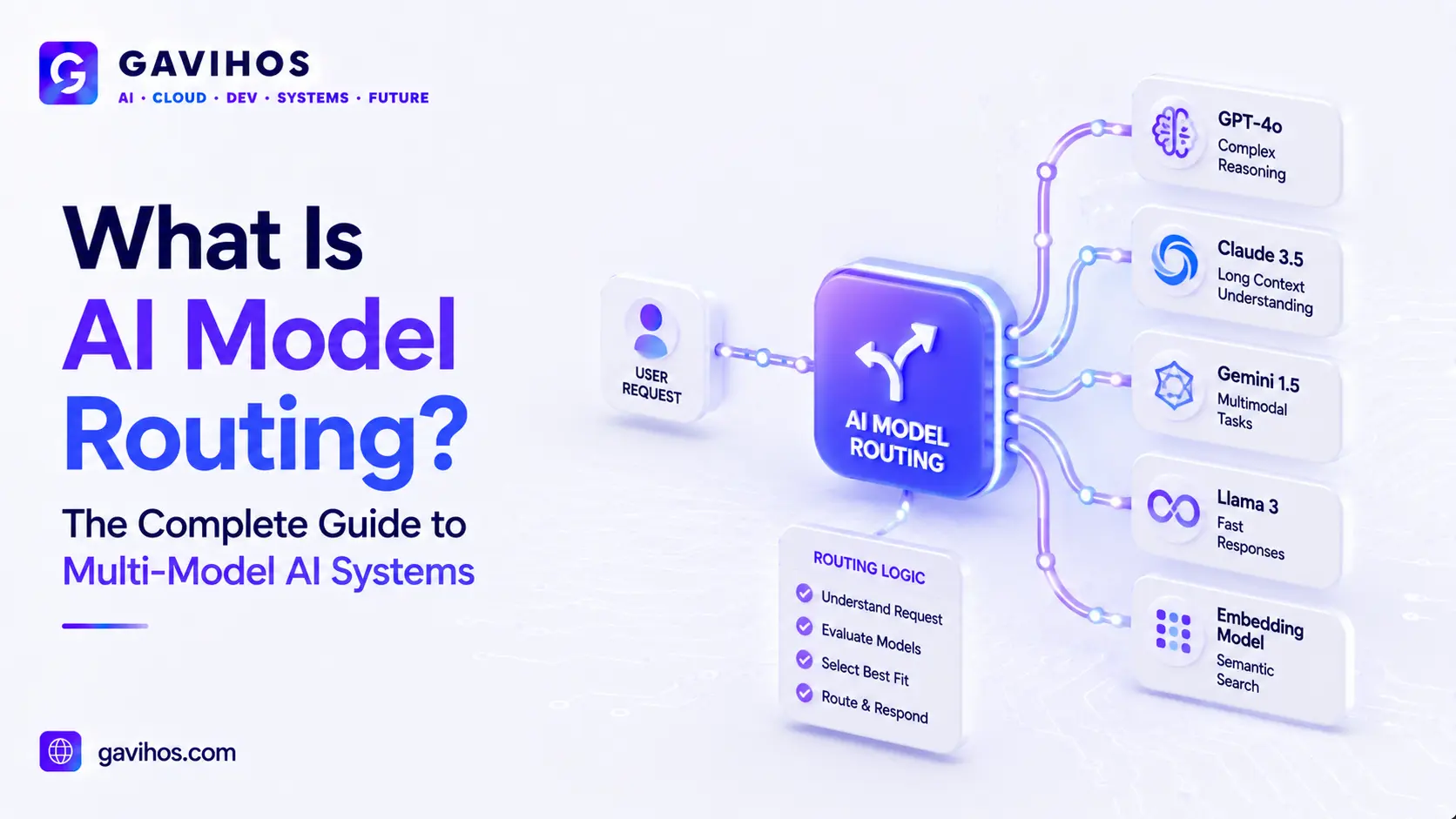
What Is AI Model Routing?
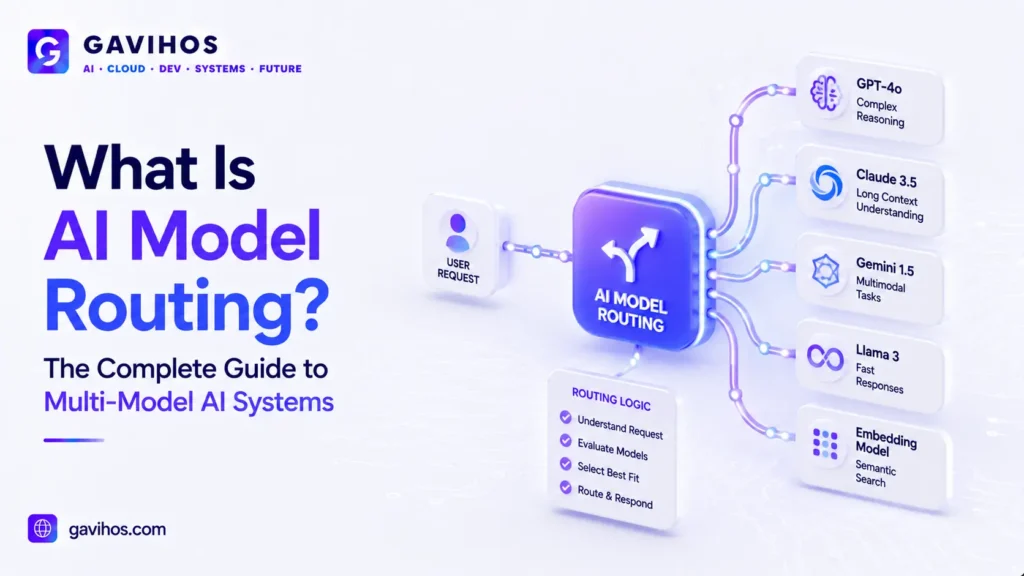
AI model routing is the practice of directing a given request to one of several available AI models, based on the nature of that request, rather than sending every request to a single fixed model. The models in a routed system are usually variants of the same underlying family — differing in reasoning depth, speed, and cost — rather than entirely unrelated products.
A concrete, current example: GitHub confirmed on July 9, 2026 that OpenAI’s GPT-5.6 family is rolling out inside GitHub Copilot as three distinct variants — Sol, Terra, and Luna. Sol is described as having the highest reasoning ceiling in the family, built for complex reasoning over large codebases and demanding, long-running agentic work. Terra is the balanced default, suited to everyday interactive and agentic coding. Luna is the lightweight, cost-efficient option, meant for smaller, faster tasks. A developer using Copilot effectively becomes part of a routing decision every time they pick a model — or lets Copilot pick one for them.
Model routing is not unique to Copilot or to OpenAI’s models. It shows up anywhere a product offers more than one model tier and has to decide, per request, which one to use: AI coding assistants, customer support chatbots, API gateways that sit in front of multiple providers, and increasingly, autonomous AI agents that call different models for different sub-tasks within a single workflow.
Why Does It Matter?
Technology impact. Model routing turns “which AI model should handle this” from a one-time product decision into an ongoing, per-request engineering problem — one that touches latency, accuracy, and cost simultaneously, rather than any one of those in isolation.
Business impact. Running every request through the most powerful (and most expensive) model available is rarely sustainable at scale. Routing lets a company serve a large volume of simple requests cheaply while reserving the expensive model for the requests that actually need it, materially changing the unit economics of running an AI product.
Industry impact. As GPT-5.6, and comparable tiered families from other vendors, become the norm rather than the exception, model routing is quietly becoming required infrastructure for any serious multi-model AI product — not an optional optimization bolted on later.
Why Now?
Model routing existed in a limited form as soon as any provider offered more than one model size, but it has become genuinely important only recently, for two main reasons.
Model families have gotten deliberately tiered. Vendors used to ship one flagship model and, separately, a cheaper “lite” version as an afterthought. GPT-5.6’s Sol/Terra/Luna split — three models explicitly designed and marketed around different reasoning-versus-cost tradeoffs — reflects a newer approach: build the tiering into the model family from the start, so that routing between tiers is the intended usage pattern, not a workaround.
Agentic workloads made single-model routing impractical. An AI coding agent working through a large task might need deep reasoning to plan an approach, then dozens of fast, cheap calls to execute small steps. Forcing all of that through one model wastes money on the easy steps or shortchanges the hard ones. GitHub’s own description of GPT-5.6 Sol as built for “demanding, long-running agentic work” — distinct from Luna’s role in “smaller, faster tasks” — is a direct acknowledgment that a single agentic session now spans multiple, different jobs that no single model tier serves well.
A few years ago, most AI products simply used whatever single model their provider offered. Today, with tiered families becoming standard and usage-based billing tied directly to which model tier is used, deciding how to route requests has become a real architectural choice with real cost and quality consequences.
How It Works
Step 1 — A request arrives. A user asks a question, or an agent generates a sub-task that needs a model call — anything from “fix this typo” to “refactor this 4,000-line module.”
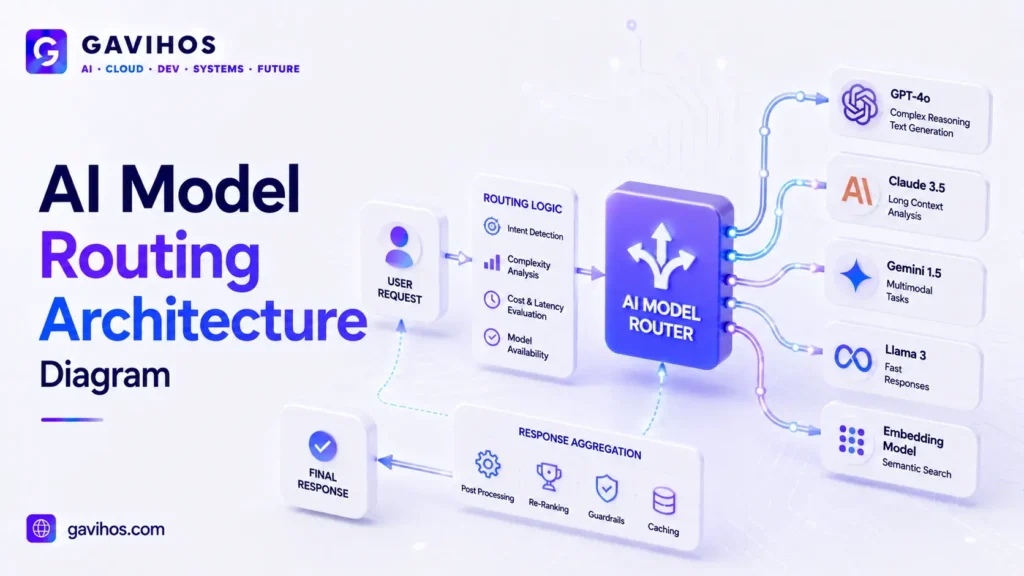
Step 2 — The system classifies the request. Some systems let the user pick a model explicitly (as Copilot does, offering Sol, Terra, or Luna directly). Others try to infer the right tier automatically, using signals like task complexity, expected output length, or which tool or workflow triggered the request.
Step 3 — The request is routed to a model tier. Based on that classification, the request goes to the highest-reasoning model (for complex, high-stakes work), the balanced default (for everyday tasks), or the fastest, cheapest model (for small, low-risk tasks).
Step 4 — The model responds, and cost/latency are tracked. Because different tiers are billed and metered differently — GitHub notes GPT-5.6 models are billed at provider list pricing under usage-based billing — routing decisions directly affect the bill, not just the response quality.
Step 5 — The routing logic improves over time. Products that route automatically typically refine their classification over time, using observed outcomes (did the cheap model actually get it right, or did the request need escalating) to improve future routing decisions.
Architecture / Components
| Component | Role | Why It Matters |
|---|---|---|
| Model tiers | The distinct models available to route between (e.g., Sol, Terra, Luna) | Defines the actual tradeoff space — reasoning depth vs. speed vs. cost |
| Router / classifier | The logic (manual selection or automated) that decides which tier handles a request | The core decision point that determines both quality and cost outcomes |
| Cost/latency policy | Rules or budgets governing when the expensive tier is allowed | Prevents runaway spend while still allowing escalation for genuinely hard tasks |
| Fallback path | What happens if the chosen tier fails, times out, or refuses | Keeps the system reliable even when the “ideal” model isn’t available |
| Usage metering | Tracking of which tier handled which request, for billing and evaluation | Feeds both the customer’s bill and the router’s own future improvement |
Real World Use Cases
- AI coding assistants. GitHub Copilot’s rollout of GPT-5.6 Sol, Terra, and Luna lets developers (or Copilot itself) match a model to the task — Sol for large-codebase reasoning, Luna for quick edits — instead of one model handling everything identically.
- AI agent platforms. Multi-step agentic workflows route planning and complex-reasoning steps to a stronger model while routing simple, repetitive execution steps to a cheaper, faster one, keeping overall latency and cost manageable across a long-running task.
- Customer support chatbots. Support platforms often route straightforward, high-volume questions to a fast, inexpensive model and escalate ambiguous or high-stakes conversations to a more capable (and more expensive) model.
- AI gateways and model aggregators. Infrastructure products that sit in front of multiple AI providers route requests not just between tiers of one vendor’s models, but across entirely different vendors, based on cost, latency, or availability.
- Enterprise document and data analysis. Teams processing large volumes of documents often route bulk, simple extraction tasks to a lightweight model while reserving a stronger reasoning model for documents flagged as ambiguous or high-value.
Benefits
- Matches cost to actual task difficulty, instead of paying premium-model prices for simple requests.
- Improves latency for easy tasks by avoiding an unnecessarily large, slow model.
- Lets a single product support both quick, cheap interactions and deep, expensive reasoning without picking just one.
- Scales more predictably, since routing policy — not just raw model capability — becomes a lever for managing cost as usage grows.
Limitations
- Routing decisions can be wrong: an under-classified request sent to a weaker model may produce a worse answer than intended.
- Automated routing adds its own complexity and potential failure point — the classifier itself needs to be built, tested, and maintained.
- Manual routing (letting users pick a model, as Copilot currently does) shifts the burden of a good decision onto the user, who may not know which tier actually fits their task.
- Billing complexity increases, since usage-based pricing tied to model tier means costs become harder to predict in advance compared to a single flat-rate model.
Engineering Tradeoffs
What improves: Cost efficiency and latency for the bulk of everyday requests, since they no longer have to pass through the most expensive model by default.
What becomes harder: Predicting total cost in advance, since spend now depends on how requests are classified and routed, not just on total request volume.
New complexity introduced: A routing/classification layer that itself needs engineering, testing, and ongoing tuning — get it wrong, and either quality or cost suffers.
Operational costs: Monitoring shifts from “how many requests did we serve” to “how were requests distributed across tiers, and was that distribution correct” — a genuinely different, more granular observability problem.
When this approach should not be used: For low-volume products where a single model tier already comfortably handles every request within acceptable cost and latency, adding a routing layer is unnecessary complexity with little practical payoff.
Best Practices
- Start with manual model selection (letting users or developers choose) before investing in automated routing — it’s simpler, and it reveals real usage patterns that inform a future automated router.
- Track outcomes by tier, not just overall accuracy, so you can tell whether cheaper tiers are quietly underperforming on tasks they’ve been assigned.
- Build a fallback path for every tier, so a model timeout or refusal doesn’t stall the entire request.
- Treat routing policy as something to revisit regularly — model capabilities and pricing change often enough that a routing rule that made sense six months ago may no longer be optimal.
Common Mistakes
- Defaulting every request to the most powerful (and most expensive) available model “to be safe,” which quietly erodes the cost benefits routing is meant to provide.
- Building an automated router without a way to measure whether its classifications are actually correct.
- Ignoring fallback behavior, so a single model outage or rate limit disrupts an entire product rather than just one tier.
- Assuming a lightweight/fast model tier is a strict downgrade rather than the right tool for genuinely simple tasks.
What Most People Get Wrong
“More models means more complexity for the user.” In well-designed systems, most users never interact with routing directly — it happens automatically or through a simple, well-labeled choice, not a confusing menu of technical model names.
“The cheapest model is always worse.” A lightweight model tier isn’t a lesser product bolted on for cost reasons — it’s purpose-built for exactly the high-volume, low-complexity requests where a larger model would be wasted effort.
“Routing is only relevant to large AI companies.” Any product using more than one model tier — including smaller teams calling multiple providers through a gateway — faces the same routing decisions, just at a smaller scale.
“Model routing is just load balancing.” Load balancing distributes identical requests across identical servers for capacity reasons. Model routing distributes different requests across genuinely different models based on the nature of the task — a qualitative decision, not just a capacity one.
Future Outlook
Expect tiered model families like GPT-5.6’s Sol/Terra/Luna split to become the standard shape of a model release, rather than a single flagship model, as more vendors follow this pattern. Expect automated routing to improve as vendors and platforms gain more real usage data about which tasks actually need the most expensive tier versus which don’t. And expect the concept of “which model should handle this” to keep spreading beyond coding tools into nearly every category of AI product that offers more than one model option — customer support, search, document processing, and autonomous agents alike.
FAQ
1. What is AI model routing? AI model routing is the practice of directing an AI request to one of several available models — typically differing in reasoning depth, speed, and cost — based on the nature of that request, instead of sending every request to a single fixed model.
2. Why do AI products use multiple model tiers instead of one model? Because different tasks have very different requirements: some need deep reasoning and can tolerate slower responses, while others need a fast, cheap answer. A single model tier can’t efficiently serve both.
3. Is AI model routing the same as load balancing? No. Load balancing distributes identical requests across identical infrastructure for capacity reasons. Model routing distributes different kinds of requests to genuinely different models based on the task itself.
4. What is an example of AI model routing in a real product? GitHub Copilot’s rollout of OpenAI’s GPT-5.6 Sol, Terra, and Luna models, confirmed via GitHub’s official changelog on July 9, 2026, lets developers select (or Copilot select) between a high-reasoning model, a balanced default, and a lightweight, fast option.
5. Who decides which model handles a request — the user or the system? It varies. Some products, like current GitHub Copilot, let the user choose the model directly. Others use automated classifiers to route requests without user involvement.
6. Does model routing save money? Yes, when implemented well — routing simple, high-volume requests to a cheaper model tier while reserving expensive models for complex tasks reduces overall cost compared to using the most powerful model for everything.
7. What are the risks of automated model routing? The main risk is misclassification — sending a genuinely complex request to a lightweight model can produce a weaker answer than the task actually needed.
8. Does every AI product need model routing? No. Products with low request volume or a single, consistent task type may not benefit enough from routing to justify the added complexity of building and maintaining a router.
9. How does model routing relate to AI agents specifically? Agentic workflows often involve multiple distinct sub-tasks (planning, execution, summarization) within one session, making routing especially valuable — a single agent session can use a strong model for planning and a fast, cheap model for repetitive execution steps.
10. Will model routing become more or less common over time? More common. As tiered model families become the default way vendors release models, and as usage-based billing ties cost directly to which tier is used, routing is becoming standard infrastructure rather than an advanced optimization.
Analyst Perspective
The most important thing about AI model routing is that it quietly shifts a product decision that used to happen once (which model do we use?) into a decision that now happens continuously, for every request. That’s a bigger architectural change than it sounds like, because it means the router itself — not just the underlying models — becomes a genuine point of competitive differentiation. Two products built on the exact same GPT-5.6 family can perform very differently depending entirely on how well each one routes requests between Sol, Terra, and Luna.
A second-order effect worth watching: as routing infrastructure matures, expect the model name itself to matter less to end users than it does today. Most Copilot users choosing between Sol, Terra, and Luna are really just choosing a point on a cost/speed/quality curve — the specific model behind that choice is almost incidental. Over time, expect more products to abstract that choice away entirely, presenting users with an intent (“make this fast” vs. “make this thorough”) rather than a model name, with routing quietly handling the rest.
Developers should pay attention to how their own tools bill for model tier usage, since routing decisions now translate directly into cost line items. Businesses evaluating AI vendors should ask not just “which model do you use” but “how do you route between tiers,” since that routing logic — more than the raw model itself — often determines the actual cost and quality a customer experiences.
Key Takeaways
- AI model routing directs a request to one of several available models — differing in reasoning depth, speed, and cost — based on the nature of that request.
- GitHub Copilot’s July 9, 2026 rollout of GPT-5.6 Sol, Terra, and Luna is a concrete, current example of tiered models built for routing between reasoning-heavy, balanced, and fast/cheap use cases.
- Routing is distinct from load balancing: it’s a qualitative decision about task type, not just a capacity-distribution mechanism.
- Benefits include better cost efficiency and latency; risks include misclassification and added system complexity.
- As tiered model families and usage-based billing become standard, model routing is shifting from an advanced optimization to required infrastructure for any serious multi-model AI product.
Continue Learning
- GitHub Copilot Adds OpenAI’s GPT-5.6 Sol, Terra, and Luna Models
- OpenAI GPT-5.6: Sol, Terra, and Luna Explained
- GitHub Copilot Agent Mode Explained
- Vercel AI SDK: The Complete Guide
- What Are AI Agents?
About GAVIHOS
GAVIHOS helps developers, founders and technology enthusiasts understand AI, software engineering and emerging technologies through practical guides, tutorials and industry analysis.
Stay Updated
Follow GAVIHOS for practical AI, technology and developer-focused insights.
External Links
| Source | URL |
|---|---|
| GitHub Changelog — GPT-5.6 Sol, Terra, and Luna in GitHub Copilot | https://github.blog/changelog/2026-07-09-openais-gpt-5-6-sol-terra-and-luna-are-now-available-in-github-copilot/ |
| GitHub Docs — Supported AI Models in GitHub Copilot | https://docs.github.com/en/copilot/reference/ai-models/supported-models |
| OpenAI Platform Docs — Models | https://platform.openai.com/docs/models |
| Anthropic Docs — Models Overview | https://docs.anthropic.com/en/docs/about-claude/models |