Every high-performance server you’ve ever used — Redis, Nginx, Node.js, HAProxy — has to answer the same basic question millions of times a second: which of the thousands of open network connections it’s holding actually has new data waiting to be read? Loop through every connection and ask “anything new?” and you’ll burn CPU cycles checking sockets that are sitting idle 99.9% of the time. That naive approach is why early web servers struggled to scale past a few thousand concurrent connections.
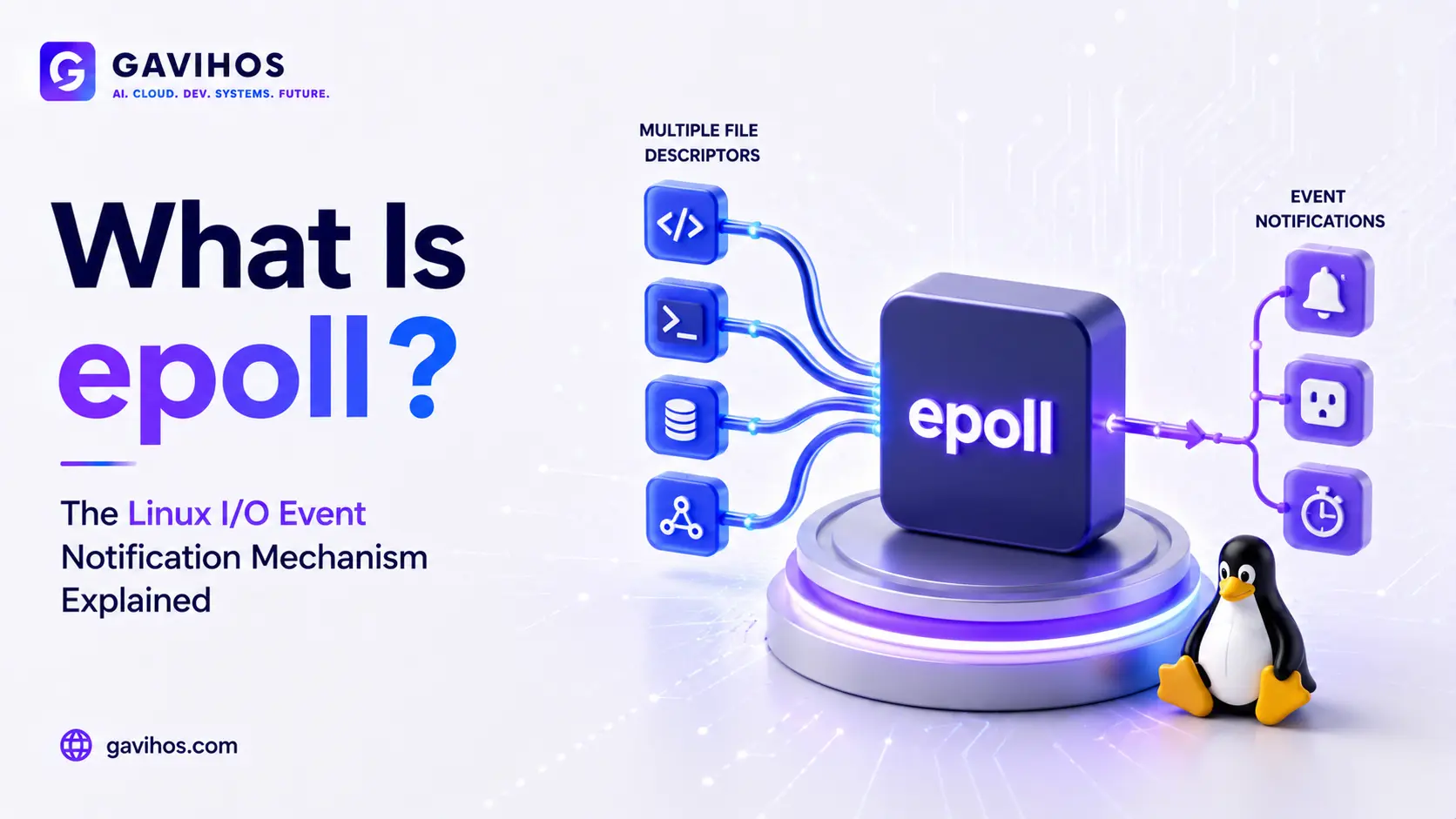
epoll is the Linux kernel’s answer to that problem. It’s an API that lets a program register interest in a set of file descriptors (sockets, pipes, and similar objects) and then simply wait — the kernel does the work of tracking which ones become ready and hands back only that short list when something actually happens. It’s the mechanism, still in the kernel’s eventpoll subsystem, that Nginx’s event loop, Redis’s single-threaded I/O model, and Node.js’s libuv all sit on top of.
This guide explains what epoll is, why it exists, how it actually works under the hood, and where it fits relative to the alternatives — the kind of foundational systems concept that keeps showing up in interviews, in framework documentation, and in postmortems, regardless of which specific product or vendor is in the headlines this week.
What Is It?
epoll is a Linux-specific system call interface for scalable I/O event notification. It lets a process ask the kernel to monitor a large number of file descriptors and notify it only about the ones that are ready for I/O — readable, writable, or in an error state — instead of forcing the process to check every descriptor itself.
The name comes from “event poll.” It was introduced into the Linux kernel in version 2.5.44 (2002) specifically to solve a scalability problem with the older select() and poll() system calls, which both require the caller to pass the entire list of watched descriptors to the kernel on every single call.
epoll centers on three system calls:
epoll_create1()— creates an epoll instance and returns a file descriptor representing it.epoll_ctl()— adds (EPOLL_CTL_ADD), modifies (EPOLL_CTL_MOD), or removes (EPOLL_CTL_DEL) a file descriptor from the set the epoll instance is watching.epoll_wait()— blocks (or waits with a timeout) until at least one watched descriptor becomes ready, then returns only the ready ones.
That “returns only the ready ones” detail is the entire point. The kernel maintains the list of watched descriptors internally across calls, so a program with 50,000 open connections doesn’t need to describe those 50,000 connections to the kernel every time it wants to check for activity — it registers them once and asks “what’s ready?” repeatedly.
Why Does It Matter?
Technology impact. epoll is the reason a single Linux process can hold tens or hundreds of thousands of concurrent network connections without pinning a CPU core just to check which ones are active. It’s the load-bearing primitive underneath the “event loop” pattern that defines an entire category of software: reverse proxies, in-memory databases, and async runtimes.
Business impact. The efficiency gain translates directly into infrastructure cost. A server design that can handle 10x more concurrent connections per machine using the same hardware is a real, measurable reduction in the number of machines a company needs to run its edge and caching layer — which is why every serious high-concurrency system on Linux is built on top of it rather than reinventing connection handling from scratch.
Industry impact. epoll (and its cross-platform equivalents — kqueue on BSD/macOS, IOCP on Windows) established the pattern that modern async runtimes are built around. When you write async/await code in Node.js, Python’s asyncio, or Rust’s tokio, you are, several layers down, ultimately relying on epoll to tell the runtime when to wake your code back up.
Why Now?
epoll itself isn’t new — it shipped in 2002. It’s worth understanding today for two connected reasons.
It is still the load-bearing layer under nearly all modern async infrastructure. Every time a new async runtime, reverse proxy, or database claims impressive concurrency numbers, the underlying I/O model is very often epoll (or io_uring, its newer cousin) doing the actual work. Understanding epoll is understanding a large fraction of how server-side infrastructure claims its performance numbers.
Kernel code that’s over two decades old is now getting closer scrutiny than it used to. epoll’s core logic sees ongoing maintenance and occasional correctness fixes as the kernel evolves — new usage patterns, new hardware behavior, and more rigorous static and dynamic analysis surface edge cases that didn’t matter, or weren’t found, when the code was first written. A subsystem being old doesn’t mean it’s finished; it means it has had more time for subtle bugs to accumulate in less-frequently-exercised code paths, particularly around reference counting and cleanup — the same category of area GAVIHOS has covered before in aging network software.
A few years ago, treating a 20-year-old, widely-used kernel subsystem as something worth explaining from first principles might have seemed unnecessary — “it just works.” The more that async, event-driven architectures become the default way to build backend systems, and the more that security research increasingly focuses on exactly this kind of long-lived, rarely-touched kernel code, the more useful it is for developers to actually understand the mechanism instead of treating it as an invisible implementation detail.
How It Works
Step 1 — Create an epoll instance. A process calls epoll_create1(), which returns a file descriptor representing a new, empty epoll instance inside the kernel. This instance is where the kernel will track everything the process wants to be notified about.
Step 2 — Register interest in file descriptors. For each socket or pipe the program cares about, it calls epoll_ctl(epfd, EPOLL_CTL_ADD, fd, &event), specifying which events it wants to be told about — readable data (EPOLLIN), writable buffer space (EPOLLOUT), or error conditions. The kernel adds this file descriptor to an internal data structure (historically a red-black tree) associated with the epoll instance.
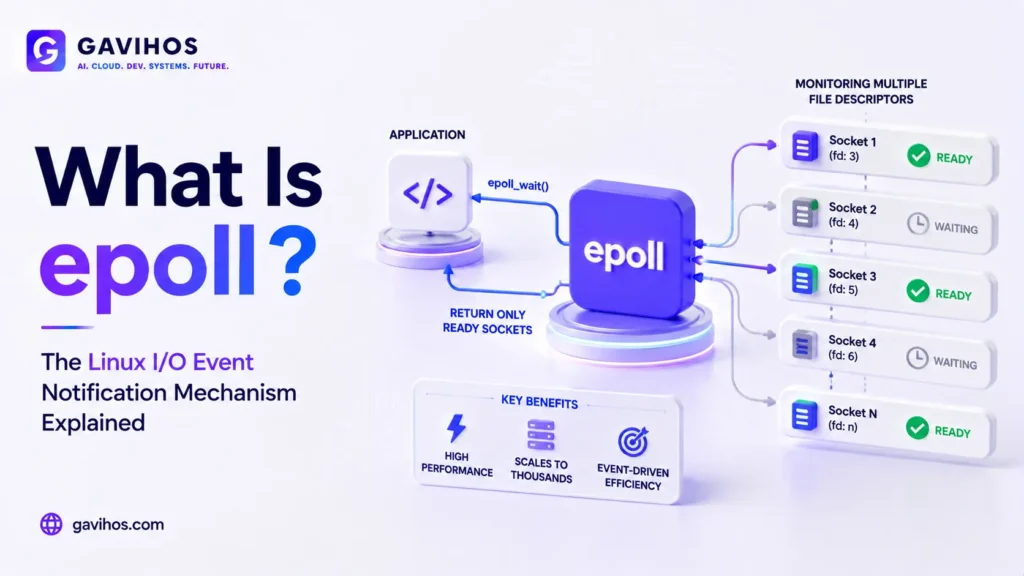
Step 3 — Wait for events. The process calls epoll_wait(), which blocks until at least one registered file descriptor becomes ready, or until an optional timeout expires. Internally, each watched file maintains a callback that fires when its state changes — the kernel isn’t polling anything in a loop; it’s reacting to events as they happen and appending the ready descriptor to a “ready list” attached to the epoll instance.
Step 4 — Process only the ready descriptors. epoll_wait() returns an array containing only the file descriptors that are actually ready — not the entire watched set. The program then reads from, writes to, or otherwise handles exactly those connections, and loops back to epoll_wait() to wait for the next batch.
Step 5 — Modify or remove as connections change. As connections close or the program’s interest changes (for example, it’s done writing and only wants to know about readability), it calls epoll_ctl() with EPOLL_CTL_MOD or EPOLL_CTL_DEL to update or remove that descriptor from the watched set.
A simple analogy: select()/poll() is like a teacher calling the entire class roll every few minutes to see who has a question. epoll is like students raising their hands — the teacher only looks at the hands that are up, and doesn’t need to re-ask the whole class each time.
Architecture / Components
| Component | Role | Why It Matters |
|---|---|---|
epoll instance (epfd) | Kernel-side object tracking a set of watched file descriptors | The handle a program uses to add, modify, and wait on descriptors |
| Interest list | The set of file descriptors currently registered with the epoll instance | Persists across calls — no need to re-describe watched sockets each time |
| Ready list | The subset of watched descriptors currently ready for I/O | What epoll_wait() actually returns — the core efficiency gain |
| Callback/wake mechanism | Per-file hooks that add a descriptor to the ready list when its state changes | Makes epoll event-driven rather than requiring the kernel to scan every descriptor |
| Edge-triggered vs level-triggered mode | Controls whether an event fires once per state change (edge) or repeatedly while the condition holds (level) | Affects correctness — edge-triggered mode requires the caller to fully drain a socket’s buffer or risk missing data |
Real World Use Cases
1. Nginx. Nginx’s event-driven worker processes use epoll (on Linux) to handle tens of thousands of concurrent client connections per worker without spawning a thread per connection, which is central to its reputation for low memory overhead under high concurrency.
2. Redis. Redis’s single-threaded command-processing model relies on an event loop built on epoll (via an abstraction layer that also supports kqueue and other backends) to multiplex client connections without needing multiple threads to handle concurrent clients.
3. Node.js / libuv. Node’s non-blocking I/O model is implemented by libuv, which uses epoll on Linux under the hood to know when file descriptors are ready, enabling JavaScript’s single-threaded event loop to handle many concurrent I/O operations.
4. HAProxy and other load balancers. High-throughput load balancers use epoll-based event loops to proxy large numbers of simultaneous connections between clients and backend servers with minimal per-connection overhead.
5. Custom high-performance network services. Any service written in C, C++, Go (via its runtime’s network poller), or Rust (via tokio, mio) that needs to handle large numbers of concurrent connections on Linux is, at some layer, built on epoll or its newer sibling io_uring.
Benefits
Scales with active connections, not total connections. The cost of epoll_wait() is proportional to the number of ready descriptors, not the total number registered — a server holding 100,000 idle connections and 50 active ones pays roughly the cost of checking 50, not 100,000.
No per-call setup cost for the watched set. Because the kernel remembers what’s registered, a program doesn’t need to reconstruct and pass a full descriptor list on every wait call, unlike select().
Supports both edge-triggered and level-triggered notification, giving programs flexibility in how aggressively they need to drain buffers versus how simple they want the notification logic to be.
Battle-tested and universally available on Linux, meaning it’s a safe, well-understood default for any Linux-targeted high-concurrency service, with mature tooling and decades of production use across the software that underpins most of the internet.
Limitations
Linux-specific. epoll is not portable. Cross-platform software needs an abstraction layer (like libuv or libevent) that picks epoll on Linux, kqueue on BSD/macOS, and IOCP on Windows — epoll itself doesn’t solve the portability problem.
Edge-triggered mode is easy to misuse. In edge-triggered mode, a program must read (or write) until it gets EAGAIN, fully draining the buffer, or it can miss data that arrived after the last read but before the next epoll_wait() call. This is a common source of subtle bugs in hand-rolled event loops.
Not inherently faster for small numbers of connections. For a handful of file descriptors, the overhead of managing epoll’s internal state can be comparable to or worse than simpler mechanisms like select() — epoll’s advantage shows up specifically at scale.
Doesn’t eliminate the need for careful concurrency design. epoll tells you when I/O is ready; it does nothing about the correctness of what your program does with that readiness, including how it manages shared state across callbacks — building a correct, high-performance event loop on top of epoll is still real engineering work.
Engineering Tradeoffs
What improves: The number of concurrent connections a single process or thread can handle efficiently, and the CPU cost of checking for I/O readiness at scale.
What becomes harder: Reasoning about program flow. Event-driven, callback-based code (or its async/await equivalent) is generally harder to read and debug than straightforward sequential blocking code, because execution jumps around based on which events fire and in what order.
New complexity introduced: Correct buffer draining in edge-triggered mode, careful handling of partial reads/writes, and managing per-connection state across an event loop instead of relying on a dedicated thread’s call stack to hold that state implicitly.
Operational costs: Debugging an epoll-based service under load typically requires different tooling and mental models than debugging a thread-per-connection service — stack traces are less useful when logic is spread across callbacks or coroutine resumptions.
When this approach should not be used: For low-concurrency internal tools or scripts, a simple blocking I/O model is easier to write, easier to debug, and won’t meaningfully underperform — reaching for epoll (or an async framework built on it) before you actually have a concurrency problem adds complexity without a corresponding benefit.
Best Practices
Prefer an established async framework or runtime over hand-rolling an epoll loop. Libraries like libuv, libevent, or language-native async runtimes have already solved the edge cases (buffer draining, error handling, portability) that are easy to get subtly wrong in a first attempt.
Use edge-triggered mode carefully, and only when you understand the draining requirement. Level-triggered mode is more forgiving for teams newer to epoll-based programming, at a small efficiency cost.
Don’t reach for epoll-based architecture prematurely. If your service handles a modest, predictable number of concurrent connections, a simpler threaded or blocking model may be easier to build correctly and maintain.
Keep per-connection state explicit and centralized, rather than scattered across closures or callback chains, to keep event-driven code debuggable as the system grows.
Common Mistakes
Forgetting to fully drain a socket in edge-triggered mode, leading to missed data that silently sits in the kernel buffer until the next unrelated event triggers a check.
Treating epoll as automatically thread-safe. Multiple threads sharing a single epoll instance need careful design; naive concurrent use of the same file descriptor across threads is a common source of race conditions.
Assuming epoll code is portable. Code written directly against the epoll API will not compile or run on non-Linux systems without a compatibility layer — a mistake developers sometimes make when moving between Linux and macOS/BSD development environments.
Reinventing the event loop instead of using a proven library. Hand-rolled epoll loops frequently miss edge cases in error handling and connection lifecycle management that mature libraries have already addressed.
What Most People Get Wrong
“epoll makes I/O faster.” epoll doesn’t make an individual read or write faster — it makes checking readiness across many connections more efficient. The actual I/O operation speed is unchanged; what improves is how cheaply a program can find out which of many connections needs attention.
“epoll is a threading model.” epoll is an I/O readiness notification mechanism, not a concurrency model. It’s commonly paired with a single-threaded event loop (as in Redis or Node.js) but can also be used across multiple threads — the two concepts are related but distinct.
“async/await means my code isn’t using epoll.” High-level async syntax in modern languages is typically a much friendlier interface over exactly this kind of low-level, kernel-provided readiness notification. The abstraction hides epoll; it doesn’t replace it.
“Newer always means better — io_uring has replaced epoll.” io_uring, introduced in Linux 5.1, offers a more general and often faster interface for both I/O readiness and I/O completion, and is increasingly used in new high-performance systems. But epoll remains extremely widely deployed, well understood, and sufficient for the overwhelming majority of network I/O workloads — it hasn’t been made obsolete, just given a newer, more specialized alternative for certain workloads.
Future Outlook
Expect epoll to remain the default I/O event mechanism underneath most Linux network software for the foreseeable future, even as io_uring adoption grows for workloads that benefit from its more general completion-based model (particularly disk I/O and workloads that want to avoid per-call system call overhead). The two are not mutually exclusive — many systems use different mechanisms for different I/O types.
Expect continued security and correctness scrutiny of long-lived kernel subsystems like eventpoll, driven partly by the growing use of AI-assisted code auditing to systematically review large C codebases for memory-safety issues that traditional manual review has historically had limited bandwidth to catch. Subsystems that are old, widely deployed, and rarely touched are exactly the kind of code this kind of tooling is being pointed at.
Expect async runtimes across languages to continue abstracting epoll (and its equivalents) further away from application developers, while the underlying mechanism itself changes relatively slowly — it’s a stable, foundational layer that newer tooling builds on top of rather than replaces outright.
FAQ
1. What is epoll? epoll is a Linux kernel API for scalable I/O event notification. It lets a program register a set of file descriptors and be notified only about the ones that are ready for I/O, instead of checking every descriptor manually.
2. Why was epoll created? epoll was introduced to solve the scalability limits of the older select() and poll() system calls, which require passing the full watched-descriptor list to the kernel on every call, making them inefficient with large numbers of connections.
3. What’s the difference between epoll and select()/poll()? select() and poll() require the caller to describe the entire watched set on every call and the kernel must check each one. epoll lets the kernel remember the watched set across calls and only returns descriptors that are actually ready, which scales far better with large connection counts.
4. What is edge-triggered vs level-triggered mode in epoll? Level-triggered mode notifies a program repeatedly as long as a condition (like readable data) holds true. Edge-triggered mode notifies only once when the state changes, requiring the program to fully drain the available data or risk missing it until the next unrelated event.
5. Does epoll work on macOS or Windows? No. epoll is Linux-specific. macOS and BSD use kqueue, and Windows uses I/O Completion Ports (IOCP). Cross-platform libraries like libuv abstract over these differences.
6. What software uses epoll? Nginx, Redis, Node.js (via libuv), HAProxy, and most high-concurrency network services written for Linux use epoll, either directly or through an abstraction layer.
7. Is epoll the same as an event loop? No. epoll is the underlying kernel mechanism for I/O readiness notification. An event loop is the higher-level application or runtime construct that uses epoll (or a similar mechanism) to repeatedly wait for events and dispatch handling code.
8. What is io_uring and does it replace epoll? io_uring is a newer Linux kernel interface (introduced in kernel 5.1) for asynchronous I/O that can handle both readiness and completion notification with less system-call overhead. It doesn’t replace epoll outright — both are actively used, often for different workload types within the same system.
9. Why does epoll matter for backend engineers who never write raw system calls? Because the async runtimes and frameworks used daily (Node.js, Python’s asyncio, Go’s networking runtime) are built on epoll under the hood. Understanding it clarifies why async I/O scales the way it does and helps in debugging performance issues that trace back to the event loop.
10. Can bugs in epoll’s kernel code affect application security? Yes. Because epoll runs inside the kernel, a memory-safety bug in its implementation can potentially be exploited for privilege escalation — a real category of vulnerability that security researchers actively look for in long-lived kernel subsystems, precisely because of how widely and continuously they’re used.
Analyst Perspective
The most easily overlooked fact about epoll is how much modern software infrastructure quietly depends on a piece of kernel code most developers will never read or call directly. Every claim about a database, proxy, or runtime handling “hundreds of thousands of concurrent connections” is, several abstraction layers down, a claim about how well that software uses epoll (or a similar mechanism) — the framework’s marketing describes the outcome; epoll is doing the actual work.
The second thing worth noticing is what happens to code like this over a 20+ year lifespan. epoll isn’t fragile — it’s genuinely one of the most battle-tested subsystems in the Linux kernel. But “battle-tested” doesn’t mean “immune to new discovery.” Long-lived, rarely-modified kernel code accumulates exactly the kind of subtle reference-counting and cleanup edge cases that are hard for humans to catch through periodic manual review, and increasingly attractive targets for systematic, AI-assisted auditing — a pattern GAVIHOS has covered in other long-lived open-source network code as well.
For developers building on top of async frameworks, the practical takeaway isn’t “go rewrite your event loop.” It’s understanding that the abstraction you’re using — async/await, a framework’s non-blocking I/O claims, a database’s concurrency model — has a real, specific mechanism underneath it, with real tradeoffs and a real (if rare) attack surface. That understanding pays off directly the next time a performance problem, a scaling limit, or a kernel-level security advisory shows up in something you run.
Key Takeaways
- epoll is a Linux kernel API for scalable I/O event notification, letting a program watch many file descriptors and be told only which ones are actually ready
- It solves the scalability problem of
select()/poll(), which require re-describing the entire watched set on every call - Nginx, Redis, Node.js, and HAProxy all rely on epoll (directly or through an abstraction layer) for their high-concurrency I/O models
- epoll is Linux-specific; cross-platform software needs a compatibility layer to also support
kqueue(BSD/macOS) and IOCP (Windows) - Edge-triggered mode is more efficient but requires careful buffer draining to avoid missing data
- epoll isn’t obsolete — io_uring is a newer, complementary interface for certain workloads, not a wholesale replacement
- As long-lived kernel code, epoll’s implementation remains an active area of security research, which is directly relevant to understanding vulnerabilities discovered in it
Continue Learning
- Squidbleed (CVE-2026-47729): What Developers Need to Know About the 29-Year-Old Squid Proxy Vulnerability
- Insecure Deserialization Explained
- AI-Accelerated Cyberattacks: How AI Is Shrinking the Defender’s Response Window
- Vercel AI SDK Complete Guide: How to Build AI Applications in TypeScript
- libssh2 CVE-2026-55200: Remote Code Execution Explained
About GAVIHOS
GAVIHOS helps developers, founders and technology enthusiasts understand AI, software engineering and emerging technologies through practical guides, tutorials and industry analysis.
Stay Updated
Follow GAVIHOS for practical AI, technology and developer-focused insights.
External Links
| Source | URL |
|---|---|
| Linux man-pages — epoll(7) | https://man7.org/linux/man-pages/man7/epoll.7.html |