Introduction
Prompt engineering is the practice of designing inputs to language models to reliably produce useful outputs. That definition sounds simple. The implications are not.
The same model given two different prompts can produce dramatically different outputs — one correct and useful, the other wrong and confidently stated. No code change, no fine-tuning, no infrastructure update: just a difference in how the task was described. This is what makes prompt engineering both powerful and frustrating. The model’s capability is fixed; how much of that capability you access depends largely on how you communicate with it.
This guide explains how prompt engineering works, the core techniques, the advanced patterns used in production systems, and the tradeoffs that most introductions skip.
What Is Prompt Engineering?
Prompt engineering is the discipline of structuring inputs to language models to produce desired outputs reliably. A prompt is any text — or text combined with images, code, or data — that you pass to a model as input. Prompt engineering is the work of designing those inputs carefully.
It is a practical skill, not a theoretical one. The goal is not to understand the mathematical mechanism by which a transformer processes tokens — it is to understand, empirically, which input patterns produce useful outputs for your specific task and model.
The field has matured significantly since 2022. What started as informal trial-and-error has become a body of documented techniques with reproducible effects, measurable quality differences, and clear failure modes.
Why Now?
Prompt engineering became important because of the gap between what language models can do and what they do by default.
Early language models were primarily evaluated on academic benchmarks with fixed formats. Practitioners discovered quickly that the same model that failed a benchmark in a simple format could pass it when the prompt was structured differently. The model’s capability was not the binding constraint — the interface was.
Several developments have sharpened this further:
Models are now used in production. In 2022, most LLM users were researchers. Now they are developers, product teams, and businesses. Production use requires reliability — a 90% accuracy rate on a demo is interesting; on a customer-facing system, it is a problem. Prompt engineering is the primary lever for moving from “works most of the time” to “works reliably enough to ship.”
Agentic AI raised the stakes. When a model takes actions — calling APIs, executing code, writing files — a bad output is not just an inconvenient wrong answer. It is a bad action. Prompt engineering for agents, particularly for system prompts and tool descriptions, directly affects whether an agent completes its task or fails in unpredictable ways.
Models have gotten better but not perfect. Better models are more capable, but they also surface subtler failure modes. A task that a smaller model failed loudly — with obviously wrong output — may be handled by a larger model with confidently stated but subtly incorrect output. Prompt design affects both types of failure.
How Prompt Engineering Works
Language models predict the next token in a sequence. Everything before the model’s response — your instructions, examples, context, and constraints — shapes what that prediction looks like. Prompt engineering is the practice of structuring that input to make the right prediction more likely.
Three things affect model output:
What information is present. The model can only use what is in its context window. If your task requires knowing a fact, that fact must either be in the prompt or in the model’s training data. Prompt engineering includes deciding what context to provide and how to structure it.
How the task is framed. Models are sensitive to framing. “Summarize this article” and “Write a three-sentence summary of this article for a technical audience” activate different learned patterns. The second is more specific and typically produces more useful output.
What constraints are stated. Left unconstrained, models optimize for plausibility, not accuracy. Explicit constraints — “if you are uncertain, say so”, “cite your sources”, “do not make up statistics” — shift the model’s behavior toward patterns that match those constraints.
Core Techniques
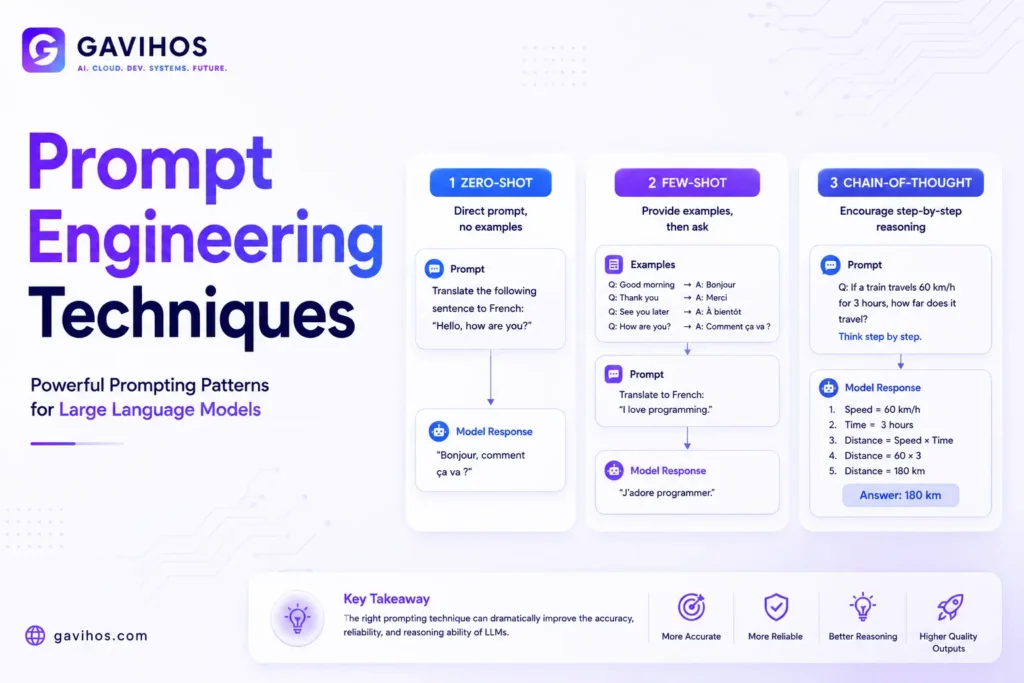
Zero-Shot Prompting
Give the model a task description with no examples. The model applies its general knowledge to the task.
Use when: the task is well-defined, the model’s training covers it, and the expected output format is clear.
Limitation: for ambiguous tasks or unusual formats, zero-shot prompts often produce outputs that technically answer the question but miss what was actually needed.
Few-Shot Prompting
Give the model one or more examples of input-output pairs before stating the actual task. The model infers the pattern from the examples and applies it to the new input.
This is consistently one of the highest-impact techniques. Examples communicate intent more precisely than descriptions. A model shown three examples of what you mean by “formal summary” will produce a more accurate formal summary than a model given a verbal description of formality.
The examples themselves must be high quality. Low-quality examples teach the model the wrong pattern.
Chain-of-Thought (CoT) Prompting
Ask the model to reason through the problem step by step before giving a final answer. This can be as simple as adding “think step by step” to the end of a prompt, or as structured as providing examples that show reasoning steps explicitly.
CoT improves performance on tasks that require multi-step reasoning: math problems, logic puzzles, multi-constraint planning. It does not reliably improve simple factual recall, and it does not eliminate hallucination — the model can reason its way to a wrong answer.
The underlying mechanism: by generating intermediate reasoning steps, the model is effectively breaking a hard single-step prediction into multiple easier ones. Each step is more likely to be correct than a direct prediction of the final answer.
System Prompts
System prompts are persistent instructions given to the model before any user interaction. They define the model’s role, constraints, output format, and behavior policies. Every major model provider supports some form of system prompt or system message.
System prompts are the primary tool for production prompt engineering. They are where you define: what the model is (a customer support agent, a code reviewer, an analyst), what it can and cannot do, how it should format responses, and how it should handle edge cases.
A well-designed system prompt reduces the need for per-request instructions because the baseline behavior is already correct. A poorly designed system prompt creates a model that behaves unpredictably because the base instructions are ambiguous or contradictory.
Instruction Prompting
Structure the prompt as an explicit task description with clear parameters: what to do, what to use as input, what format to return, what constraints apply.
Task: Summarize the following article.
Audience: Software engineers with no background in finance.
Format: Three bullet points, each under 25 words.
Constraint: Do not use financial jargon without explaining it.
Input: [article text]
This structure reduces ambiguity and produces more consistent output than natural-language requests that mix task, context, and constraints together.
Output Formatting
Specify the exact format you want the model to return. JSON, markdown tables, numbered lists, XML — if you tell the model what format to use, it will use it. If you do not, it will guess.
For applications that parse model output programmatically, explicit output formatting is essential. “Return a JSON object with fields: title (string), summary (string), tags (array of strings)” produces parseable output. “Summarize this and list some tags” produces unparseable prose.
Advanced Techniques
ReAct (Reasoning + Acting)
ReAct is a prompting pattern that interleaves reasoning and tool use. The model reasons about what to do, takes an action (calls a tool), observes the result, reasons about the observation, takes another action, and so on until the task is complete.
This is the foundation of most production AI agents. The model is not just generating text — it is planning, executing, and adapting based on real-world results. The prompt structure defines the format for each cycle: Thought, Action, Observation.
Self-Consistency
Generate multiple responses to the same question, then aggregate them — typically by majority vote. Self-consistency improves accuracy on tasks where the model sometimes reasons correctly and sometimes does not. If five out of seven attempts reach the same answer via different reasoning paths, that answer is more likely to be correct than any single attempt.
Cost: multiple API calls per question. Use where accuracy is critical and cost is not the primary constraint.
Least-to-Most Prompting
Decompose a complex task into simpler subproblems, solve them in order, and use each answer as context for the next. This is especially effective for multi-step problems where the model fails to solve the whole problem in one shot but can solve each part correctly when isolated.
Meta-Prompting
Use the model to improve the prompt. Ask it to identify weaknesses in your current prompt, generate variations, or produce a better version. This works surprisingly well because the model can reason about prompt structure — it was trained on text that includes prompt examples and discussions of prompt quality.
Prompt Structure Components
| Component | Purpose | Example |
|---|---|---|
| Role | Defines the model’s perspective | “You are a senior security engineer reviewing code for vulnerabilities.” |
| Context | Provides background the model needs | “The following function processes user-uploaded file names.” |
| Task | Describes what to do | “Identify any path traversal vulnerabilities.” |
| Constraints | Limits the response | “Only report issues with CVSS score >= 7.0.” |
| Output format | Specifies structure | “Return a JSON array of objects with fields: line, severity, description.” |
| Examples | Shows expected pattern | Three examples of correctly formatted vulnerability reports |
Prompt Engineering for AI Agents
Agent prompting differs from single-call prompting in several important ways.
Tool descriptions are prompts. When a model decides whether to call a tool, it reads the tool’s description. A vague or misleading description causes the model to call the wrong tool or fail to call the correct one. Tool descriptions should clearly state: what the tool does, when to use it, what parameters it requires, and what it returns.
System prompts define agent identity. An agent’s system prompt is its constitution — it defines what the agent is, what it can do, what it cannot do, and how it should behave when it hits uncertainty. Weak system prompts produce agents that hallucinate capabilities or take inappropriate actions.
Memory injection is a prompt engineering challenge. When context from previous interactions needs to be included in a new prompt, decisions about what to include, how to format it, and how much space to use are all prompt engineering decisions. Including too much dilutes the model’s attention; including too little loses relevant context.
Constraints become more important, not less. In a chat application, a bad model output is an inconvenient response. In an agent, a bad output may cause a bad action. “Do not delete files without explicit confirmation” is a constraint that matters far more in an agent system than in a text generation context.
Real-World Use Cases
1. Code Review Automation
A system prompt defines the reviewer role and quality standards. A few-shot prompt with example code reviews teaches the output format. Chain-of-thought reasoning improves detection of subtle bugs. Output formatting ensures the review can be parsed and posted to the PR.
2. Customer Support Agent
The system prompt defines the product, the company’s policies, escalation rules, and tone. Tool descriptions define when to look up orders, initiate refunds, or escalate to a human. Few-shot examples show how to handle common question types. Constraints prevent the agent from making commitments the company cannot keep.
3. Document Summarization at Scale
Instruction prompting with explicit audience and format constraints ensures consistent output across thousands of documents. Output formatting ensures parseable summaries. Constraints like “do not infer information not stated in the document” reduce hallucination in high-stakes summarization tasks.
4. SQL Generation
Few-shot examples showing database schema + question → SQL query teach the model the correct output format. Constraints like “only generate SELECT queries” prevent destructive actions. Output formatting ensures valid SQL that can be executed directly.
5. Content Moderation
Chain-of-thought prompting improves accuracy on edge cases by making the model reason about why content does or does not violate policy before classifying it. Self-consistency on borderline cases reduces false positives and false negatives.
Benefits
No retraining required. Prompt improvements take minutes to test. Fine-tuning takes hours to days and requires labeled data.
Model-portable. Prompt patterns transfer across models better than fine-tuned weights. A well-structured instruction prompt works similarly across GPT, Claude, and Gemini.
Cost-effective iteration. Testing a new prompt costs fractions of a cent per call. Testing a new fine-tuned model requires a training run.
Additive with other techniques. Prompt engineering compounds with fine-tuning, RAG, and Extended Thinking. A well-engineered prompt makes each of those more effective.
Limitations
Not a substitute for fine-tuning on domain knowledge. If the task requires specialized knowledge the model was not trained on — obscure domain terminology, company-specific procedures, proprietary data — prompt engineering cannot compensate. Fine-tuning on domain data is required.
Prompts are model-specific. A prompt optimized for GPT-4o may underperform on Claude Sonnet. Models have different sensitivities to phrasing, structure, and instruction style. If you switch models, retest prompts.
Non-determinism. The same prompt with temperature > 0 produces different outputs across runs. Prompt engineering improves the average, not every instance. For reliability requirements above a threshold, you need additional validation layers.
Context window limits. Every token of prompt is a token not available for response or document context. Long prompts reduce available space for the content you want the model to process.
Prompt injection risk. In systems where user input is incorporated into prompts, a malicious user can inject instructions that override the system prompt. This is a genuine security concern in production applications, not an edge case.
Engineering Tradeoffs
More structure vs. more flexibility. Highly structured prompts with explicit instructions and output formats produce consistent, parseable output but may miss cases the structure did not anticipate. Open-ended prompts are more flexible but produce more variable output.
Longer prompts vs. shorter context. Detailed system prompts and few-shot examples improve output quality but consume context window space. For long documents, this tradeoff can be significant.
Specificity vs. generalization. A prompt tuned precisely for one task produces excellent output for that task and often poor output for related but different tasks. Generalizing requires more abstract instruction, which reduces peak performance on the target task.
Prompt engineering vs. fine-tuning. Prompt engineering is faster and cheaper to iterate; fine-tuning produces better results for highly specialized tasks at scale. The practical answer for most teams: start with prompts, evaluate whether fine-tuning is justified by the quality gap and the volume of the task.
Best Practices
Test with diverse inputs. A prompt that works on your ten test examples may fail on the eleventh. Build a test set that covers edge cases, boundary conditions, and inputs you expect to be difficult.
Version your prompts. A prompt change is a behavior change. Treat prompt updates with the same rigor as code changes: version control, change descriptions, test before deployment.
Separate system prompt from user input. Do not concatenate user input directly into your system prompt. This is the primary vector for prompt injection. Use the model provider’s designated structure for separating system instructions from user messages.
Constrain outputs explicitly. If you need JSON, say so. If you need a number, say so. If you need the model to acknowledge uncertainty rather than guess, say so. Left unconstrained, models optimize for plausible-sounding output, not accurate output.
Measure before and after. “This prompt feels better” is not sufficient justification for a change in production. Measure on a representative test set with clear success criteria.
Common Mistakes
Asking multiple questions in one prompt. Models tend to answer one well and skim the others. If you need three things, ask for three things explicitly and structure the output to include all three.
Vague instructions. “Write a good summary” leaves “good” undefined. “Write a three-sentence summary that includes the main finding, the methodology, and the conclusion” does not.
Ignoring the model’s tendencies. Different models have different default behaviors. Some are more conservative; others are more verbose. Prompts should account for these tendencies rather than assuming all models behave identically.
No examples for novel output formats. If you need output in an unusual format — a custom JSON schema, a specific table structure — include at least one example. Zero-shot format instructions alone often produce approximations.
What Most People Get Wrong
“More tokens = better prompt.” Length is not quality. A 500-word prompt full of redundancy and vague instructions will underperform a 50-word prompt that is specific and well-structured.
“Just add ‘think step by step.'” Chain-of-thought helps for reasoning tasks but does not fix factual errors. A model that does not know the answer will reason its way to a wrong one just as confidently as it would state a wrong one directly.
“Prompt engineering is a temporary hack until models get smarter.” Smarter models shift the types of prompts that work, they do not eliminate the need for careful prompt design. GPT-4 required different prompts than GPT-3; GPT-5 requires different prompts than GPT-4. The skill compounds with model improvements, not disappears.
“Prompts do not need versioning.” In production, a prompt change is a behavior change. Teams that treat prompts as throwaway text strings and models as interchangeable parts ship reliability problems. Prompts are software artifacts and should be treated as such.
Future Outlook
Prompt engineering is not going away, but it is evolving.
As models improve, the techniques that matter shift. Early LLMs required careful hand-holding through simple tasks. Current frontier models handle those tasks reliably with minimal prompting. The challenge has moved to harder tasks: complex multi-step reasoning, reliable tool use in agents, consistent behavior across thousands of production calls.
The emergence of structured output APIs — where the model is constrained to return valid JSON matching a specified schema — reduces one class of prompt engineering work (output formatting) while increasing the importance of another (task description quality, since the model now needs to understand the task precisely enough to populate the schema correctly).
For AI agents, prompt engineering importance is increasing. As agents are given more autonomy, the quality of their system prompts and tool descriptions becomes more consequential. A poorly described tool in a low-stakes chatbot causes an unhelpful response; a poorly described tool in an autonomous agent causes a bad action.
FAQ
1. What is prompt engineering? Prompt engineering is the practice of designing inputs to language models to reliably produce desired outputs. It involves structuring instructions, context, examples, and constraints to make the model’s response more accurate, consistent, and useful.
2. Do I need to know how transformers work to do prompt engineering? No. Prompt engineering is an empirical skill — you learn it by testing what works, not by understanding the math. A practical understanding of how models process context and what they tend to do by default is more useful than deep architectural knowledge.
3. What is the difference between zero-shot and few-shot prompting? Zero-shot prompting gives the model a task with no examples. Few-shot prompting provides one or more input-output examples before the actual task. Few-shot typically produces more consistent output because examples communicate intent more precisely than instructions.
4. What is chain-of-thought prompting? Chain-of-thought prompting asks the model to reason through a problem step by step before giving a final answer. It improves performance on tasks requiring multi-step reasoning but does not eliminate hallucination.
5. How is prompt engineering different from fine-tuning? Prompt engineering shapes model behavior through input design. Fine-tuning changes the model’s weights through training on new data. Prompt engineering is faster and cheaper to iterate; fine-tuning produces better results for highly specialized tasks at scale. Most teams start with prompt engineering and consider fine-tuning when the quality gap justifies the cost.
6. Are prompts transferable between models? Partially. Core principles (clear instructions, explicit format, good examples) transfer well. Specific phrasing, instruction style, and sensitivity to constraints vary by model. Always test prompts on the target model rather than assuming they transfer directly.
7. What is a system prompt? A system prompt is a persistent set of instructions given to the model before any user interaction. It defines the model’s role, constraints, behavior policies, and output conventions. System prompts are the foundation of production prompt engineering for applications and agents.
8. What is prompt injection? Prompt injection is an attack where a malicious user includes instructions in their input that override or modify the system prompt. It is a real security concern in applications that incorporate user input into model prompts. Mitigation includes strict separation of system instructions from user content.
9. How do I know if my prompt is good? Test it on a representative set of inputs, including edge cases. Measure the output against clear success criteria. Good prompts produce consistent, accurate outputs across the distribution of inputs the system will actually encounter — not just the examples you used to design the prompt.
10. Do I need prompt engineering if I use RAG? Yes. RAG adds retrieved context to the model’s input. Prompt engineering determines how that context is structured, what instructions surround it, and how the model is asked to use it. RAG and prompt engineering are complementary — good RAG retrieval with poor prompt design still produces poor output.
Analyst Perspective
The framing of prompt engineering as a “skill” — something you get better at with practice — is correct but incomplete. The more important framing is: prompt engineering is the interface layer between human intent and model behavior, and like all interface layers, it requires design discipline.
The consistent failure mode in production AI applications is not capability — modern frontier models are genuinely capable for most practical tasks. The failure mode is interface design. The model could answer the question correctly, but the prompt did not communicate the question clearly enough, did not include the right context, or did not constrain the output format properly.
This is why the teams that ship reliable AI products tend to treat prompt engineering with the same rigor as they treat API contract design or schema definition. They version prompts. They test across input distributions. They treat prompt changes as behavior changes that require validation. They document why prompts are structured the way they are, so the next person does not break them accidentally.
The second thing most introductions get wrong: prompt engineering is a moving target, and the right reaction to that is to invest in testing infrastructure, not to try to learn a fixed set of techniques. The techniques that work today will be partially obsolete in two years as model behavior changes. The discipline of testing, measuring, and iterating will still be valid.
For teams building with agentic AI specifically: tool description quality is the highest-leverage thing in most agent systems right now, and it gets the least attention. Developers spend days on the model selection decision and minutes writing tool descriptions. The tool description is a prompt, and a bad tool description breaks agent behavior in ways that are hard to debug. It deserves the same care as any other prompt.
Key Takeaways
- Prompt engineering is the practice of designing model inputs to reliably produce useful outputs — it is an empirical skill, not a theoretical one
- Few-shot prompting, chain-of-thought, system prompts, and explicit output formatting are the four highest-impact techniques for most production use cases
- For AI agents, tool description quality and system prompt precision are the primary levers — a poorly described tool causes bad tool selection; a weak system prompt causes unpredictable agent behavior
- Prompts are model-specific: always test on the target model; do not assume prompts transfer directly between providers
- Treat prompts as software artifacts: version them, test them across diverse inputs, measure before and after changes
- Prompt engineering compounds with fine-tuning, RAG, and Extended Thinking — it is not a temporary workaround but a permanent discipline in AI application development
Continue Learning
- What Are AI Agents? Architecture, Memory, Tools and Real-World Use Cases
- What is Agentic AI? How Autonomous AI Systems Think and Act
- What is RAG? Retrieval-Augmented Generation Explained
- Claude Extended Thinking Mode: Developer Guide to the GA Release
- LangGraph Explained: Complete Guide to Multi-Agent Orchestration
About GAVIHOS
GAVIHOS helps developers, founders and technology enthusiasts understand AI, software engineering and emerging technologies through practical guides, tutorials and industry analysis.
Stay Updated
Follow GAVIHOS for practical AI, technology and developer-focused insights.
External Links
| Source | URL |
|---|---|
| Anthropic Prompt Engineering Guide | https://docs.anthropic.com/en/docs/build-with-claude/prompt-engineering/overview |
| OpenAI Prompt Engineering Guide | https://platform.openai.com/docs/guides/prompt-engineering |
| Chain-of-Thought Paper (Google Research) | https://arxiv.org/abs/2201.11903 |