What is RAG? Complete Guide to Retrieval-Augmented Generation
Introduction
AI models are trained on data up to a fixed date. After that, they know nothing new. If you ask an AI about something that happened last month, or about a document that exists only inside your company, it cannot answer accurately — it either halts or, worse, makes something up.
This problem has a name: the knowledge cutoff limitation. It is the single biggest constraint on deploying AI in real business environments.
Retrieval-Augmented Generation (RAG) solves it.
RAG connects AI models to external knowledge sources at the moment they answer a question. Instead of relying solely on what the model learned during training, a RAG system retrieves the relevant information first, then uses it to generate an accurate, grounded response.
In this guide you will learn:
- What RAG is and why it exists
- How RAG works step by step
- The architecture and key components
- The four types of RAG and when to use each
- Real-world applications across industries
- Benefits, limitations, and best practices
- How to evaluate whether your RAG system is working
What Is RAG?
Retrieval-Augmented Generation (RAG) is an AI architecture that connects a language model to an external knowledge source at inference time, retrieving relevant information before generating a response.
The term was introduced in a 2020 research paper by Patrick Lewis and colleagues at Meta AI Research. The core insight was simple: instead of training a model to memorize everything, give it the ability to look things up.
A standard language model works like a closed-book exam. It can only use what it already knows.
A RAG system works like an open-book exam. Before answering, it searches its knowledge base, finds the relevant pages, and uses them to construct its response.
The difference in reliability is significant. The difference in the ability to use private, current, and domain-specific information is total.
As of 2026, RAG has moved from experimentation to production-critical enterprise architecture. It is the primary method organizations use to build AI applications that answer questions accurately from their own data.
Why RAG Exists: The Problem It Solves
The Knowledge Cutoff Problem
Every language model has a training cutoff date. After that date, the model has no knowledge of new events, updated policies, new products, or changed regulations. For many enterprise applications — particularly in legal, financial, medical, and compliance domains — this limitation makes unaugmented models unusable.
RAG solves this by separating the knowledge source from the model. The knowledge base can be updated continuously. The model does not need to be retrained.
The Hallucination Problem
Language models generate plausible-sounding text. When they lack sufficient grounding information, they sometimes generate plausible-sounding but incorrect text — a behavior called hallucination.
RAG reduces hallucinations by giving the model concrete source material to work from. When a model generates a response grounded in retrieved documents, it has less room to invent.
The Private Data Problem
A model trained on public data knows nothing about your internal documents, proprietary databases, customer records, or institutional knowledge. Fine-tuning a model on private data is expensive, slow, and creates data security risks.
RAG enables models to work with private data without training on it. The data stays in your knowledge base. The model reads it at query time, uses it to answer, and the retrieved documents are discarded after the interaction.
How RAG Works: Step by Step
A RAG system processes every query through a fixed pipeline. Understanding each step is the foundation for understanding RAG architecture.
Step 1: Ingestion (Happens Before Any Query)
Before RAG can retrieve anything, it must index the knowledge base.
Documents — PDFs, web pages, internal wikis, database records, code files — are split into smaller chunks. Each chunk is passed through an embedding model, which converts the text into a high-dimensional numerical vector (typically 768 to 1,536 dimensions). This vector represents the meaning of the chunk mathematically.
All vectors are stored in a vector database alongside the original text. The vector database is built for one purpose: finding vectors that are mathematically similar to a query vector quickly, even across millions of stored chunks.
Step 2: Query Processing
A user submits a query: “What is our refund policy for enterprise subscriptions?”
The same embedding model that processed the documents converts this query into a vector.
Step 3: Retrieval
The system searches the vector database for the chunks whose vectors are most similar to the query vector. Similarity is typically measured using cosine similarity — the closer the angle between two vectors, the more semantically similar the content.
The top-K most similar chunks are returned. K is typically between 3 and 20 depending on the use case. More chunks provide more context; fewer chunks reduce noise and cost.
Step 4: Reranking (Optional but Common in Production)
The retrieved chunks are passed through a reranker — a model that re-scores the chunks for relevance to the specific query. Reranking improves precision: the embedding similarity step finds candidates, the reranker selects the best ones.
Step 5: Prompt Augmentation
The top retrieved chunks are inserted into the language model’s prompt alongside the original query. A simplified example:
Context:
[Chunk 1: "Enterprise subscriptions are eligible for full refunds within 30 days..."]
[Chunk 2: "Refund requests must be submitted through the billing portal..."]

Question: What is our refund policy for enterprise subscriptions?

Answer:
The language model now has the source material it needs to answer accurately.
Step 6: Generation
The language model generates a response using the retrieved context. Because the answer is grounded in the retrieved documents, it is specific, accurate, and citable.
The Full Pipeline at a Glance
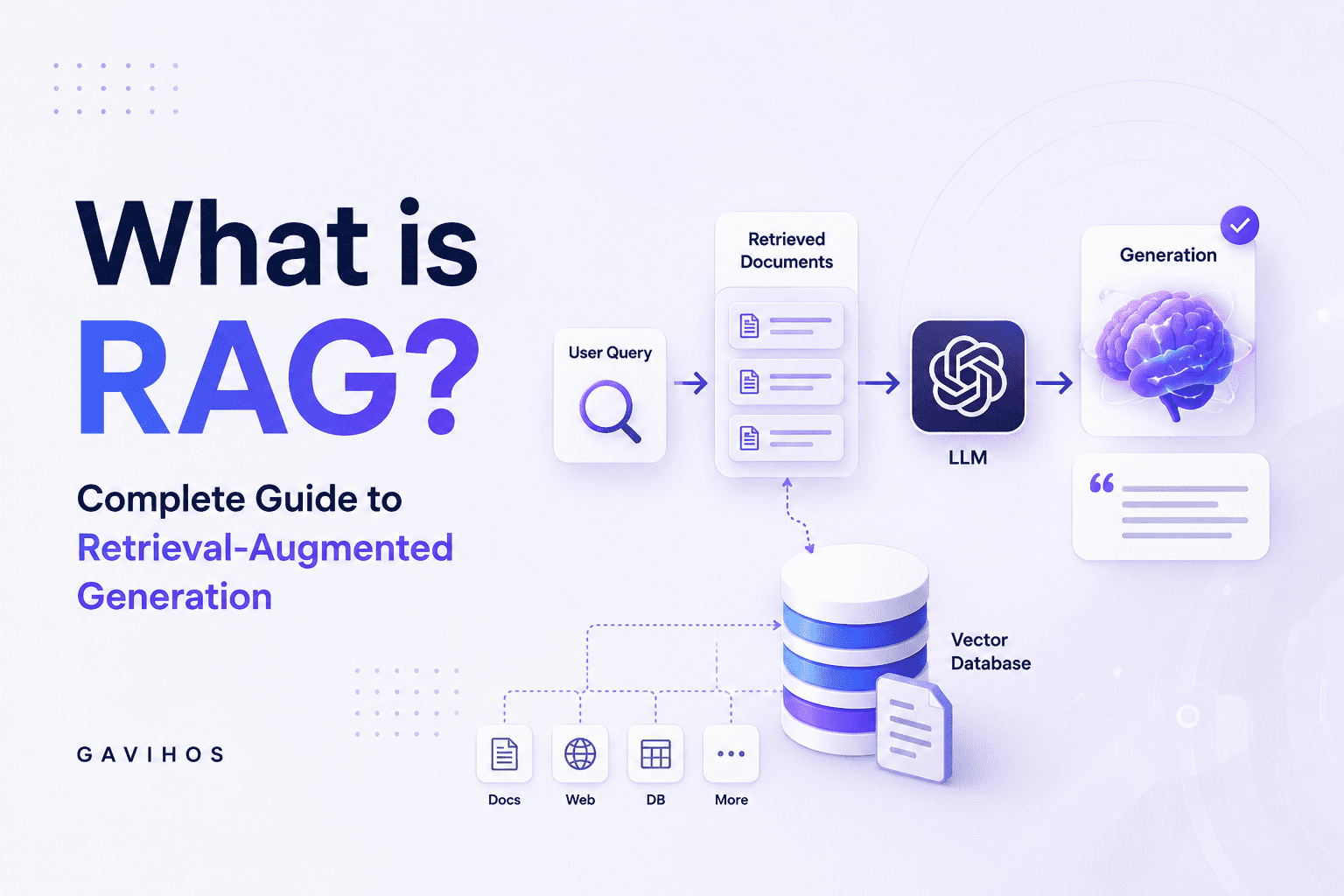
[Documents] → Chunk → Embed → [Vector Database]

[User Query] → Embed → Retrieve → Rerank → Augment Prompt → [LLM] → [Response]
RAG Architecture: Core Components
1. Document Loader
Ingests documents from sources: file systems, databases, web pages, APIs, email systems. Handles format conversion (PDF to text, HTML to markdown).
2. Text Splitter / Chunker
Divides documents into chunks. Chunk strategy significantly affects retrieval quality.
| Strategy | Description | Best For |
|---|---|---|
| Fixed-size chunks | Split every N characters | Simple use cases |
| Sentence splitting | Split at sentence boundaries | General Q&A |
| Recursive splitting | Split by paragraph, then sentence, then word | Most production systems |
| Semantic chunking | Split at meaning boundaries using embeddings | High-accuracy systems |
3. Embedding Model
Converts text to vectors. Popular options include text-embedding-3-large (OpenAI), voyage-3 (Voyage AI), and nomic-embed-text (open-source). Embedding model choice affects retrieval quality more than most other decisions.
4. Vector Database
Stores and indexes vectors for fast similarity search. Purpose-built options include Pinecone, Weaviate, Qdrant, and Chroma. Traditional databases with vector extensions include PostgreSQL with pgvector and Redis.
5. Retriever
Executes the similarity search. In 2026, hybrid retrieval — combining dense vector search with sparse keyword search (BM25) — is the consensus production strategy. Dense search finds semantically similar content; sparse search finds exact keyword matches. Combining both improves coverage across different query types.
6. Reranker
A cross-encoder model that scores each retrieved chunk against the query with higher precision than the initial retrieval step. Adds latency but significantly improves precision. Common choices: Cohere Rerank, BGE Reranker.
7. Language Model (Generator)
Receives the augmented prompt and generates the final response. The LLM can be any model: Claude Fable 5, GPT-5, Gemini, a locally-running open-source model. The RAG architecture is model-agnostic.
8. Response Handler
Post-processes the generated response. May add source citations, apply filters, log the interaction for evaluation, or route to downstream systems.
Component Summary Table
| Component | Role | Examples |
|---|---|---|
| Document Loader | Ingests knowledge sources | LangChain loaders, LlamaIndex readers |
| Text Splitter | Chunks documents | RecursiveCharacterTextSplitter, semantic chunker |
| Embedding Model | Converts text to vectors | voyage-3, text-embedding-3-large |
| Vector Database | Stores and indexes vectors | Pinecone, Weaviate, Qdrant, pgvector |
| Retriever | Finds relevant chunks | Dense, sparse, hybrid |
| Reranker | Re-scores retrieved chunks | Cohere Rerank, BGE Reranker |
| LLM / Generator | Generates grounded response | Claude Fable 5, GPT-5, Gemini |
| Response Handler | Post-processes output | Citation injection, logging, filtering |
The Four Types of RAG
1. Naive RAG
The original pipeline: chunk documents, embed them, retrieve by similarity, augment the prompt, generate. Simple to implement, works for basic Q&A.
Limitations: precision is limited by embedding similarity alone; no query optimization; no context compression; hallucinations possible when retrieved chunks are marginally relevant.
2. Advanced RAG
Improves on Naive RAG with:
- Query rewriting — the LLM rewrites the user’s query into a form that retrieves better results
- Hypothetical document embedding (HyDE) — the LLM generates a hypothetical answer, then retrieves chunks similar to that hypothetical answer
- Contextual compression — retrieved chunks are compressed to remove irrelevant content before entering the prompt
- Reranking — cross-encoder reranking improves chunk selection
Suitable for most production applications where Naive RAG precision is insufficient.
3. Modular RAG
Treats each RAG component as a replaceable module. Teams can swap embedding models, retrieval strategies, rerankers, and generators independently. Enables experimentation without rebuilding the entire pipeline.
Standard for engineering teams managing RAG at scale.
4. Agentic RAG
The dominant enterprise pattern in 2026.
Instead of a fixed retrieval pipeline, AI agents dynamically decide how to retrieve information. An agentic RAG system might:
- Decompose a complex query into sub-queries
- Route each sub-query to the most appropriate knowledge source
- Retrieve from multiple sources in parallel
- Validate retrieved content for relevance before using it
- Iterate — if the first retrieval is insufficient, the agent retrieves again
Agentic RAG is more accurate and more capable than fixed-pipeline RAG, particularly for multi-step research tasks and complex enterprise workflows. It requires more infrastructure and is harder to debug, but for high-value use cases the accuracy improvement justifies the complexity.
Real World Use Cases
1. Enterprise Knowledge Base Q&A
A 50,000-employee enterprise has documentation spread across SharePoint, Confluence, internal wikis, and Salesforce. Employees spend hours searching for answers that exist somewhere in the system.
A RAG system indexes all of it. Employees ask natural language questions. The system retrieves the relevant policies, procedures, or product specs and returns a direct answer with source citations.
Accuracy is high because responses are grounded in the actual documents. New policies are indexed immediately — no model retraining required.
2. Legal Research and Contract Analysis
A law firm uses RAG to search across thousands of past contracts and case files. When reviewing a new contract, the AI retrieves comparable clauses from previous agreements, flags deviations from standard templates, and identifies relevant case precedents.
The model does not replace the lawyer. It eliminates the hours of manual search that precede legal judgment.
3. Customer Support Automation
A SaaS company’s support AI is built on RAG over the product documentation, changelog, and resolved support tickets. When a customer asks why a feature behaves a certain way, the AI retrieves the relevant documentation section and generates an accurate explanation.
Ticket deflection rate improves significantly. Escalations to human agents are reserved for issues the knowledge base does not cover.
4. Medical and Clinical Decision Support
A hospital system uses RAG to help clinicians quickly surface relevant treatment guidelines, drug interaction data, and case literature during patient consultations. The knowledge base is updated as new clinical guidelines are published.
Critical: responses include citations so the clinician can verify source material before acting on it.
5. Software Development Assistance
A development team’s internal RAG system is indexed on their codebase, internal architecture documentation, past incident reports, and runbooks. When an engineer encounters an unfamiliar system, they ask the RAG system natural language questions and receive answers grounded in the actual internal documentation.
This is distinct from general-purpose code AI — it knows the internal system, not just public patterns.
6. Financial Research and Compliance
A financial services firm uses RAG over regulatory documents, filings, and internal compliance guidelines. Analysts ask questions about applicable regulations for specific transaction types. The system retrieves the relevant regulatory text and generates a structured summary with citations.
The compliance team reviews and approves. The AI handles the retrieval research.
Benefits
Reduces hallucinations. Grounding responses in retrieved documents significantly reduces the model’s tendency to generate plausible but incorrect content.
Works with current information. The knowledge base is updated independently of the model. No retraining required when policies, products, or regulations change.
Works with private data. Proprietary information never leaves the knowledge base and never enters model training. The model reads it at query time only.
Citable responses. Every response can include source citations, enabling human verification of AI outputs — a key enterprise trust requirement.
Model-agnostic. RAG architecture works with any LLM. Swapping the underlying model (e.g., from GPT-5 to Claude Fable 5) does not require rebuilding the retrieval pipeline.
Cost-efficient. Adding knowledge to a RAG system is far cheaper than retraining or fine-tuning a model. Incremental knowledge updates cost only the indexing computation.
Auditable. Retrieved documents can be logged alongside queries and responses, providing a full audit trail of what information the AI used to generate each answer.
Limitations
Retrieval quality is the ceiling. The language model can only work with what the retriever returns. If the relevant document is not retrieved, the response will be wrong regardless of model capability. Garbage in, garbage out applies to the retrieval step.
Latency. RAG adds at least one round trip (retrieval) and often two (retrieval + reranking) to every query. For latency-sensitive applications, this overhead must be engineered carefully.
Chunking is hard. How you split documents significantly affects what gets retrieved. The “right” chunk size and strategy depends on your document types and query patterns. There is no universal answer.
Context window limits. Retrieved chunks consume the model’s context window. Large K values or large chunk sizes can fill the window, reducing the space available for reasoning. Production systems must balance retrieval breadth with context efficiency.
Doesn’t improve reasoning. RAG improves knowledge access, not reasoning ability. If a task requires multi-step reasoning that the base model cannot perform, adding a retrieval layer does not fix that gap.
Evaluation is non-trivial. Measuring RAG system quality requires evaluating both retrieval precision/recall and generation quality. This demands purpose-built evaluation infrastructure that many teams underinvest in.
Best Practices
Start with chunking strategy. Before choosing a vector database or embedding model, define your document types and expected query patterns. Chunking strategy has the highest impact on retrieval quality and should be decided first.
Use hybrid retrieval in production. Combining dense vector search with sparse BM25 search consistently outperforms either method alone. Implement hybrid retrieval from the start rather than adding it later.
Implement reranking before scaling. A reranker adds latency but dramatically improves precision. Add it before you scale user volume — retrofitting it later is harder than building it in.
Evaluate retrieval and generation separately. Use a retrieval evaluation framework (precision@K, recall@K, MRR) alongside a generation evaluation framework (faithfulness, answer relevance, context precision). Fixing the wrong layer wastes time.
Implement metadata filtering. Attach metadata (document type, date, department, access level) to each chunk during ingestion. Use metadata filters to scope retrieval — queries about HR policy should not retrieve sales documentation.
Design for access control. In enterprise deployments, different users should retrieve from different knowledge subsets. Design access-controlled retrieval from the beginning. Retrofitting it into an unscoped system is architecturally painful.
Version your knowledge base. Track when documents were indexed, when they were updated, and when they were removed. Stale documents in the knowledge base produce stale responses.
Common Mistakes
Indexing everything without curation. Indexing low-quality, outdated, or irrelevant documents degrades retrieval quality. Curate what enters the knowledge base the same way you would curate what enters a training dataset.
Ignoring chunking overlap. Without overlap between adjacent chunks, facts that span a chunk boundary become unretrievable. A 10–15% overlap between chunks prevents this — it is a one-line change with significant retrieval quality impact.
Using one embedding model for all document types. A general-purpose embedding model is a reasonable starting point. For specialized domains (legal, medical, code), domain-specific embedding models produce meaningfully better retrieval.
Not testing with adversarial queries. Teams test RAG with the queries that work. Production users send queries the team did not anticipate. Test with unanticipated, ambiguous, and adversarial queries before launch.
Skipping evaluation infrastructure. Many teams deploy RAG without systematic evaluation. They cannot tell whether a change to chunking, retrieval, or reranking improved or degraded overall quality. Build evaluation before you optimize.
RAG vs Fine-Tuning: When to Use Each
| Dimension | RAG | Fine-Tuning |
|---|---|---|
| Knowledge update speed | Real-time (re-index) | Slow (retrain) |
| Private data | Safe — data not in model weights | Risk — data in model weights |
| Reasoning style | Unchanged | Can be adapted |
| Cost of knowledge updates | Low (indexing only) | High (training compute) |
| Best for | Factual Q&A, current knowledge | Style, tone, task format adaptation |
| Hallucination risk | Lower (grounded) | Higher (no retrieval grounding) |
Most production AI applications use RAG for knowledge grounding and fine-tuning for behavioral adaptation. They are complementary, not competing, approaches.
Future Outlook
Agentic RAG is the default. Fixed-pipeline RAG is being replaced by agent-orchestrated retrieval that can decompose queries, route to multiple sources, validate relevance, and iterate. MCP (Model Context Protocol) is emerging as the standard interface for connecting agentic RAG systems to enterprise data sources.
Multimodal RAG. Retrieval is expanding beyond text to images, audio, video, and structured data. Enterprises with rich media knowledge bases will require retrieval systems that understand and search across modalities.
RAG evaluation standardization. Purpose-built RAG evaluation frameworks (RAGAS, TruLens, DeepEval) are maturing. Expect evaluation to become a standard part of every production RAG deployment within 12 months.
Smaller, specialized retrievers. Rather than one large generalist knowledge base, enterprises are moving toward multiple specialized retrievers — one for HR policy, one for product documentation, one for regulatory compliance — each optimized for its domain.
Sovereign RAG. As AI compute becomes national infrastructure, enterprises in regulated industries will demand RAG systems that run entirely within their own infrastructure, including the embedding model and vector database. Fully on-premises RAG stacks are a growing market.
Frequently Asked Questions
What does RAG stand for? RAG stands for Retrieval-Augmented Generation. It is an AI architecture that retrieves relevant information from an external knowledge base before generating a response.
How is RAG different from fine-tuning? Fine-tuning bakes knowledge into the model’s weights during training. RAG retrieves knowledge at query time without modifying the model. RAG is better for factual accuracy with current or private data; fine-tuning is better for adapting the model’s behavior and reasoning style.
Does RAG prevent hallucinations? RAG reduces hallucinations significantly by grounding responses in retrieved documents. It does not eliminate them entirely. If the retriever returns irrelevant documents, the model may still hallucinate. Retrieval quality determines the upper bound.
What is a vector database and why is it used in RAG? A vector database stores text as numerical vectors and enables fast similarity search — finding the vectors most similar to a query vector. Traditional databases search by exact keyword match; vector databases search by meaning, making them essential for semantic retrieval.
What is the difference between RAG and semantic search? Semantic search retrieves documents based on meaning. RAG takes semantic search one step further — it retrieves the documents and then uses a language model to generate an answer based on them. RAG produces a synthesized response; semantic search produces a ranked list of documents.
What is Agentic RAG? Agentic RAG uses AI agents to orchestrate the retrieval process dynamically instead of following a fixed pipeline. Agents can decompose queries, route to multiple knowledge sources, validate retrieved content, and iterate if the first retrieval is insufficient.
Is RAG suitable for real-time data? RAG can support near-real-time data if the ingestion pipeline processes new documents quickly. Streaming ingestion pipelines can reduce the lag between a document being created and becoming retrievable to seconds or minutes.
What embedding model should I use for RAG? For general-purpose RAG, text-embedding-3-large (OpenAI) and voyage-3 (Voyage AI) are strong starting points. For specialized domains (code, medical, legal), domain-specific embedding models produce better retrieval. Always evaluate with your specific documents and queries.
How do I know if my RAG system is working? Evaluate at two levels: retrieval (is the relevant document being retrieved? measure precision@K and recall@K) and generation (is the response faithful to the retrieved documents? measure faithfulness and answer relevance). Use frameworks like RAGAS for systematic evaluation.
Can I use RAG with open-source models? Yes. RAG is model-agnostic. You can use any LLM, including open-source models like Llama, Mistral, or Qwen, as the generator. Open-source embedding models (nomic-embed-text, BGE) are also production-viable for the retrieval layer.
Key Takeaways
- RAG connects language models to external knowledge at query time, solving the knowledge cutoff and private data problems without retraining the model.
- The core pipeline is: ingest documents → embed chunks → store in vector database → retrieve on query → augment prompt → generate grounded response.
- Hybrid retrieval (dense vector search + sparse keyword search) is the 2026 consensus production strategy for retrieval quality.
- The four RAG types — Naive, Advanced, Modular, Agentic — map to increasing complexity and accuracy. Most production systems use Advanced or Agentic RAG.
- RAG reduces hallucinations but does not eliminate them — retrieval quality is the ceiling on response quality.
- Fine-tuning and RAG are complementary: use RAG for knowledge grounding, fine-tuning for behavioral adaptation.
- Evaluation is non-negotiable in production: measure retrieval precision/recall and generation faithfulness separately.
- Agentic RAG with MCP-connected knowledge sources is the architecture driving enterprise AI in 2026.
Continue Learning
If this article was useful, here are the next topics to explore on GAVIHOS:
- What is Model Context Protocol (MCP)? — Learn how MCP connects AI agents to the tools and data sources that power Agentic RAG systems
- What is Claude Fable 5? — Learn about Anthropic’s latest model, which you can use as the generator in your RAG system
About GAVIHOS
GAVIHOS helps developers, founders and technology enthusiasts understand AI, software engineering and emerging technologies through practical guides, tutorials and industry analysis.
Stay Updated
Follow GAVIHOS for practical AI, technology and developer-focused insights. No hype. No noise. Just clear explanations of the technologies that matter.